

This series has traced a common thread through its examination of AI-resistant assessment: the shift from evaluating artifacts to observing performance, or, more accurately, from what students produce in isolation to what they demonstrate through presence. Part 1 explored the design critique, where thinking becomes visible through real-time defense. In part 2, we examined video logs as multimodal evidence anchored in the body. Part 3 turned to the Socratic Seminar, where the conversation itself becomes the object of assessment. And part 4 investigated the whiteboard defense, where problem-solving becomes visible as it unfolds in real time.
Each of these methods addresses a particular dimension of the assessment problem in the age of generative AI. Yet they still position students as themselves: a designer defending their design choices, or a student working through a problem they have been assigned. What none of these methods fully captures is the capacity to act under conditions of genuine social uncertainty. They cannot assess if a student can step into an unfamiliar role, encounter another person whose responses cannot be predicted, and navigate toward some good outcome using knowledge, judgment, and interpersonal skills simultaneously.
This fifth and final installment examines a method that places students directly inside the problem they are trying to solve: Role-Playing Assessment. Unlike methods that position students as commentators on their own work, role-playing asks students to become practitioners. They need to inhabit a professional or social identity and respond to an unfolding scenario as if the stakes were real. The assessment, therefore, is not what they say about what they would do. It is what they actually do, right now, with another person watching.
The Archaeology of Enactment: From Psychodrama to Professional Licensure
Role-playing assessment did not emerge from educational theory. It was born from the recognition that traditional testing systematically failed to predict performance under real-world conditions. To understand why this method works, we need to trace its convergent origins across three distinct fields: psychotherapy, military intelligence, and medical education.
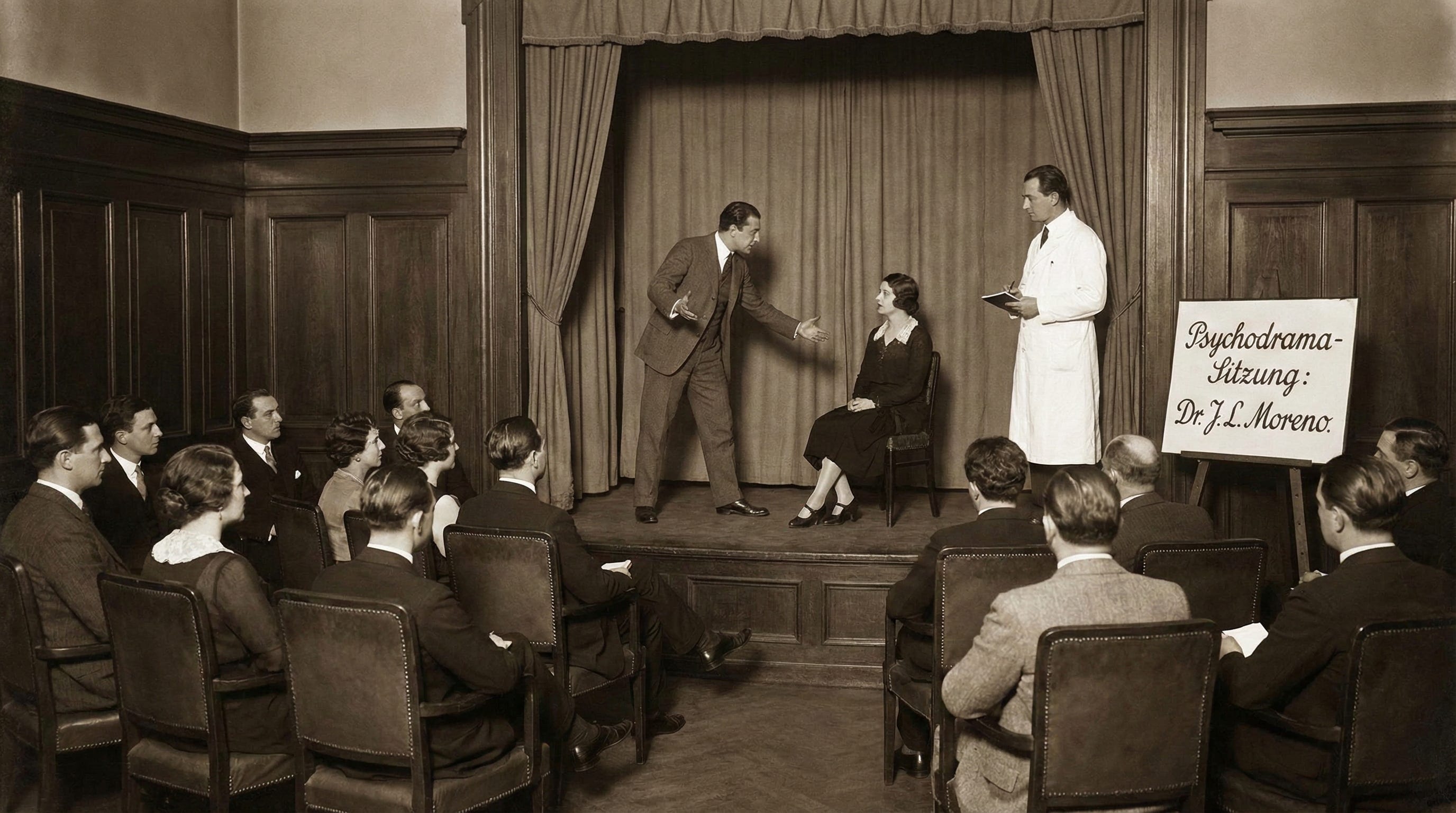
The intellectual bedrock lies in the work of Jacob L. Moreno, a Viennese psychiatrist who, in the 1920s, developed psychodrama as a therapeutic technique. While Freud emphasized the excavation of the past through talk, Moreno insisted on the power of the present through action. Patients did not merely describe their conflicts; they enacted them on a stage, with trained auxiliaries playing significant figures in their lives. Moreno’s insight was that we learn who we are by trying on different social masks—that role-playing initiates the emergence of the self. This insight would prove foundational. He also developed the structural vocabulary that role-playing assessment still uses: the protagonist (the subject being assessed), the auxiliary ego (the supporting actor who facilitates the scenario, often also called the confederate), and the director (the educator who controls the simulation).
The transition from therapy to assessment occurred during World War II, when the US Office of Strategic Services faced a problem that no written test could solve: how to select spies. The OSS needed people who could operate behind enemy lines, maintain cover identities under interrogation, and lead resistance cells in hostile territory. Intelligence quotient was insufficient. What mattered was performance under stress.
At a secret facility in Virginia, OSS psychologists designed simulations that would later become templates for corporate and educational assessments. One exercise required candidates to move a heavy load across a stream using limited resources while observers evaluated leadership and cooperation. Another asked candidates to direct two “helpers” in building a wooden structure. The helpers were trained actors instructed to be obstructive and insulting. The goal was not to complete the task but to observe how candidates managed their frustration. This marked the first systematic use of role-play to measure personality traits and behavioral competencies for high-stakes selection.
After the war, these techniques migrated to the corporate world. AT&T’s landmark Management Progress Study in 1956 formalized what would become the Assessment Center method: a multi-day evaluation where candidates participated in business games, in-basket exercises, and role-plays designed to reveal competencies that interviews and tests could not detect. The innovation was methodological rigor. AT&T developed Behaviorally Anchored Rating Scales that moved assessment away from vague impressions toward specific observable behaviors.
But the most consequential development came from medicine. In 1975, Ronald Harden and his team at the University of Dundee introduced the Objective Structured Clinical Examination (OSCE), originally dubbed the “Steeplechase” because students moved from station to station like horses jumping fences. Harden’s genius was to break clinical competence into discrete, observable units. Instead of one long, variable interaction with an actual patient, where a student might pass because they drew a simple case or a lenient examiner, the OSCE industrialized clinical assessment. A student might complete twenty short, standardized stations: taking a history from an actor at Station 1, interpreting an ECG at Station 2, demonstrating CPR on a mannequin at Station 3. The format offered objectivity through standardized scripts, structure through specific checklists, and clinical relevance through performance-based tasks.
This history reveals role-playing assessment as a response to a failure that predates AI by decades: the gap between knowing that and knowing how. Written examinations measure whether a student can recall information and synthesize concepts. They cannot measure whether that student can navigate the embodied, interpersonal, emotionally volatile reality of professional practice. A surgeon may possess encyclopedic knowledge of anatomy, yet fail to manage a palliative care consultation. A lawyer may cite precedent with precision, yet crumble under judicial scrutiny. Role-playing assessment exists because competence is not merely cognitive. It is somatic, relational, and performative.
Why Role-Playing Assessment Resists Artificial Intelligence
The resilience of role-playing assessment does not rest on the claim that AI is merely “not good enough yet” at conversation. Current large language models can sustain coherent, persona-driven dialogue for extended interactions. They can adopt the voice of a patient with chronic back pain, a disgruntled employee, or a skeptical investor. The challenge is not that AI cannot participate in role-plays, but that it cannot demonstrate the specific human capacities that role-plays are designed to assess.
Consider what happens in a well-designed clinical simulation. A medical student enters a room to find an actor portraying a fifty-five-year-old construction worker with back pain who is skeptical of medication and worried about losing his job. The student must gather a medical history while building rapport. The “patient” may become evasive when asked about alcohol use. He may express frustration when the student suggests imaging studies that would require time off work. The student must read these cues in real time—the tightened jaw, the averted gaze, the shift in posture—and adjust their approach accordingly.
This interaction assesses multiple competencies simultaneously. The student shows clinical knowledge by asking the right questions in the right sequence. They demonstrate communication skills by modulating their language for a patient who did not attend medical school. They exhibit emotional intelligence by recognizing when the patient’s resistance is rooted in fear rather than stubbornness. Most importantly, they do all of this while the clock runs and the patient responds in ways that cannot be fully predicted.
An AI system could generate a transcript that sounds like competent history-taking. But the assessment is not the transcript. It is the student’s physical presence in the room: their eye contact, their positioning relative to the patient, their voice modulation when delivering difficult information, and their recovery when the conversation takes an unexpected turn. These are acts of embodiment that require a body. They are acts of real-time responsiveness that require genuine presence.
The theoretical framework of embodied cognition helps explain why this matters. For decades, cognitive science treated the mind as a computer processing abstract symbols independent of the body. Embodied cognition challenges this assumption, arguing that thinking is fundamentally rooted in the body’s interaction with the environment. In the context of role-playing assessment, this means the student is not just thinking about nursing, law, or management; they are physically enacting it. The act of standing over a patient, holding a stethoscope, or modulating one’s voice to soothe a distressed actor recruits neural systems associated with action, perception, and emotion. The stress may be simulated, but the physiological response is real, and so is the learning associated with regulating that response.
Role-playing theorists describe a phenomenon called “bleed,” where the player’s genuine emotions spill over into the character and the character’s experiences affect the player. This is not a bug, but a feature. The visceral anxiety felt during a simulated cardiac arrest creates a somatic marker—a physical memory of the event—that encodes the learning far more deeply than reading a textbook or even watching a video. This embodied learning is precisely what AI cannot demonstrate.
There is also the matter of phronesis—a virtue centered in Aristotelian practical wisdom describing the capacity to make the right ethical decision in a complex situation. Role-playing assessment can simulate scenarios where no algorithm provides the correct answer. This might be a patient refusing treatment due to religious beliefs, a subordinate whose performance problems may stem from a family crisis, or a historical figure whose values conflict with contemporary norms. The assessment focuses not on reaching a predetermined outcome but on the student’s deliberation, their balancing of competing values, and their moral sensitivity to the stakes of the situation. This is what it means to assess judgment rather than knowledge.
Four Architectures of Role-Playing Assessment
Role-playing assessment is not a single method but a family of related structures, each optimized for different competencies and institutional contexts. Understanding these variations allows educators to select the format that best matches their learning objectives.
The first and most formalized structure is the clinical simulation, exemplified by the OSCE. This architecture prioritizes standardization and reliability. Students rotate through timed stations where they encounter Standardized Patients, usually laypeople trained to portray specific cases consistently. The same “patient” presents the same symptoms to every student, allowing for direct comparison of performance. Scoring relies on checklists that break clinical competence into discrete, observable behaviors: Did the student wash their hands? Did they ask about allergies? Did they explain the diagnosis in accessible language? This architecture works best when the goal is to assess technical proficiency and ensure that every student meets minimum competency standards before entering practice.

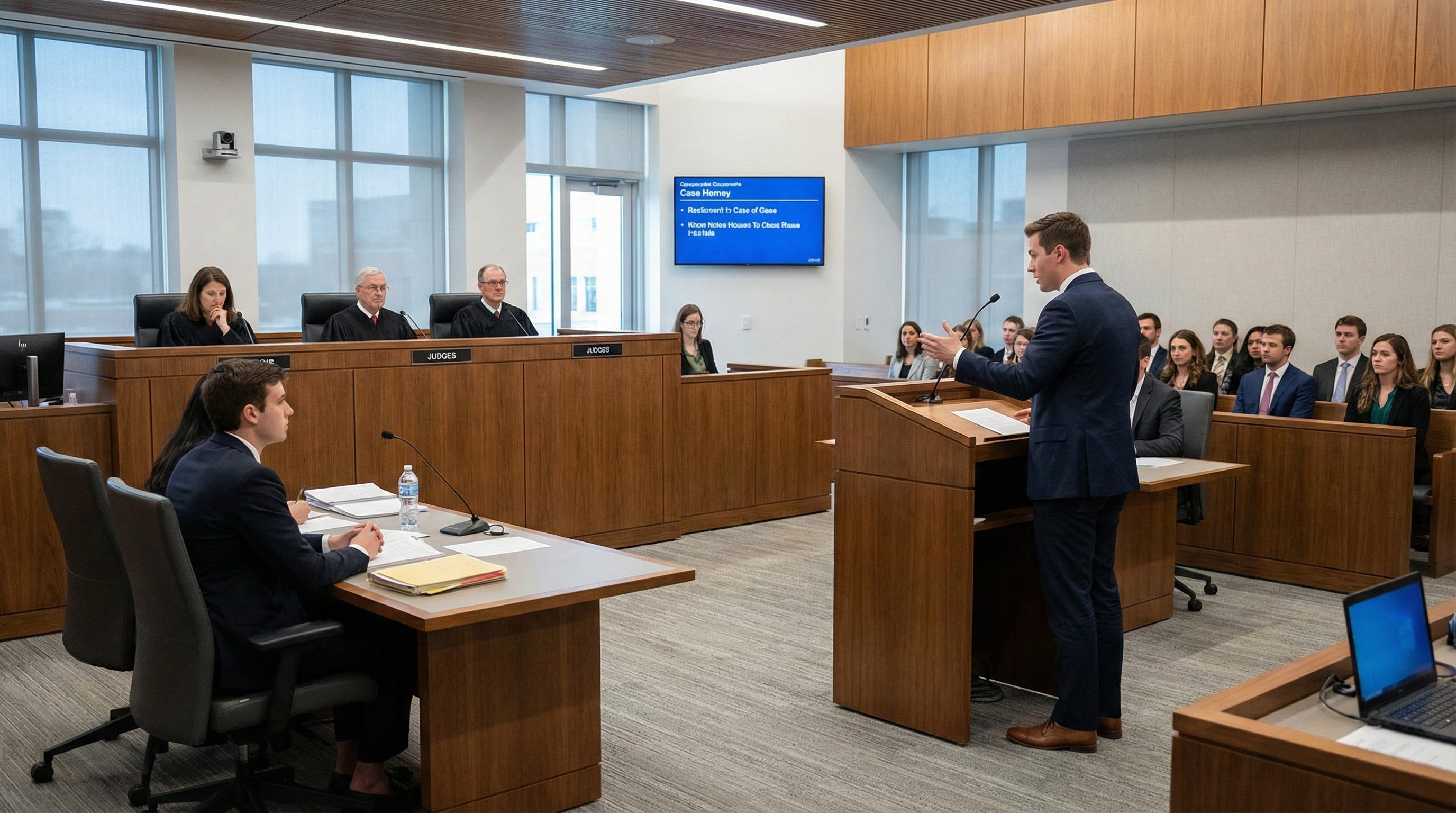
The second structure is the adversarial simulation, most fully developed in legal education through the Moot Court. Unlike the OSCE, which strives for neutrality, the Moot creates conflict by design. Students assume the role of appellate attorneys arguing a fictional case before judges who actively challenge their reasoning. The assessment is not just the prepared argument but the capacity to respond to hostile questioning—to maintain composure when a judge exposes a weakness in the case, to acknowledge limitations while pivoting to stronger ground, and to think on one’s feet when the expected line of questioning fails to materialize. This architecture works best when the goal is to assess resilience under pressure and the ability to sustain coherent argumentation against opposition.
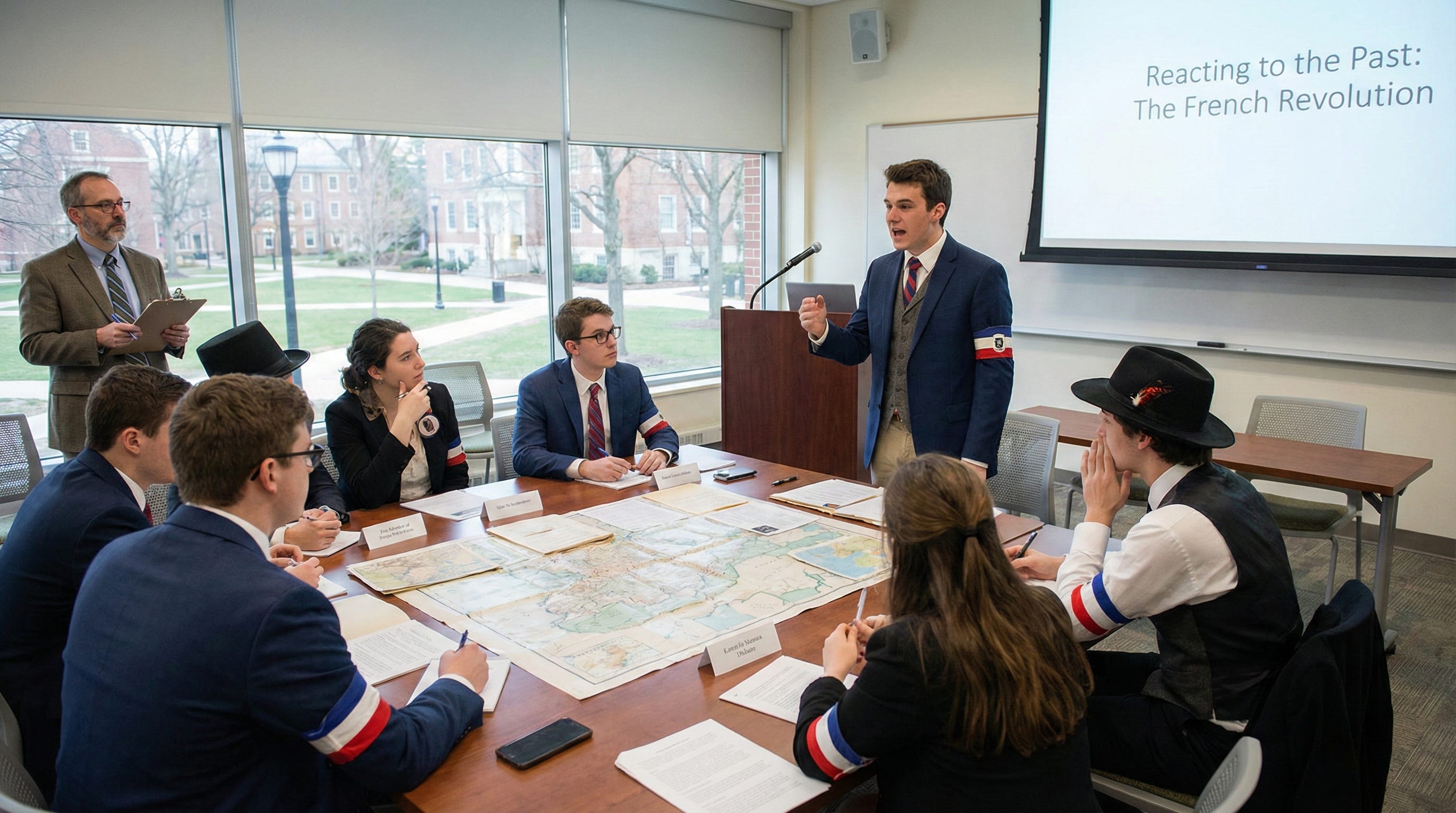
The third structure is the immersive simulation, best represented by Reacting to the Past, a pedagogy developed by historian Mark Carnes that transforms history classrooms into weeks-long role-playing games. Students assume historical personas with specific objectives, such as a radical democrat in ancient Athens or a conservative in the French Revolution, and pursue those objectives through speeches, written manifestos, and strategic maneuvering. Unlike the timed stations of the OSCE, immersive simulations unfold over extended periods, allowing students to develop and refine their characters’ positions through sustained engagement. Assessment is holistic rather than checklist-based, evaluating the student’s grasp of historical context, their rhetorical sophistication, and their strategic thinking. This architecture works best when the goal is a deep engagement with complex material and the development of perspective-taking capacity.
The fourth structure is the professional scenario, used extensively in corporate Assessment Centers and increasingly adapted for educational contexts. Students encounter workplace situations, such as a disgruntled employee, a failed negotiation, or a team conflict, and must navigate them while assessors observe. Unlike clinical simulations, professional scenarios rarely have a single correct approach. Multiple strategies might work; the assessment focuses on the quality of the student’s choices and their ability to execute those choices under observation. This architecture works best when the goal is to assess soft skills like leadership, conflict resolution, and interpersonal communication that resist reduction to checklists.
Integrating Role-Play Across the Curriculum
Role-playing assessment works best when it is not an isolated event but a developmental sequence integrated throughout a course or program. The architecture of this integration matters as much as the design of individual assessments.
Consider a course in organizational leadership. Early in the semester, students might engage in low-stakes practice scenarios with peers: a three-minute conversation with a “team member” who missed a deadline. These formative exercises introduce the format and establish norms without the pressure of grading. Students receive feedback not from the instructor but from peers and from structured self-reflection.
As the semester progresses, the scenarios increase in complexity and stakes. A mid-semester assessment might involve a trained simulation actor playing a more challenging role: an employee whose performance problems may stem from undisclosed personal difficulties. The student must gather information, offer appropriate support, and make a judgment call about how to proceed—all while being observed and evaluated. The rubric expands beyond behavioral checklists to include the quality of the student’s reasoning and their awareness of the ethical dimensions of the situation.
The culminating assessment integrates role-play with other evidence of learning. A student might submit a written analysis of a leadership challenge, then participate in a simulation that tests whether they can execute the approach they advocated on paper. The defense that follows asks them to explain the gap between their plan and their performance—what they would do differently and what they learned from the experience. This integration prevents students from treating role-play as a performance disconnected from their actual understanding.
Placement matters as much as sequence. Role-playing assessments work poorly when students are distracted. They require cognitive resources for sustained attention and emotional resources for managing the stress of performance. Schedule assessments when students can bring their full capacity to the task, and provide adequate preparation time so that performance reflects competence rather than anxiety.
Running Role-Plays Well: The Instructor’s Craft
The quality of role-playing assessment depends heavily on execution. A poorly designed or facilitated simulation produces unreliable data and frustrates students. Several principles distinguish effective practice.
The scenario must be calibrated to the students’ level of preparation. A challenge that exceeds students’ current capability produces only evidence of failure, not evidence of learning. This requires careful attention to what students have been taught and what they can reasonably be expected to show. The scenario should stretch students without overwhelming them—what Vygotsky called the Zone of Proximal Development, the space between independent capability and capability with support.
The scenario partner, whether a trained standardized patient, an actor, a peer, or an instructor, must maintain consistency across students while remaining responsive to the interaction. This balance is difficult. Too much scripting makes the encounter feel robotic and fails to test the student’s adaptability. Too much improvisation introduces variability that undermines fair comparison. The solution is to train scenario partners not on specific lines but on the character’s underlying motivations and constraints. A standardized patient playing someone skeptical of medication should understand why that skepticism exists so they can respond authentically to whatever approach the student takes.
The physical environment shapes the assessment in ways that are easy to underestimate. A room that feels like a test feels like a test. Where possible, create realism: a simulated examination room for clinical encounters, a conference table for negotiation scenarios, and costumes or props that support immersion. This environmental scaffolding helps students enter the “magic circle” of the simulation, treating the fictional scenario as if it were real.
Timing also requires careful calibration. Students need enough time to show competence, but not so much time that the scenario loses its pressure. The OSCE model of short, timed stations works well for assessing discrete skills. Longer formats work better for complex scenarios where relationship-building or extended deliberation is part of what is being assessed. Communicate time expectations clearly in advance so that students can pace themselves appropriately.
The instructor’s role during the assessment is primarily observation, not intervention. Document what you see: specific behaviors, specific words, specific moments when the student succeeded or struggled. This documentation becomes the basis for feedback and grading. Resist the impulse to intervene when the student is struggling unless the scenario has genuinely broken down. The student’s capacity to recover from difficulty is itself part of what you are assessing.

Honest Challenges and Structural Limitations
Role-playing assessment is not a solution to every assessment problem, and treating it as such undermines its legitimate value. Several challenges require honest acknowledgment.
The most fundamental is the cost. Role-playing assessment is resource-intensive. It requires physical space, trained actors, faculty time for observation and feedback, and scheduling logistics that can be nightmarish in large courses. A well-designed OSCE might cost tens of thousands of dollars per administration. This limits how frequently the method can be deployed and raises questions about equity: wealthy institutions can afford more realistic simulations than their under-resourced counterparts.
Reliability remains a persistent challenge. Human performance is variable, and human judgment is subjective. Without rigorous training, two assessors observing the same role-play may assign vastly different scores. Case specificity compounds the problem: a student’s performance on one scenario does not reliably predict their performance on another. This necessitates multiple observations across varied situations, further increasing costs and complexity.
Implicit bias threatens the fairness of even well-designed assessments. Recent studies have documented troubling patterns: Black candidates performing at borderline levels receive harsher penalties than White candidates with identical performance, while female candidates receive higher scores on communication domains that reflect gendered expectations about nurturing behavior. These findings suggest that evaluators bring their prejudices into the assessment room despite standardization efforts. Addressing this requires not just assessor training but structural interventions, such as diverse assessment teams, blind scoring where possible, or rubrics that focus on outcomes rather than style.
The performative nature of role-play can introduce construct-irrelevant variance. A student may possess the required competence but fail the assessment because they suffer from social anxiety or stage fright. The assessment then measures confidence rather than capability. This is particularly concerning for neurodiverse students. Standard role-play formats often privilege neurotypical social norms, including sustained eye contact and rapid verbal processing. An autistic student might show empathy through attention to detail and careful action but fail a rubric that demands sustained eye contact as a marker of connection.
Finally, role-playing assessments involving sensitive topics raise ethical concerns that cannot be ignored. Asking students to enact scenarios involving racism, sexual violence, or historical trauma can cause genuine psychological harm. For students from marginalized communities, reenacting historical oppression may trigger re-traumatization. For anyone, playing a perpetrator can create moral injury and identity confusion. These risks require careful scenario design, robust consent processes, and meaningful debriefing after difficult simulations.
Your Role-Playing Assessment Implementation Toolkit
This section consolidates the principles discussed above into a sequential framework for designing and conducting role-playing assessments. Treat this as an adaptable structure rather than a rigid prescription.
Step 1: Define What You Are Assessing
Role-play is a method, not a competency. Before designing the scenario, clarify the specific knowledge, skills, and dispositions you want to observe. Be precise: “communication skill” is too vague; “ability to deliver difficult news while maintaining the client’s trust” provides the specificity needed for scenario design and rubric development.
Step 2: Calibrate the Scenario to Your Students and Context
The scenario should present a challenge that is difficult but achievable, given what the students have learned. It should create ambiguity that requires judgment. If there is a single obvious correct response, a role-play is unnecessary. And it should be realistic enough that students can treat it as a genuine professional situation rather than an academic exercise.
Step 3: Prepare Your Scenario Partners
Whether you are using trained standardized patients, colleagues, or peers, scenario partners need to understand the character’s underlying motivations, the boundaries of acceptable improvisation, and the specific behaviors that should trigger particular responses. Practice the scenario with your actors before deploying it with students, and debrief afterward to identify inconsistencies.
Step 4: Design the Assessment Rubric Before the Assessment
The rubric should specify what you are looking for at multiple performance levels, with enough detail that different assessors would reach similar conclusions about the same performance. Decide whether you are using checklist scoring (discrete behaviors marked present or absent), global rating scales (holistic judgments on dimensions), or some combination. Share the rubric with students in advance so they know what success looks like.
Step 5: Create the Physical and Temporal Conditions for Success
Reserve appropriate space, schedule adequate time, and minimize disruptions. Brief students on logistics and expectations before the assessment begins. If the scenario involves sensitive content, provide advance warning and meaningful opt-out alternatives.
Step 6: Document What You Observe
During the assessment, your primary task is recording specific behaviors, statements, and moments—not making summary judgments. This documentation becomes the evidence base for feedback and grading. Develop a notation system that allows you to capture relevant details without disrupting your attention to the ongoing interaction.
Step 7: Debrief and Provide Feedback
The assessment’s pedagogical value extends beyond the performance itself. Within 48 hours, require students to submit structured reflections on their experience. Provide feedback that is specific, evidence-based, and developmental—not vague praise or criticism but concrete observations tied to the rubric criteria, with clear guidance on how to improve.
Step 8: Iterate and Refine
After each administration, review the assessment data for patterns that suggest problems with the scenario, the rubric, or the rating process. Solicit feedback from students and scenario partners. Treat every role-play as a learning opportunity for your own assessment design.
The Stakes of Enactment
Role-playing assessment represents something more than a technique for avoiding AI-assisted fraud. It embodies a particular understanding of what education is for: not merely the transmission of information but the formation of people who can act wisely in situations of genuine uncertainty. The written examination tests whether students can recall and analyze. The role-play tests whether they can be the professionals their training claims to produce.
This makes the method both powerful and demanding. It is easy to administer a multiple-choice exam. It is difficult to create a simulated reality that is immersive enough to evoke authentic performance and structured enough to permit fair comparison. But the difficulty is precisely the point. We do not trust pilots who have only read about flying. We should not trust doctors, lawyers, teachers, or leaders who have only written about their professions.
Role-playing assessment does not solve every problem of AI in education. It is expensive, time-consuming, and difficult to scale. It requires investments in infrastructure and training that many institutions will resist. Its reliability depends on rigorous design and ongoing calibration. And its fairness depends on vigilance against the biases that human assessors inevitably carry.
But for the competencies that matter most—the ones that require not just knowledge but wisdom, not just thinking but acting, not just intelligence but presence—role-playing remains the only method that places students where learning actually occurs: in the midst of the mess, responding to what is happening right now, with other humans watching and the outcome genuinely uncertain. This is not a retreat from assessment’s challenges. It is an advance toward what assessment was always supposed to measure.
The images in this article were generated with Nano Banana Pro.
P.S. I believe transparency builds the trust that AI detection systems fail to enforce. That’s why I’ve published an ethics and AI disclosure statement, which outlines how I integrate AI tools into my intellectual work.