

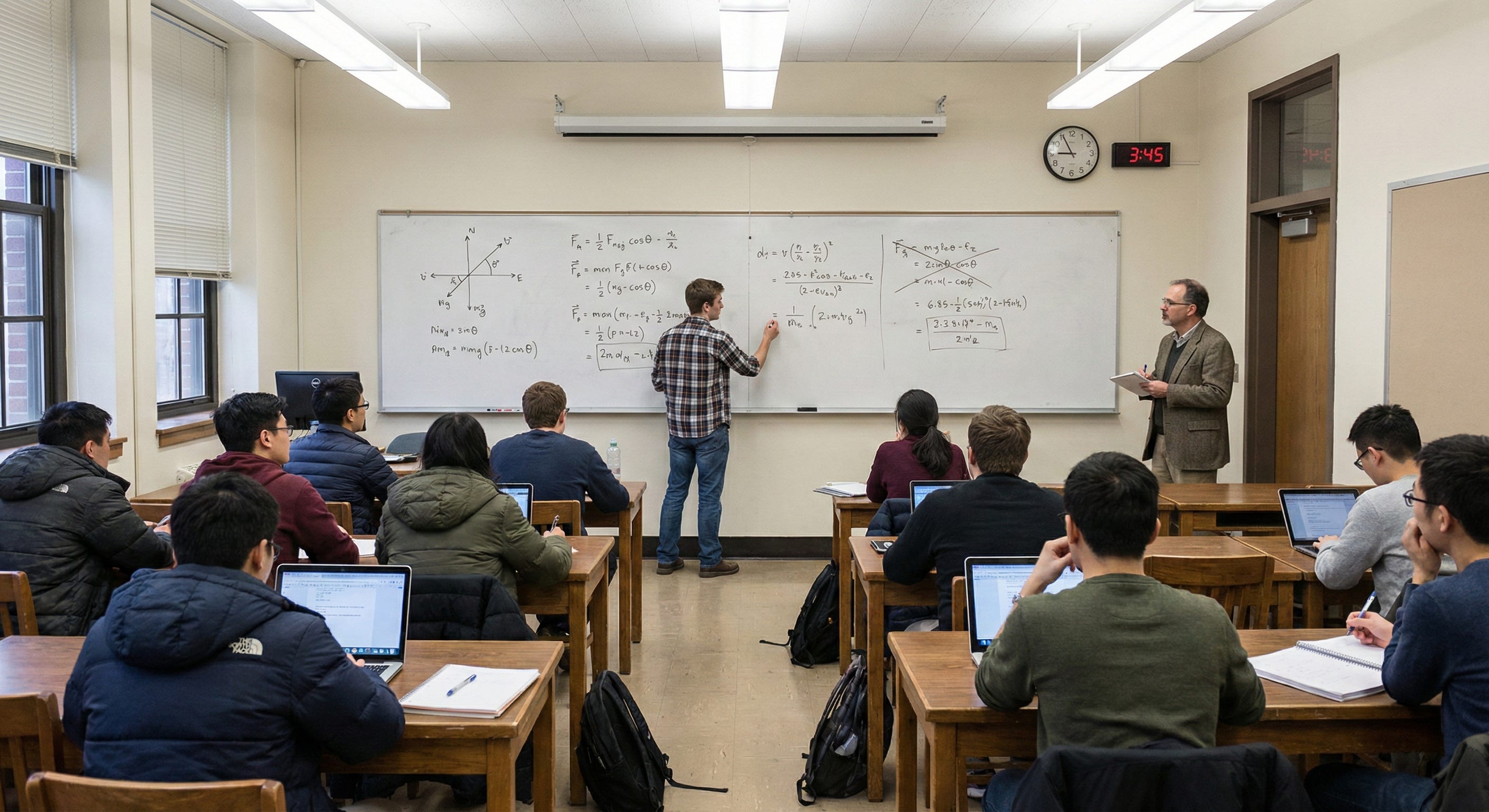
The first three installments of this series examined methods that make cognition visible through performance: design critiques that reveal thinking through the defense of creative choices, video logs that document reasoning as it unfolds, and Socratic seminars that assess understanding through collaborative dialogue. Each method shifts assessment from artifact to process, from the static product a student submits to the dynamic demonstration of what they can do in the moment.
The whiteboard defense extends this logic to its most concentrated form. Where the seminar distributes intellectual work across a community and the vlog captures thinking in relative privacy, the whiteboard defense isolates a single student before a vertical surface and an expert evaluator. It asks one question with ruthless clarity: Can you construct this solution right now, from scratch, while explaining every step? The method transforms problem-solving from a private mental act into a public performance where every assumption, every procedural choice, and every moment of uncertainty becomes visible.
This installment examines the whiteboard defense as a structure for assessing technical mastery in STEM disciplines while acknowledging its growing adoption in humanities courses. Unlike earlier methods in this series that emerged from progressive education movements, the whiteboard defense carries the austere legacy of military academies and professional gatekeeping. Understanding why it works requires confronting this inheritance directly.
From West Point to the Tech Interview: An Assessment Method’s Journey
The whiteboard defense descends from a specific moment in American educational history. In 1817, Colonel Sylvanus Thayer assumed command of the United States Military Academy at West Point during a period of institutional crisis. The academy had been producing officers whose engineering knowledge proved unreliable under battlefield conditions. Thayer, influenced by his observations of the École Polytechnique in Paris, implemented a pedagogical system that would define rigorous STEM education for the next two centuries.
The Thayer Method, as it became known, inverted the classroom’s traditional architecture. Students were responsible for mastering material before entering the room. Class time was not for transmission but for verification. At the start of each session, the instructor would command: “Take boards!” Cadets would proceed to the blackboards lining the walls, each assigned a specific theorem or engineering problem. They would construct the complete solution from memory while the instructor moved from board to board, hearing an oral “recitation” where each cadet defended their work and answered probing questions.
This structure survived largely unchanged into the 21st century, outlasting the advent of calculators, computers, and the digital revolution. The method established principles that remain central to whiteboard assessment: cognition must be visible, mastery requires real-time demonstration, and understanding reveals itself through the capacity to explain one’s reasoning under scrutiny.
The philosophical foundation for the method’s interrogative dimension reaches back further, to Socratic dialectic. Elenchus, an ancient method of engaging in cooperative argumentative dialogue using questions, offered a structure for teachers to interact with students at the board. The Socratic interlocutor does not merely correct errors but asks questions designed to expose the robustness of a student’s mental model: “What do you mean by ‘force’ in this context?” “Why are we assuming this system is closed?” “If we doubled the mass, what would happen to the period?”
This questioning style distinguishes between simple memorization (the student knows a formula works) and conceptual understanding (the student knows why it works). The goal is not to catch students in errors but to make their reasoning structure visible, allowing both student and instructor to see where understanding is solid and where it needs reinforcement.
Social constructivism provides the theoretical framework for why this visibility matters. Lev Vygotsky’s concept of the Zone of Proximal Development describes the space between what a learner can do independently and what they can achieve with guidance. The whiteboard defense allows instructors to intervene precisely within this zone. Unlike a written exam where feedback arrives days later, the defense enables dynamic scaffolding. When a student stalls on a derivation, the instructor can offer a calibrated prompt to help bridge the gap, turning assessment into a learning event.
The method also leverages metacognition through what cognitive scientists call the “think-aloud” protocol. When students verbalize their solution while constructing it, they must monitor their own cognitive processes. Research on the “self-explanation effect” demonstrates that explaining each step enhances deep learning. Students are more likely to detect their own logical inconsistencies and gaps when they must articulate their reasoning aloud.
The whiteboard defense migrated beyond military education through two distinct paths. In physics education, it developed into Modeling Instruction’s “board meetings,” where small groups construct whiteboards summarizing laboratory data or conceptual models, then present to the class. The defense becomes communal. Groups defend their model against scientific critique from peers and the instructor, mimicking professional peer review. In computer science and engineering, the method transformed into the technical interview, a high-stakes hiring filter where candidates solve algorithmic problems at a whiteboard while “thinking aloud” for evaluators.
This dual heritage shapes how we understand the method’s contemporary purpose. The academic tradition emphasizes diagnostic visibility and formative feedback. The professional tradition emphasizes authenticity verification and predictive validity. Both recognize that watching someone construct a solution reveals far more about their capabilities than examining the finished product.

Why the Whiteboard Defense Resists Artificial Intelligence
The method’s resistance to AI stems from a fundamental mismatch between what generative systems can produce and what the defense actually assesses. A large language model can synthesize solutions to complex problems instantaneously. It can write code, derive equations, and generate sophisticated analyses that would take human students hours to produce. But the whiteboard defense does not assess the ultimate answer. It assesses the construction process itself.
Consider what happens during a typical defense. A student receives the prompt: “Derive the equation of motion for a damped harmonic oscillator.” They must begin from first principles, draw a force diagram, apply Newton’s second law, and work through the mathematical steps to arrive at the differential equation. Along the way, they make choices: which coordinate system to use, whether to consider the damping force proportional to velocity, how to handle boundary conditions. Each choice must be articulated and justified.
An instructor watching this performance sees far more than whether the student reaches the correct answer. They observe hesitation that indicates weak understanding, self-correction that shows active monitoring, and the distinction between procedural errors (a dropped negative sign) and conceptual failures (fundamental misunderstanding of energy conservation). They can probe the edges: “How would this change if friction were not negligible?” “What assumptions are we making about the spring constant?” These questions test whether the student possesses a robust mental model or merely pattern-matched from similar problems.
AI cannot convincingly simulate this performance because it lacks the temporal and embodied qualities the assessment targets. The defense occurs in real time, without the ability to generate multiple responses and select the best one. It requires spontaneous adaptation to the instructor’s questions, drawing on a coherent understanding that extends beyond the immediate problem. When an instructor pivots mid-defense to explore a related concept, the student must access their broader knowledge base immediately. An AI assistant consulted surreptitiously would introduce fatal delays and disconnects.
There is also the matter of disambiguation that is absent in written assessment. In mathematics and coding, trivial syntax errors can ruin solutions. A missing semicolon or dropped negative sign renders an answer technically incorrect even when the underlying logic is sound. The whiteboard defense allows instructors to separate these surface features from deeper understanding. An instructor can say, “Assume the syntax is correct—walk me through the logic,” refocusing assessment on conceptual mastery.
The defense simultaneously evaluates technical knowledge and professional competencies that remain invisible in written work: clarity of explanation, organization under pressure, and the capacity to receive and integrate feedback. The method also assesses what Donald Schön called “reflection-in-action”—a concept we explored in detail in Part 1 of this series. When a student reaches an impossible result at the board, they must notice the error in real time and reason backward to find where their logic went wrong. This capacity to monitor one’s own problem-solving process, recognize when an approach isn’t working, and adjust course mid-stream represents exactly the improvisational intelligence that Schön identified as central to professional competence. A student’s ability to admit uncertainty gracefully, to ask for clarification when a question is ambiguous, or to explain complex ideas to a non-expert audience—all become visible during the live defense.
Finally, the method creates an unbreakable chain of custody between student and artifact. The real-time generation under direct observation verifies that the student demonstrating competence is the same person who will be certified as having mastered the material. In an age where automated systems can generate convincing solutions, this verification function has become central to assessment’s credibility.
Three Structures for Different Pedagogical Purposes
The whiteboard defense operates through distinct structural variations, each serving specific learning objectives and classroom contexts. Understanding these variations allows instructors to match method to purpose rather than applying a single format universally.
The Individual Technical Defense represents the method’s purest form, directly descended from the Thayer Method. A single student stands before a whiteboard facing an instructor or small evaluation panel. They receive a problem prompt and work through it while narrating their reasoning. The instructor remains mostly silent during construction, then shifts to active questioning once the student reaches a solution or a natural stopping point. This structure maximizes diagnostic visibility. The instructor can observe the student’s entire problem-solving process without the mediating influence of group dynamics. It works best for assessing individual mastery of technical skills where there is typically one correct approach: mathematical proofs, algorithm design, chemical reaction mechanisms, or physics derivations.
The evaluation here is high-resolution. The instructor tracks not just whether the student arrives at correct answers but how they get there: Do they work systematically or jump around? Do they check their work? Do they recognize when they’ve made an error? This format proves particularly valuable for identifying specific misconceptions that written exams often mask. A student might arrive at a correct answer through compensating errors that cancel out, appearing competent on paper while harboring fundamental misunderstandings. The live defense exposes these hidden gaps.
The Board Meeting format, developed within Modeling Instruction pedagogy, transforms the defense into a collaborative and communal activity. Small groups of students work together to solve a problem or analyze data, constructing their solution on portable whiteboards. They then present to the entire class arranged in a circle, with each group’s board visible to all. Other groups and the instructor offer critiques and questions. The presenting group must defend their approach, justify their assumptions, and respond to challenges.
This structure serves different pedagogical goals. It emphasizes scientific discourse and peer review rather than individual verification. Students learn to construct arguments that convince their peers, not just satisfy an authority figure. They must anticipate objections, marshal evidence, and engage with alternative interpretations. The assessment focuses on the quality of reasoning, the use of evidence, and the capacity for intellectual dialogue rather than computational correctness alone. Board meetings work especially well for experimental sciences where data interpretation is as important as procedural knowledge: physics laboratories, chemistry experiments, or biology field observations.
The defense here is distributed. No single student carries full responsibility for the solution, which reduces anxiety while increasing the collaborative skills being assessed. Students learn that scientific understanding emerges through community consensus rather than individual insight. The method socializes students into disciplinary practices—presenting findings, responding to critique, revising claims based on evidence. As we saw in Parts 1 and 3 of this series, this socialization represents both the method’s pedagogical power and its potential risk: students absorb not just procedural knowledge but the implicit values and assumptions of the disciplinary community.
The Staged Defense introduces scaffolding that makes the method accessible while preserving its assessment integrity. Students receive the problem prompt days before the actual defense, allowing time to prepare, research relevant concepts, and develop a solution strategy. However, during the defense itself, they must reconstruct the solution from scratch without notes. The instructor may provide the same problem with modified parameters, or ask students to solve a parallel problem using the same underlying principles.
This variation acknowledges that some cognitive work, such as researching concepts, identifying relevant equations, or mapping solution pathways, need not occur under time pressure to show true mastery. What matters is whether students have internalized the logic sufficiently to reproduce it independently. The staged defense reduces the anxiety that can distort performance while maintaining the essential assessment function: verification that students understand their own solutions deeply enough to reconstruct and explain them.
This format works particularly well for complex, multi-step problems where the cognitive load of starting from absolute scratch would overwhelm working memory: system architecture design, proof of a major theorem, or comprehensive data analysis. It also serves equity by giving students with different processing speeds or neurodivergent learning styles adequate preparation time while still requiring real-time demonstration.
Building the Whiteboard Defense Into Your Course
Integrating the whiteboard defense effectively requires understanding it as a semester-long pedagogical structure rather than an isolated assessment event. Students need preparation, practice, and progressive skill development before facing high-stakes defenses.
Consider a physics or engineering course where you plan to use whiteboard defenses for both formative and summative assessment. Your semester progression might follow this arc:
In Week 3, introduce the method through low-stakes practice. Select a problem students have already solved in homework—one where you know they’ve achieved competence. Ask for volunteers to demonstrate their solution at the board while you model appropriate questioning. The goal is demystification. Students see that a defense is not an interrogation designed to catch errors, but a structured conversation about problem-solving. Use this first session to establish the rhythm: construction phase, interrogation phase, feedback phase. Debrief afterward, highlighting what worked: clear diagrams, explicit statement of assumptions, logical progression through steps.
By Week 6, conduct your first graded individual defenses, but keep stakes moderate—perhaps 5% of the final grade. Give students the problem set several days in advance with explicit guidance about what kinds of questions you’ll ask. The emphasis is on whether they’ve internalized the solution logic, not whether they can perform perfectly under time pressure. Schedule 20-minute blocks: five minutes for setup and initial thinking, ten minutes for construction and narration, five minutes for instructor questions and feedback. Keep sessions private or semi-private to minimize social-evaluative stress.
Structure your grading around observable behaviors tied to learning objectives. Preparation and Organization (20%): Did the student bring appropriate materials? Do they begin with a systematic approach? Conceptual Understanding (35%): Can they explain why they’re taking each step? Do they recognize when results violate physical constraints? Problem-Solving Process (25%): Do they check their work? Do they recognize and correct errors? Can they adapt when challenged? Communication (20%): Can they explain technical concepts clearly? Do they respond appropriately to questions?
Week 10 might introduce board meetings for laboratory analysis. After students complete an experiment, small groups construct whiteboards presenting their data, analysis, and conclusions. The class reconvenes in a circle for presentations and questioning. Each group gets ten minutes: five for presentation, five for defense against peer and instructor questions. Grade both the quality of the board (data visualization, claim-evidence connections, acknowledgment of uncertainty) and the quality of the defense (responsiveness to questions, handling of criticism, ability to distinguish between what their data shows and what it suggests).
By Week 14, you’re ready for high-stakes summative defenses—perhaps 15-20% of the final grade. Use the staged defense format: provide the problem prompt a week in advance, but during the actual defense, modify parameters or ask for a parallel application. A student who prepared to analyze a spring-mass system might face a defense question about a pendulum, requiring them to transfer their understanding to a new context. This tests not just preparation but genuine comprehension.
The key to successful integration is treating each defense as a learning opportunity, not just an evaluation event. Even in high-stakes summative contexts, provide immediate qualitative feedback. The student should leave understanding exactly where their reasoning was strong and where it needs development. This transforms the defense from a judgment into a diagnostic conversation.
Conducting Effective Whiteboard Defenses
The quality of a whiteboard defense as assessment depends on meticulous execution across three dimensions: environmental design, facilitation technique, and question calibration.
The Physical Space and Materials
The board itself matters more than you might expect. A cramped 3-by-4 foot whiteboard forces students to erase and rewrite, destroying the visual record of their reasoning process. Ideally, provide a 6-by-4 foot surface or larger—enough space that students can lay out their entire solution pathway without overwriting. If using traditional chalkboards, the surface should be clean and the chalk fresh. Poor materials create unnecessary barriers that contaminate assessment.
Position matters. The student should stand facing the board with you positioned at an angle where you can see both the student and what they’re writing. Avoid sitting directly behind them, which creates a surveillance dynamic. Don’t sit at a desk while they stand as this amplifies the power differential. If possible, use a stool or chair positioned to the side, creating a consultant posture rather than an examiner posture.
Have appropriate markers or chalk in multiple colors readily available. Color coding helps students organize their thinking: perhaps black for given information, blue for assumptions, red for the solution pathway, green for checking work. Provide erasers within easy reach. Students should feel free to revise as they work. Self-correction is valuable assessment data, not a deficiency to hide.
The Temporal Structure
Open with explicit framing. Before presenting the problem, remind students that the goal is to make their thinking visible, not to perform flawlessly. Acknowledge that uncertainty and errors are normal parts of problem-solving. This framing reduces anxiety without lowering standards.
Present the problem prompt clearly, ideally in writing, so students can refer back to it. Give them two to three minutes of silent thinking time before they must begin writing. This “settling” period allows students to organize their approach mentally, reducing the cognitive load during execution.
During the construction phase (typically 10-15 minutes), maintain what I call “active silence.” You’re not passively observing but actively documenting. Take notes on the student’s process: where they hesitate, what they write and then erase, whether they check their work. This documentation becomes the evidence base for your feedback. Resist the urge to intervene when students struggle. Struggle is assessment data. Only interrupt if a student has completely stalled for over 60 seconds, offering minimal prompts: “What do you know so far?” “What’s your next step?”
The interrogation phase (5-10 minutes) requires careful question calibration. Begin with clarification questions that establish shared understanding: “Walk me through what this variable represents.” “Why did you choose this coordinate system?” These questions should feel collaborative, not adversarial. If the student has made errors, your questions should guide them toward recognition without simply telling them the answer: “What happens if we plug this value back into the original equation?” “Does this result make physical sense given what we know about the system?”
Use hypothetical questions to test the robustness of understanding: “How would your approach change if the surface had friction?” “What if the mass were ten times larger?” These questions distinguish between students who have memorized a procedure for one specific case and those who possess transferable understanding.
End with immediate qualitative feedback, delivered while the student is still at the board. Identify specific moments where their reasoning was strong: “When you recognized that negative result and went back to check your free-body diagram, that showed excellent metacognitive awareness.” For weaknesses, be equally specific: “I noticed you assumed constant acceleration here, but let’s examine whether that assumption holds for this system.”
Question Architecture and the Socratic Progression
Effective questions during the interrogation phase follow a hierarchy from surface to depth. Clarification questions establish basic understanding: “What does this term represent?” “Why are we using this formula?” These questions should feel supportive, helping both of you establish shared reference points.
Probing questions test the stability of understanding: “How did you determine these initial conditions?” “What assumptions are we making about the system?” These questions ask students to make their invisible reasoning visible, to articulate decisions that often happen automatically for experts.
Extension questions assess transferability: “What would change if we removed this constraint?” “Can you think of another system that behaves similarly?” These questions reveal whether students have isolated knowledge or connected understanding.
Challenge questions, used sparingly, stress-test misconceptions: “But doesn’t that contradict what we established about energy conservation?” These questions should be posed with genuine curiosity, not as gotchas. The goal is to create a cognitive conflict that prompts students to examine their own reasoning.
The art lies in calibrating question difficulty to student response. If a student is performing strongly, push toward extension and challenge questions to assess the upper boundary of their competence. If a student is struggling with basic execution, focus on clarification questions that scaffold without removing the cognitive work. The whiteboard defense is an adaptive assessment in real time.
Limitations, Pitfalls, and Honest Challenges
The whiteboard defense carries significant costs and introduces genuine equity concerns that demand acknowledgment and mitigation rather than dismissal.
The Time and Scale Problem
The method’s most acute limitation is temporal. A thorough individual defense requires 20-30 minutes per student: time for setup, construction, interrogation, and feedback. In a course with 60 students, conducting defenses for everyone is logistically prohibitive. Even with teaching assistants, you’re looking at 20-40 hours of assessment time per cycle. This scale challenge has appeared throughout this series—from design critiques to Socratic seminars—as an inherent feature of assessment methods that prioritize human interaction over artifact evaluation. Each method in this series has required an honest acknowledgment that AI resistance comes with real costs in instructor time and institutional resources.
Mitigation strategies exist but introduce their own complications. Random sampling—where only a subset of students defends, or students defend on randomly selected topics—creates uncertainty that can motivate broader preparation. A student who knows they might be asked to defend any concept from the past four weeks must maintain readiness across the entire curriculum. However, this approach feels unfair to students who happen to be selected multiple times while others are never called. It also means final grades rest on limited assessment evidence for some students.
Board meetings distribute the time cost across groups but change what’s being assessed. Group defenses evaluate collaborative work and communication skills alongside technical knowledge. This serves important learning objectives but doesn’t provide the same high-resolution diagnostic data about individual understanding that solo defenses offer. A student might contribute little to their group’s work yet receive the same grade as their more engaged peers.
Some instructors use defenses as a supplementary verification system rather than a primary assessment. After the written exams, they randomly select students whose performance seems incongruent with their coursework trajectory—either unexpectedly strong or surprisingly weak—for follow-up defenses. This “spot-check” approach focuses assessment resources where they’re most needed for authenticity verification. However, it requires clear communication to students that such callbacks might occur, and it risks feeling punitive to students who are called in.
The Anxiety and Performance Stress Factor
The whiteboard defense introduces construct-irrelevant variance through anxiety. Research on technical interviews shows that performance can drop by more than half when candidates are observed, solely because of social-evaluative stress. Students may possess a solid understanding but cannot demonstrate it because the performance context triggers stress responses that interfere with cognitive access to knowledge.
This anxiety is not distributed equally. Studies consistently show that women in STEM fields experience higher levels of stereotype threat during oral technical assessments—the fear of confirming negative stereotypes about their group’s abilities. This can create a vicious cycle where anxiety impairs performance, confirming internal doubts, increasing anxiety in subsequent assessments. Students from backgrounds where public performance or disagreement with authority figures is culturally discouraged may face similar barriers.
The “Yerkes-Dodson curve” from psychology maps the relationship between stress and performance. Moderate stress enhances focus and performance. Excessive stress triggers fight-or-flight responses that shut down higher-order cognition. The instructor’s challenge is keeping students in the productive stress zone rather than pushing them into panic.
Mitigation requires deliberate design from the start. Conduct practice defenses early with extremely low or zero stakes, allowing students to experience the format before it matters. Make rubrics explicit and share them in advance, reducing uncertainty about evaluation criteria. Adopt a consultative rather than adversarial questioning style—you’re helping students show what they know, not trying to catch them in errors. Allow students to bring a single notecard with key formulas or concepts, reducing the memorization burden. Permit water and brief pauses. These accommodations maintain the assessment’s core function while reducing anxiety’s distorting effects.
The Bias and Equity Challenge
Oral assessment is inherently more subjective than machine-scored exams, creating vulnerability to implicit bias. Research shows that evaluators unconsciously grade students differently based on gender, race, accent, confidence level, and whether students match the evaluator’s mental image of who “belongs” in the discipline. A hesitant woman might be perceived as lacking competence, while a confident man who makes the same error is seen as having a “momentary slip.” An international student with strong technical skills but accented English might be downgraded on “communication” in ways that reflect linguistic bias rather than clarity assessment.
These biases operate unconsciously, making them difficult for individual instructors to detect and correct without external intervention. The problem intensifies when evaluation involves a subjective judgment about whether a student has “sufficiently explained” their reasoning or demonstrated “adequate understanding.”
Mitigation requires systematic approaches, not just good intentions. Use behaviorally anchored rubrics that specify exactly what different performance levels look like, reducing the space for subjective interpretation. Grade the final board artifact blind where possible—have the student leave the room so you can photograph their work and evaluate it without knowing who produced it. Complement the live defense with written components that allow different communication styles. Train all evaluators explicitly in implicit bias recognition. Consider having two evaluators present for high-stakes defenses, comparing notes to identify where their judgments diverge.
Recording defenses creates documentation that allows retrospective review for bias patterns. If female students consistently receive lower communication scores than male students despite similar technical performance, that pattern becomes visible and addressable. However, recording introduces its own complications: some students experience heightened anxiety when being recorded, and stored recordings create privacy and data security concerns.
The Neurodiversity and Accessibility Dimension
The whiteboard defense creates specific barriers for neurodivergent students. For students on the autism spectrum, the requirement to interpret social cues from the evaluator, maintain eye contact, and process questions in real time while simultaneously constructing a solution may demand cognitive resources that neurotypical students take for granted. The sensory environment—bright lights, marker squeaking, the evaluator’s presence in peripheral vision—can be overwhelming.
Students with ADHD may struggle with the requirement to verbalize their thinking continuously. Many neurodivergent individuals process information better in writing than in speech or need processing time before responding to questions. The time-pressured, multitasking nature of the defense runs counter to their learning profiles.
Students with anxiety disorders face the same stressors as any student but with clinical-level intensity. What feels like productive pressure to a neurotypical student might trigger a full panic response for a student with an anxiety disorder. Social anxiety specifically makes public performance exceptionally difficult regardless of content mastery.
Accommodations should be individualized but might include: providing questions in writing 10-15 minutes before the defense to allow processing time; permitting students to face the board rather than the evaluator while speaking to reduce social eye contact demands; allowing pre-recording of the defense in a private space; or substituting a written explanation of the solution process with defense questions answered in writing. The challenge is implementing these accommodations without changing what’s being assessed.
Some modifications preserve the method’s core function (pre-question provision allows the same cognitive work with more processing time) while others transform the assessment into something different (allowing written responses removes the real-time spontaneity that is central to the method’s diagnostic power). Institutions must balance legitimate accommodation against assessment validity, recognizing that some students may show mastery better through alternative methods.
The Professional Authenticity Question
The whiteboard interview has been criticized within the tech industry itself as a poor predictor of job performance. Actual software development rarely requires writing code on a whiteboard without reference materials, IDE assistance, or time for research. The whiteboard interview tests a specific skill—performing algorithmic problem-solving under observation—that correlates only loosely with the collaborative, iterative work that characterizes professional practice.
If we’re using whiteboard defense partly to prepare students for professional contexts, we must acknowledge that the context itself may be an artificial construct. This doesn’t necessarily invalidate the method as pedagogy—it may assess valuable cognitive capacities even if it doesn’t perfectly mirror workplace demands—but it should temper claims about it being an authentic assessment.
Your Whiteboard Defense Implementation Toolkit
This section consolidates the principles discussed above into a sequential framework for implementing whiteboard defense in your course. Adapt these steps to your disciplinary context and institutional constraints.
Step 1: Define Your Assessment Purpose
Before designing any defense structure, clarify what you’re assessing and why. Individual technical mastery? Collaborative problem-solving? Communication skills? Scientific argumentation? Your purpose determines which variation of the method you use and how you structure evaluation criteria. Write explicit learning objectives that the defense will address. If you cannot articulate specific capacities you’re assessing beyond “understanding the material,” the method may not be the right choice.
Step 2: Choose Your Format and Schedule
Decide whether you’ll use individual defenses, board meetings, or staged defenses based on your class size, available time, and learning objectives. Map out when defenses will occur across the semester. Provide this schedule on the first day of class so students know the expectations from the start. If you’re using random selection or sampling, explain the system transparently. Allocate adequate time—rushing defenses destroys their diagnostic value.
Step 3: Develop and Share Your Rubric
Create a detailed rubric that makes expectations concrete. Avoid vague criteria like “demonstrates understanding.” Instead, specify observable behaviors: “States assumptions explicitly before beginning,” “Recognizes when a result violates physical constraints,” “Provides clear justification for methodological choices,” “Responds to questions by citing specific elements of their solution.” Weight different components according to your priorities. Share this rubric when you announce the assessment, not after students have already performed. Consider developing it collaboratively with students after they’ve seen an example defense.
Step 4: Build Preparation and Practice Into the Curriculum
Do not spring the whiteboard defense on students without preparation. In Week 2 or 3, demonstrate the format yourself by solving a problem at the board while narrating your thinking. Show students what an effective explanation looks like. Conduct practice rounds before any graded defenses. Use familiar problems that you know students have already solved successfully. The goal is skill development, not assessment. Provide extensive feedback during practice, focusing on process rather than correctness.
Step 5: Design Your Problems Strategically
For individual defenses, select problems that can be completed in the allocated time while still revealing understanding. Avoid problems with extensive calculation that would consume the entire period on routine arithmetic. Focus on problems that require conceptual decisions and strategic thinking. For staged defenses, provide the problem prompt with sufficient advance notice but design follow-up questions that require transfer rather than memorization.
Step 6: Conduct the Defense with Intentional Facilitation
Follow the temporal structure outlined earlier: framing, silent thinking time, construction phase with active observation, interrogation with calibrated questions, immediate feedback. Document the entire process for later reference. Maintain a supportive tone even when probing weaknesses. Remember that your role is to help students show their capabilities, not to catch them failing.
Step 7: Evaluate with Evidence and Provide Detailed Feedback
Grade based on the evidence you documented, referencing your rubric consistently. For each student, identify specific moments that exemplified different rubric criteria. Provide written feedback within one week while the defense is still fresh in students’ minds. Specify both strengths to maintain and areas for development. Frame feedback developmentally: “For the next defense, I’d like to see you checking your work systematically” rather than “You didn’t check your work.”
Step 8: Iterate and Refine
After each defense cycle, assess what worked and what needs adjustment. Did time allocations prove adequate? Were the problems appropriately difficult? Did your questions elicit the information you needed? Solicit student feedback about their experience—what helped them demonstrate their knowledge and what created unnecessary barriers. Use this information to refine subsequent defenses. Treat your implementation as an evolving system rather than a fixed protocol.
Why This Assessment Remains Essential
The whiteboard defense represents a profound reconception of what we mean by “knowing” in technical disciplines. It refuses the reduction of knowledge to artifact, insisting instead that understanding reveals itself through performance, through the capacity to construct solutions and explain reasoning under constraints. This shift from product to process makes the method resistant to AI-generated work, but that resistance is almost incidental to its deeper pedagogical value.
When we ask students to stand at a whiteboard and demonstrate their thinking in real time, we are assessing something that automated systems cannot yet simulate: the integration of conceptual understanding, procedural fluency, and metacognitive awareness that characterizes genuine expertise. We’re evaluating not just whether students have the right answer but whether they possess the robust mental models that allow them to construct answers, recognize when those answers are reasonable, and adapt their approach when initial strategies prove inadequate.
The method demands more from both students and instructors than traditional assessment. Students cannot rely on pattern-matching or memorization. They must develop a genuine understanding that allows them to reason from first principles, explain their choices, and respond to challenges spontaneously. Instructors must invest time in design, execution, and feedback that written exams do not require. They must develop the pedagogical skill of asking questions that reveal understanding without leading students to answers.
But in an age when text generation has become trivially easy, the whiteboard defense offers what increasingly few assessment methods can: verification that a specific student possesses specific capabilities demonstrated through specific performances. The method makes learning visible in the only moment that ultimately matters—right now, in this room, with these resources, facing this challenge. It assesses what a student can do rather than what they can turn in, what they understand rather than what they can copy, and who they are rather than what they can borrow.
The anxieties that AI has surfaced in education were always present. We simply deferred confronting them by accepting the fiction that submitted work reliably represented student capability. Generative AI has destroyed that fiction. The whiteboard defense, with all its challenges and limitations, represents one response: a return to assessment as human encounter, where verification happens through presence rather than product, through performance rather than artifact, through the irreducible reality of a mind at work before our eyes. It exemplifies what I call the “dialogic institution”—an educational structure built around human interaction as the primary site of both learning and assessment.
The images in this article were generated with Nano Banana Pro.
P.S. I believe transparency builds the trust that AI detection systems fail to enforce. That’s why I’ve published an ethics and AI disclosure statement, which outlines how I integrate AI tools into my intellectual work.