

This post is going out early as a thank-you to paid subscribers. The full piece opens up to free subscribers next Tuesday. I’m grateful you’re here, and grateful for your commitment to rethinking what education can be. Your support is what keeps this work going.

I’m a big fan of Bloom’s taxonomy.
The main reason is its action verbs. Each level of the taxonomy comes with a set of verbs that describe what a student should be able to do, from define and describe at the lower levels to critique and design at the upper ones.
For anyone who has to write learning outcomes, those verbs are a real help. They also make it much easier to tell the levels of a university curriculum apart. An introductory course can ask students to identify and explain, while a senior course in the same subject should ask them to evaluate and to make something of their own.
That is especially useful because many university faculty have had little or no pedagogical training. We are hired for what we know about our disciplines and have often learned to teach only by doing it. A list of verbs sorted by difficulty is something any new instructor can pick up and use immediately, regardless of background.
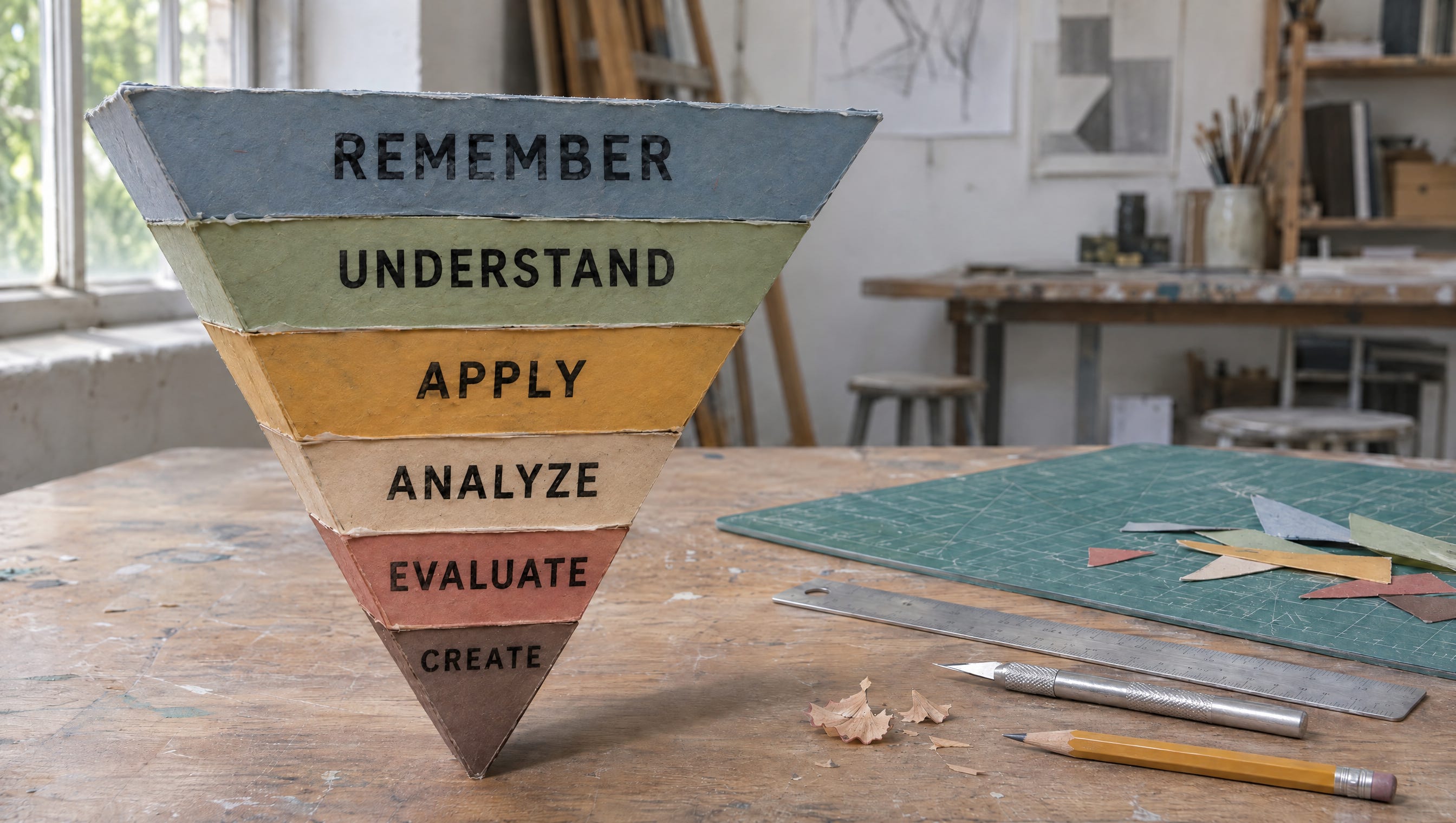
Most know Bloom’s taxonomy as a pyramid with remembering at the wide base. Above it come understanding, applying, analyzing, and evaluating, with creating at the narrow top. These six names come from the 2001 revision edited by Lorin Anderson and David Krathwohl, which updated the framework that Benjamin Bloom and his colleagues first published in 1956. For decades, that image has told us that students need to know things before they can make things.
Generative AI seems to have broken that logic. A student can now type one sentence and get an essay, a program, a design, or an analysis back in seconds, without having remembered or understood anything along the way. So if the top of the pyramid is available on demand, what is the base still for?
One answer that has been getting a lot of attention is to turn the whole thing upside down.
In May 2025, Michelle Kassorla, who teaches English and composition at Georgia State University’s Perimeter College, published a post called Inverted Bloom’s for the Age of AI. She argued that students now “CREATE FIRST, then understand later,” and that our teaching should start where they start. Since then, the idea has traveled through conference keynotes, podcasts, and Grammarly’s 2025–26 AI Trends Report.
My own reaction to the inverted pyramid is very mixed. I like that it starts from what students actually do with AI. But I also feel that something in the argument doesn’t quite add up. So in today’s post, I want to look at where the inverted pyramid comes from, what its critics have to say against it, and why I think the two sides are arguing about the wrong thing.
Create first, understand later
Kassorla’s post is much more modest than the graphic that made it famous. She describes how the idea for inverting the pyramid came out of a rushed conversation with her colleague Eugenia Novokshanova while the two were preparing a talk on critical thinking. She simply took a Bloom’s pyramid image from the University of Arkansas and turned it upside down. By her own account, she had flipped it before she had fully worked out what the flip actually meant.
The underlying model, which she worked out afterward, starts from a simple observation. Students now often begin by creating with AI. From there the learning process, she argues, runs backward through Bloom’s levels. The student evaluates the AI draft, analyzes the AI feedback, applies it in a revision, and comes to understand why the revision is better. Remembering comes last. This is what the student carries over to the next assignment.
With each step, the machine is supposed to do less and the student more.
In her contribution to the Grammarly report, Kassorla gives one quite compelling reason to ground our teaching in this model. The inverted taxonomy, she writes, can “prepare our students for careers in a world filled with AI.” Professionals rarely start from a blank page anymore, the argument goes, so students shouldn’t have to either. The AI draft becomes raw material, and the learning happens in what the student does with it.
Two more points come up whenever the model is discussed. One is about honesty. If starting with AI is part of the assignment, students have no reason to hide it, and teachers have nothing to uncover. The second point borrows the idea of productive friction. A flawed AI draft gives students something to disagree with, which, at least in theory, teaches them how to think critically.
I need to acknowledge that I find a good part of this quite convincing. Kassorla is describing what students already do. In The Candle People, I argued that educators have a duty to understand how this technology is really being used. Kassorla clearly does. And I also share her distrust of AI detection, as regular readers will know.
Not to mention that after a research career spent mostly on game-based learning, I am the last person to insist that knowledge has to come first and action later. In a good game, you act first and understand afterward.
But this is also where the trouble starts.
