

Yesterday Substack launched a button to detect AI-written posts. The button uses Pangram to scan your writing and determines how much of it was written by a human. You can use the button on posts and on notes, and even on the comment threads below them, as long as the text in the comment is over 100 words.
The response to this announcement has been instant. Some writers are thrilled that Substack has implemented this feature. They hope that Pangram will expose large amounts of low quality writing on the platform. Other writers see this for what it is: a very unreliable probabilistic guess at whether a piece of writing was or was not written by a human with the aid of AI.
I use AI assistance to write my articles and I disclose it at the end of each post. I’ve also written extensively about how I write and why I think AI detectors are a dead end. I therefore wanted to explain how one might get past this detector if they chose to do so.
A word about this post before I go further
To make my point I did not just draft this post with AI as I usually do. It was AI that wrote this post in its entirety. I gave Claude Opus 4.8 my writing instructions and then Claude generated every sentence for me. Additionally I ran the whole thing through a humanizer, undetectable.ai.
The result is that you are reading, most likely, rather poor writing. That is because humanizers take AI generated writing and deliberately mangle it to make it read more naturally. As a result the final text is often less clear and less well written than the original.
How to bypass AI detection
So, let’s say you’re a writer who uses AI but doesn’t want to reveal it to your readers. Personally, I wouldn’t recommend that. But let’s pretend for a moment that you have your reasons for not wanting to disclose your use of AI.
Keep your posts short. Pangram gets more accurate as the amount of text analyzed by the tool increases. For very short pieces of writing, accuracy declines rapidly.
Keep your notes under a hundred words. Below that length the tool has nothing to scan.
There are a couple of humanizers on the market that will tweak AI-generated prose to make it look more human, such as undetectable.ai. However, be aware that the end result is likely to be very poor prose that you will need to edit.
My mixed feelings about this
It’s possible that Substack is creating the fastest way for people to realize that these tools do not work. Readers will now be able to test out the detectors on their own by reading articles they know were written by a human and getting inaccurate results.
Conversely, they can test out obvious work generated by AI, like this one, and watch it get a 0% detection result. This will, hopefully, put an end to people putting stock in the number generated by these tools.
The right move as a writer is to disclose your AI use. Write an ethics statement and link it under everything you publish. Let the reader know what they are holding.
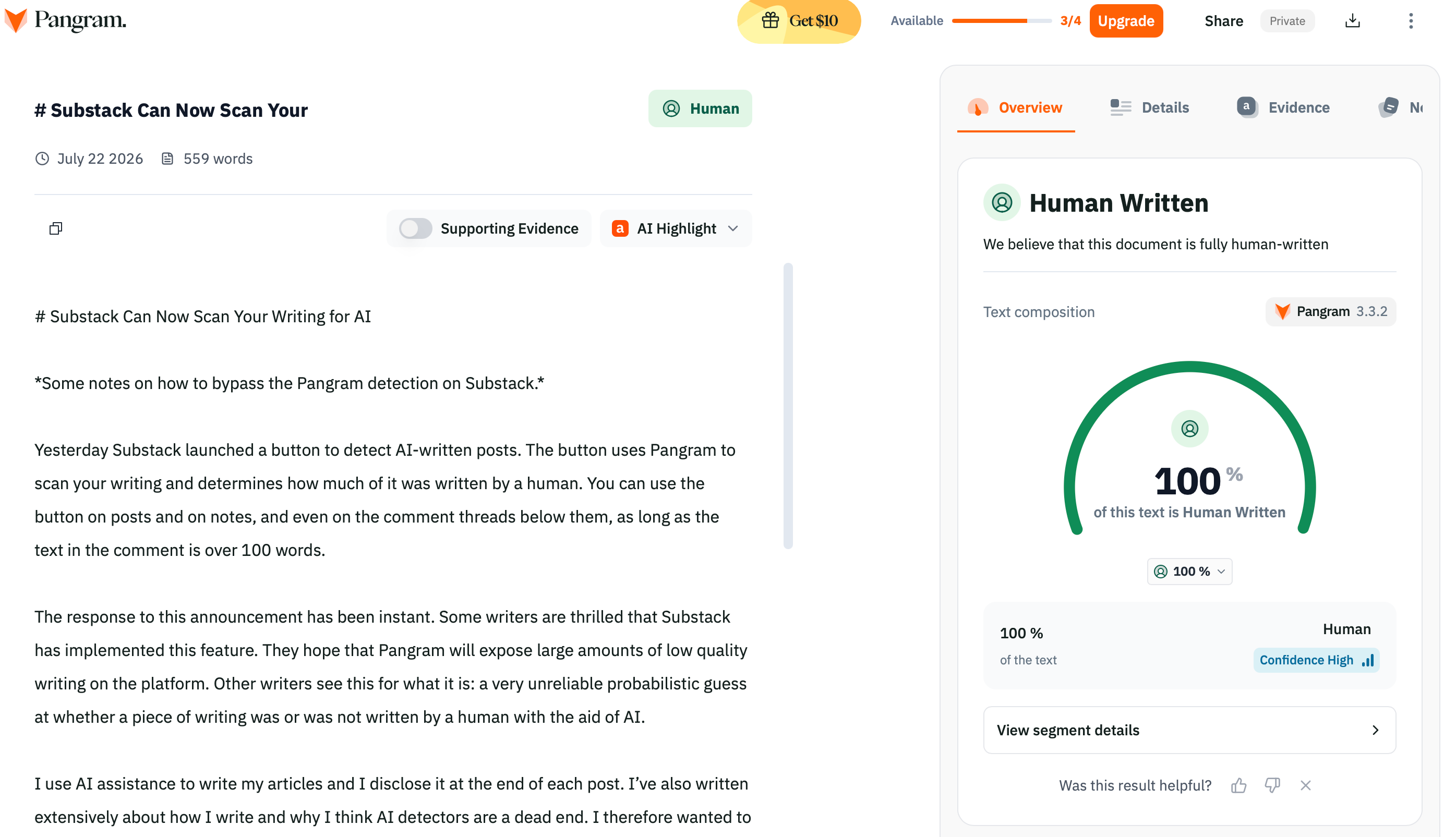
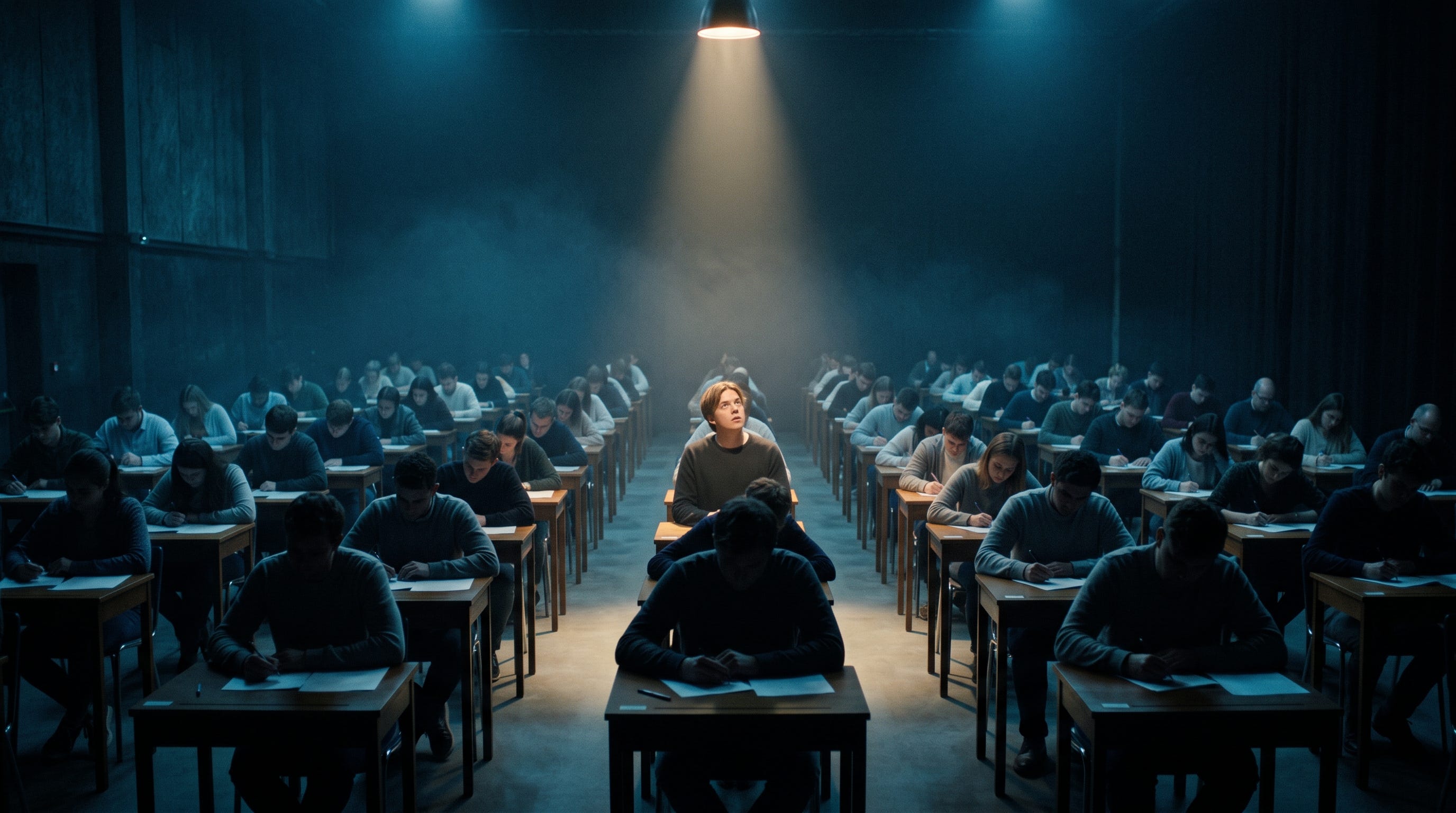
The hero image in this article was generated with Nano Banana 2. The screenshot shows the actual result when I ran this entire article through Pangram at the time I created it. The 100% human written result with high confidence is about as wrong as it can get.
P.S. I believe transparency builds the trust that AI detection systems fail to enforce. That’s why I’ve published an ethics and AI disclosure statement, which outlines how I integrate AI tools into my intellectual work.
Disclose it or not.
I don't care much if it is written with help of AI, completely by AI or by a person.
What interests me is simple: Is it good? Researched?
I take everytime good AI writing over bad human writing.
I am not talking about that: One prompt, one novel AI writing.
I am talking about AI writing where the human is always at the wheel, rejects, refines.
Grass is green,
sky is blue.
Clouds are white,
what else is new?