


Over the past few months, I’ve watched more and more colleagues quietly step back from AI. Not with a dramatic announcement, just with a shrug. The chatbot continues to write mediocre lesson plans. Students use AI to cheat. In general, the hype has cooled. The conclusion feels all too obvious to them. The technology has plateaued, the moment has passed, and their limited professional energy is better spent elsewhere.
I understand the impulse. And I fully acknowledge that the numbers seem to support that sentiment. Most organizations have now experimented with generative AI. And yet, a 2026 Gallup survey found that only about one in seven U.S. employees use it daily, and nearly half say they never use it at all. If that’s the reality after three years of relentless promotion, surely the revolution must have been oversold.
But this is where the mistake lies. Because that conclusion confuses the interface with the technology. The consumer-facing chatbot, the text box we all learned to use, has indeed largely stopped surprising us. But beneath that familiar interface, the technology is accelerating in ways most of us never get to see.
The thing is that we have been here before. Twenty-five years ago, in fact. And the last time we made this mistake, the people who checked out spent the next decade catching up.
The winter of 2000, when the internet died
On December 5, 2000, at the height of the dot-com collapse, the Daily Mail ran an article declaring the internet a passing fad.
This was not just tabloid provocation. The piece summarized findings from the Virtual Society project, an academic study spanning twenty-five European and American universities. Its director, Steve Woolgar, documented widespread user drop-off. Early web surfers had satisfied their curiosity, realized there was more to life offline, and abandoned their modems. His colleagues added that email, far from delivering the paperless office, had mostly delivered information overload.

At that time, the market agreed. Between March 2000 and October 2002, the Nasdaq lost roughly 77% of its value. Pets.com, Webvan, WorldCom, and Global Crossing, just to name a few, went under. To a reasonable observer in 2001, the digital economy looked like a collective delusion that had finally been exposed. It was a reasonable interpretation at that moment.
But as we know now, this was utterly wrong.
What the crash destroyed was the speculative valuation, and not the technology underneath it. The bubble’s real legacy was a massive, debt-financed overbuild of physical infrastructure consisting of millions of miles of fiber-optic cable, much of it laid after the Telecommunications Act of 1996. A lot of that cable then sat unused as “dark fiber” while the companies that laid it went bankrupt. That oversupply then drove the unit cost of bandwidth toward zero, carrying broadband into ordinary homes through the mid-2000s.
The effects were measurable. An econometric study of OECD countries, published in The Economic Journal, estimated that each ten-point rise in broadband penetration lifted annual per-capita GDP growth by roughly a percentage point. New technologies, including Web 2.0, e-commerce, streaming, and the cloud, were all built on infrastructure that was financed during the pre-crash mania and dismissed during the post-crash hangover.
Public disillusionment had peaked while the real transformation was still being built. It was just out of sight. The people who wrote off the web in 2001 were not wrong about 2001. They were wrong about the decade that followed.
The trough looks the same from the inside
Generative AI in 2025 and 2026 looks a lot like that moment. S&P Global Market Intelligence reports that the share of companies abandoning most of their AI initiatives more than doubled last year. An MIT initiative, Project NANDA, found that 95% of generative AI pilots failed to deliver measurable financial results. And the RAND Corporation, a nonprofit research organization, puts the failure rate at more than four in five projects, roughly double the rate for conventional IT.
The figures all seem to point in the same direction.
But if we look a little closer, we start to see a different story. Most failures appear to be organizational rather than failures of capability. Companies bought licenses without deciding what problem they were trying to solve. They deployed models on top of siloed, poorly governed data. And they ran impressive pilots, but assigned no one to own them afterward.
A field experiment led by Fabrizio Dell’Acqua showed that while generative AI produces large gains on tasks inside the model’s competence, it can produce negative results on tasks just outside it. This is a boundary the authors call the “jagged frontier.” Failure in AI deployment therefore tells us as much about the organization as it does about the tools being deployed.
Meanwhile, the infrastructure story mimics what happened with the early internet. Hyperscalers are projected to spend in access of $700 billion on data centers, GPU clusters, and energy in 2026, and skeptics reasonably ask when the returns will arrive.
But just as the fiber surplus collapsed the price of bandwidth, the compute buildout is driving down the cost of running capable models. A workload that cost about $60 per million tokens in late 2021 now runs for cents at comparable performance. And as the unit price fell, usage surged. Aggregate enterprise token use at OpenRouter reportedly grew more than fivefold within six months, to more than 25 trillion tokens per week.
25 trillion tokens per week and rising sharply. That is not what a plateau looks like.
The interface plateaued but the technology keeps going
So what is all that consumption used for, if not the chatbots we’ve all grown tired of?
It is going into agentic systems. Rather than waiting for a prompt, answering, and forgetting, an agent can take a broad objective, break it into steps, use tools across different applications, and keep working toward a result. A conventional chatbot answers one turn at a time. An agent can remember, act, and follow through across many steps without human intervention.
You can already see the shift wherever usage data is available. OpenAI reports that agentic workflows overtook conversational usage among its staff within a year, with core departments now generating most of their tokens through agents rather than chat. The shift is also changing internet infrastructure. Cloud providers are launching stateful runtimes for long-running agent workflows, and payment networks are designing “Know Your Agent” frameworks so that autonomous software can transact within regulated payment systems.

Peer-reviewed research studies point in the same general direction, though they don’t confirm those exact usage figures, and they usually measure AI-assisted work rather than autonomous agents.
Shakked Noy and Whitney Zhang, in a randomized experiment published in Science, found that participants completed professional writing tasks about 40% faster and produced better work while doing it. Erik Brynjolfsson and colleagues measured roughly a 15% increase in issues resolved per hour among customer-support agents. And three other field experiments conducted at software companies, published in Management Science, found developers completing about a quarter more tasks.
Taken together, the message is simple. AI is moving from novelty to an everyday tool. But it is doing so in enterprise back offices and developer terminals, well outside the view of an educator who mostly encounters AI through a free chatbot that feels the same as it did last year.
The fork in the road to 2030
If you take one idea from this article, it should be this one. The workforce outlook for 2030 describes a fork in the road, depending on whether people adapt as quickly as AI advances.
In one scenario, call it the age of displacement, technology outpaces workers. Businesses automate routine cognitive tasks to cut costs. The gains concentrate among a small group of specialists, and everyone else competes for a shrinking pool of narrow, task-based roles. In the second scenario, call it supercharged progress, adaptation keeps pace. Roles are redesigned rather than deleted, and professionals move from doing every task themselves to directing systems of agents.
Here is the uncomfortable part. The direction of the economy is beyond people’s control. They can, however, select how they prepare for it. A professional who disconnects now risks preparing only for the displacement scenario. The internet skeptics of 2001 had a plausible excuse for this move, because back then the evidence was still ambiguous. Today, the direction of AI development is clearer, even if the timing is not.
But what does preparation actually mean? The research points to a specific set of skills. Work published in Patterns by Zhicheng Lin and colleagues identifies three meta-skills that shape whether AI improves or degrades professional work: setting direction, judging quality, and checking the machine’s output.
A related 2026 study finds that such “AI interaction competence” predicts productivity gains better than domain knowledge. You could also call this the agent orchestration skill. That skill doesn’t outsource thinking. It delegates execution to the agents but keeps judgment with the humans.
There is one caveat. A 2026 paper introduced the idea of an “augmentation trap.” Early gains encourage adoption, while long-term passive use can erode the expertise that made those gains possible. But orchestration only works when people keep exercising the underlying AI interaction competence. There is no version of this in which you engage once, feel competent, and then just coast.

Restricting AI is not the same as ignoring it
To be clear, my argument isn’t for implementing AI in every classroom. A teacher may have excellent reasons to restrict AI in a particular course, and I’ve laid out several of them in earlier essays, including what the research on metacognitive laziness and cognitive outsourcing shows about unguided use.
What I’m arguing is that restricting a tool in your classroom and disconnecting from the technology in your professional life are entirely different decisions. The first can be sound pedagogy. But the second assumes that because the utility of the chatbot did not improve, the technology has stopped developing underneath it.
That assumption is dangerous.
Our students will graduate into an economy being rewired inside data centers and enterprise systems we will never see from a chat window. Whether we use AI on a Monday morning matters far less than whether we understand it well enough to prepare our students for how it might influence their future.
We need to design assessments that still require learning and teach the judgment and verification skills our students will need. That understanding requires significant AI interaction competence upkeep. And it has to be renewed continuously because the technology won’t pause while we catch our breath.
In 2001, the internet didn’t need anyone’s belief to keep being built. AI today doesn’t need ours either. Disconnection changes nothing about what is coming. It only changes who is ready when it arrives.
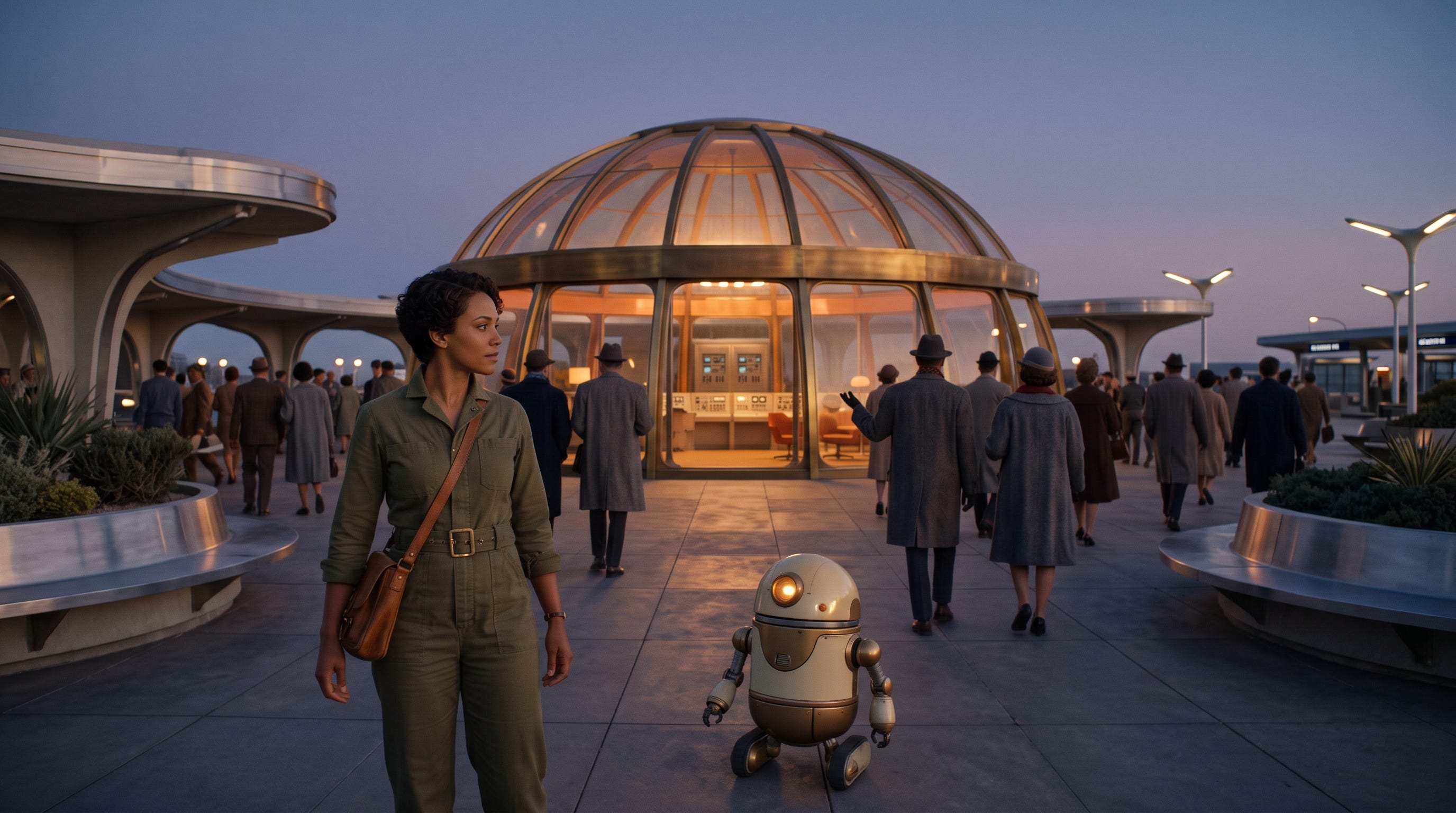
The images in this article were generated with Nano Banana 2.
If you’d like to go further, the following NotebookLM-generated audio deep dive goes beyond the post into the broader research behind it, drawing on the sources and notes I gathered along the way. This is meant as a companion to the argument, offered as an optional extra rather than a summary of it.
P.S. I believe transparency builds the trust that AI detection systems fail to enforce. That’s why I’ve published an ethics and AI disclosure statement, which outlines how I integrate AI tools into my intellectual work.