

If your feeds look anything like mine, they are full of things that feel slightly wrong. A mountain goat carries its kid up a sheer cliff, then glides through open air like a character in a video game. A child stands beside countless dog shelters built entirely out of plastic bottles. Or a crafts video that runs a little too smoothly, a little too perfect to be real.
There is a reason these clips feel off. They are. They were generated by AI, and although many of them sit on a kernel of something true, they show events that never happened.
I believe this flood of AI fakes deserves more of our attention than almost anything else on an educator’s plate right now. For me, this synthetic flood is, at its core, a story about how human minds work. It points to a weakness in our thinking that predates every image generator by a wide margin. Generative AI works like a mirror, and the uncomfortable thing about a mirror is that it only shows you what is already there.
But before we get to why we fall for it, it is worth seeing just how much of this is out there, and how strange it gets.
A catalogue of small forgeries
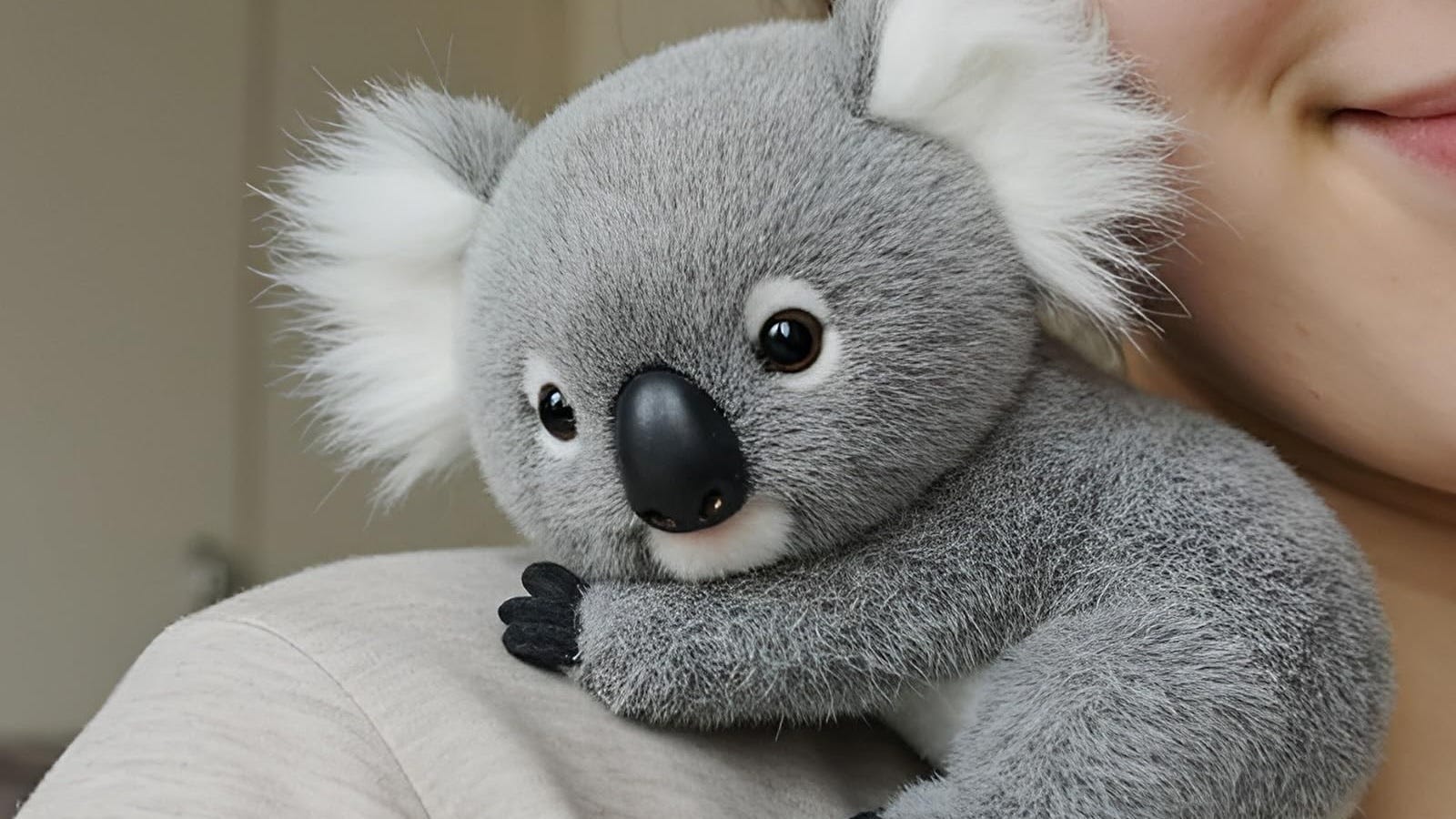
Let’s start with fake merchandise. Over the past year, social platforms have been saturated with ads for AI plush toys. Two of them, sold as Koaly and Pandy, promise something close to a living animal: a koala that breathes against your chest, a panda that hugs you back through patented “Hug Motion” or “CuddleMotion” technology.
The ad videos are enticing. The fur catches the light, the toy blinks and shifts its weight, and a wall of five-star reviews confirms the magic. But the plush that shows up in the mail is just a cheap stuffed animal worth only a few dollars, with nothing inside. The robotics that were promised never existed.
I don’t think the buyers of these toys are irrational. They are working from a reasonable premise: artificial intelligence is indeed advancing quickly, so a low-cost robotic toy seems plausible enough. The ad simply leverages the credibility of genuine progress to sell a product that does not work the way it is advertised.
Then there are stories about the incredible feats of wildlife. A whole genre of clips shows mountain goats running up vertical rock faces and then sailing through the air with a kid on their back. Posted by automated accounts, they routinely pull in millions of views.
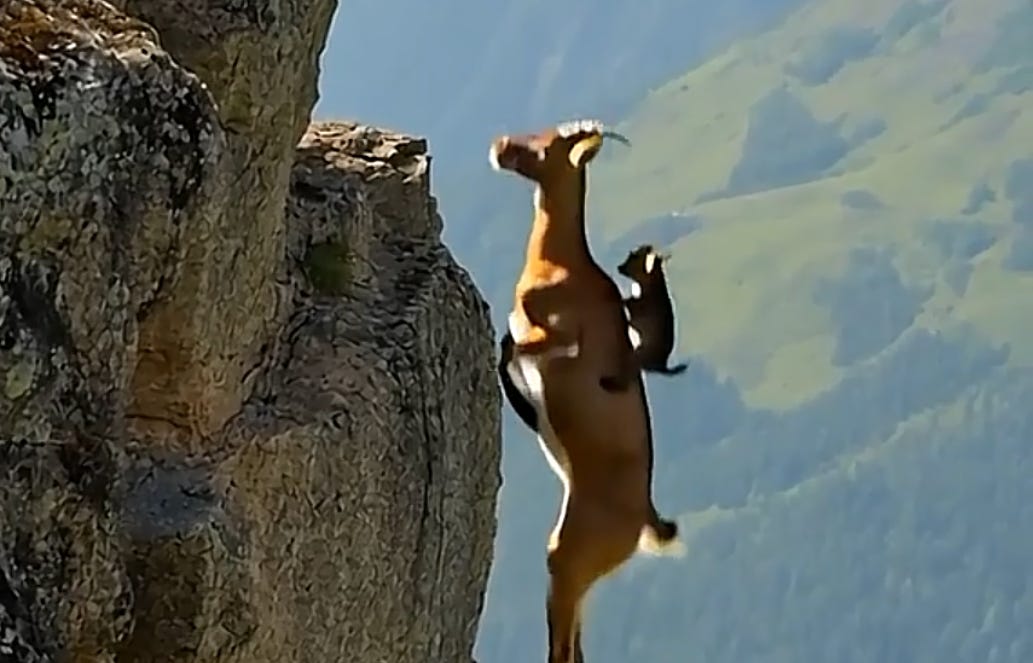
The giveaways are everywhere once you look closer: herds moving in perfect unison, or a goat staring straight into a camera that could not have been placed where it was. And the headline feat is plainly impossible. No goat glides through open air. Nor do mountain goats carry their kids around on their backs. The young are up and managing the terrain on their own legs within days of birth.
But everybody knows that mountain goats really are astonishing climbers, biologically built for near-vertical terrain. So when a skeptic flags the footage as fake, defenders cite that actual ability as proof the video is real. A true fact about the animal is used to wave away an obvious forgery.
Other fakes pull the same trick by trading on a feeling of wholesomeness. You might have seen the images: a young boy standing proudly beside an elaborate dog shelter or a life-sized statue of Jesus, every piece built from recycled plastic bottles. The captions are formulaic. “My son made this with his own hands.” And the comment sections are filled with thousands of earnest blessings.
It has to be true. Who would lie about a little boy or Jesus?
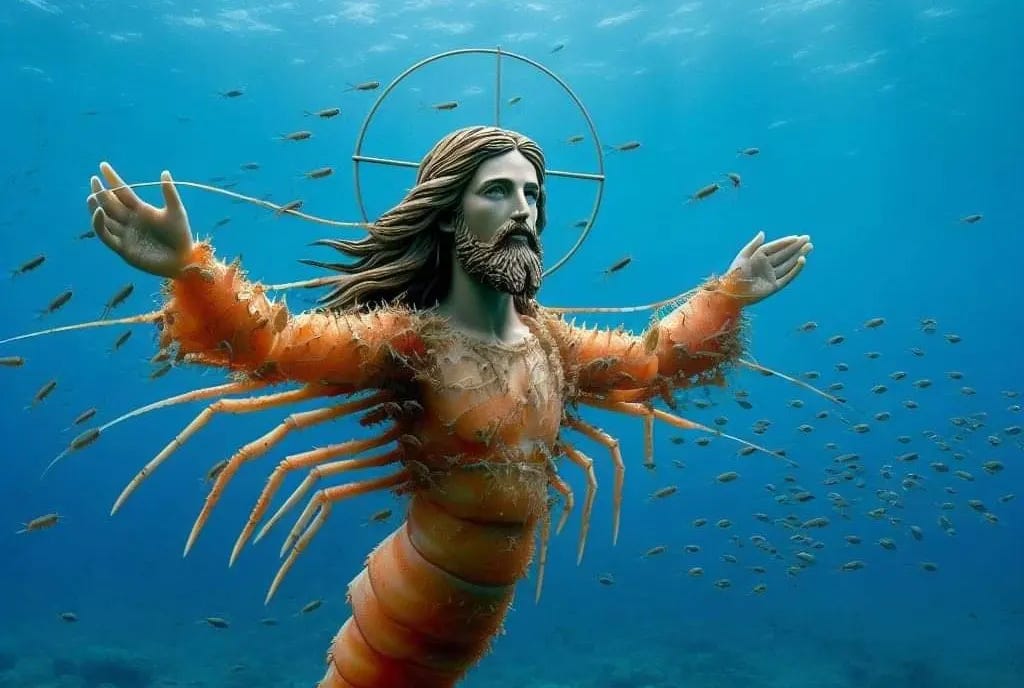
The strangest branch of the genre is the so-called Shrimp Jesus, AI-generated images of Christ fused with shrimp and other shellfish, posted to harvest engagement from the devout and the amused alike. Researchers from the Stanford Internet Observatory have found that these pages generate income from engagement by steering gullible audiences towards ad-filled click farms and phishing websites.
When a true story wears a fake face
The forgeries get harder to catch when they borrow a true event to vouch for themselves. In 2004, a British swimmer named Rob Howes was in the water off New Zealand with his daughter when a pod of dolphins encircled them and held a tight formation for roughly forty minutes, fending off a great white shark. The event is real and well-documented. The Guardian reported on it at the time.

What is new is the wave of AI images now circulating as “actual footage” of that day. They show a neat ring of undersized dolphins around a man standing calmly in waist-deep water, with a cartoonish shark fin pasted into the background. The flaws of these images are quite obvious. Yet when people point them out, many respond that the rescue genuinely happened, so the picture must be genuine too.
The truth of the story becomes a shield for the falseness of the image.
The category that worries me most is the one where the purpose of these fakes is political gain. During the aftermath of Hurricane Helene, an image swept across every platform: a small girl in a boat amid the floodwaters, crying, clutching a puppy. It was weaponized to attack the federal disaster response, attached to a false claim that FEMA had capped disaster aid.
Forensic analysts identified it as synthetic almost immediately. The girl has four fingers and a missing knuckle. The boat melts into the water and the light on her vest disobeys physics. But none of that mattered to the people sharing it. Told that the image was fake, they often answered that it expressed a “symbolic truth,” and that the literal facts were beside the point.
At that point, people are no longer being fooled. They are choosing to ignore the truth.

The machine likes what we already like
None of this misinformation would spread without a delivery system built to promote it. The main issue is that the modern social media feed is no longer a record of what your family and friends posted. It is driven by an engine tuned to predict what will hold your attention. And it increasingly fills your screen with material from accounts you have never heard of.
And because the algorithm rewards engagement over accuracy, it promotes exactly the imagery that spreads easily: the hyper-real and the emotionally loud. Offshore operators run entire clusters of pages, churning out countless images a day, then sell the resulting audiences to advertisers and scammers. This environment is hostile to thinking by design. It rewards the reflex and starves the reflective pause.
Why the eye forgives the forgery
The research is unfortunately not reassuring. A 2024 meta-analysis pooling fifty-six studies and more than eighty-six thousand participants found that human accuracy at spotting deepfakes sits around fifty-five percent, barely better than a coin toss. The most troubling finding concerns confidence. The people who perform worst tend to be the surest of themselves, which means the least capable detectors are often the most enthusiastic sharers.
Why do we fail so reliably? The reason is evolutionary. Our brains handle a busy scene by grabbing its gist, the quick, rough summary of what it means, then discarding the finer details to save effort. This is known as gist-based processing. Scroll past a crying child or a puppy in a flood, and your mind locks onto the tragedy long before it would ever think to count fingers or paws.

Psychologists call the result inattentional blindness. This is the same mechanism behind the famous experiment in which viewers asked to count basketball passes fail to notice a person in a gorilla suit stroll through the middle of the game. Attention spent on the story is attention unavailable for the anomaly.
Two forces deepen the problem. For one, we carry an old realism heuristic, a reflex to trust what we see more readily than what we read. This has been shaped over a long history where a clear image was powerful proof of something real. And intense emotion then makes it worse still. When an image is engineered to enrage you or to break your heart, it has already done most of the work of slipping past your intellectual guard.
We were never that careful
The capabilities of generative AI are genuinely new and impressive. The realism is unprecedented, and the cost of creating AI deepfakes has collapsed to almost nothing. A single operator can flood a platform with thousands of convincing images for the price of an afternoon. These tools have widened the scope of what a scammer can do, by a wide margin.
And yet. The thing they exploit is not new at all. The susceptibility was always there. You can see it in the tabloid empires built on impossible headlines and in the urban legends forwarded by chain emails. The public was never one of careful analysts who suddenly went soft. What AI contributes is only the level of fidelity.
I keep coming back to an argument I have made on this blog more than once. Our instinct is to locate the problem in the machine because the machine is the easiest thing to point at. But in reality, the harder truth sits one layer down, inside us.
Teaching the pause
If the vulnerability is human, then the response has to be educational, and it has to be more targeted than the advice we have traditionally been handing out. “Check your sources” is close to useless when the sources are themselves synthetic content farms. And telling students to look for six fingers is a losing game against models that fixed the hands months ago. The detection arms race is one we cannot win by spotting artifacts, because the artifacts keep disappearing.
What helps is teaching the psychology underneath the failure. Students who grasp how gist-based processing blinds them to small details, and who learn to feel their own emotional reflexes being worked, do measurably better at catching fakes.
Current research lines up here. An analytical habit and awareness of one’s own biases both track closely with the ability to detect synthetic media. It also helps to teach the most uncomfortable lesson, which is that our own confidence is the least trustworthy instrument we own.
The most useful classroom move is also the simplest. Put a viral image on the screen and rephrase the question it poses. Our instinct is to ask whether it is real. But the better question is who made it and why. Who profits if you believe it, and who profits even if you only react? Once a student sees that the plastic-bottle boy exists to farm a blessing that converts into ad revenue, the picture loses its emotional relevance.

The test we keep failing
There is a simple test psychologists use to gauge self-awareness. Put an animal in front of a mirror and watch whether it recognizes the reflection as itself. Many never do. They treat the image as a stranger, something to greet or chase off.
Faced with the synthetic flood, a lot of us are failing the same test. We look at the reflection of our own gullibility and see anything but ourselves. We see a scammer in another country or a deceptive new technology. Both of those are real. But neither is the thing in the mirror.
So I keep circling the same question, and I will leave it with you rather than pretend it is settled. Is the machine actually making us worse at thinking? Or has it simply held up a mirror to how we were thinking all along? I lean toward the second. And I find that oddly hopeful, because a weakness you can see is a weakness you can teach against.
All images in this article are AI generated and were advertised as being real (with the exception of Shrimp Jesus, maybe).
P.S. I believe transparency builds the trust that AI detection systems fail to enforce. That’s why I’ve published an ethics and AI disclosure statement, which outlines how I integrate AI tools into my intellectual work.