

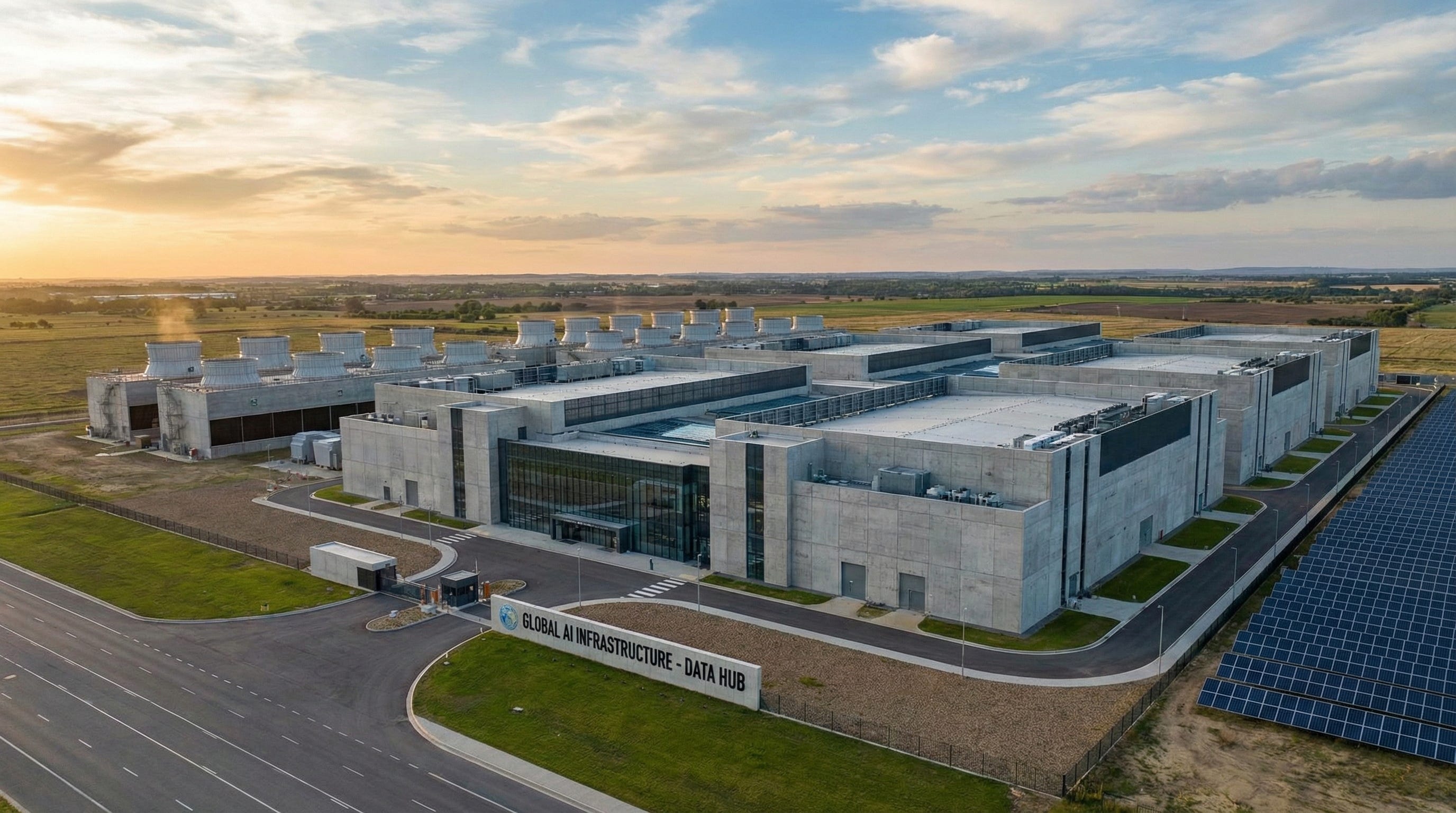
I’ve spent much of the past few months watching two AI trends diverge. On one hand, technology providers are breaking ground on massive new data centers. These are facilities that could consume as much electricity as a mid-sized city, enough that some regions are discussing restarting nuclear plants to meet demand. On the other hand, my students’ laptops are quietly gaining the ability to run AI assistants locally, without ever pinging a server.
The scale of the first trend is staggering. The five largest hyperscalers—Amazon, Microsoft, Google, Meta, and Oracle—are projected to spend over $600 billion in 2026, with roughly three-quarters allocated to AI infrastructure. Some analysts have compared this investment, as a percentage of GDP, to the Apollo program or the Interstate Highway System.
But here’s what keeps nagging at me: all of this construction assumes demand for cloud-based AI computation will continue expanding. If a substantial share of AI workloads is instead migrating to the devices people already own, then the infrastructure being financed today may systematically overshoot what the cloud actually needs.
This isn’t merely an investor’s concern. For educators, the question of where AI computation happens has real implications for access, privacy, equity, and how we design learning experiences. If intelligence increasingly lives inside the devices students carry, our policies, budgets, and pedagogical strategies will need to shift accordingly.
The following is an attempt to work through what we know, what remains uncertain, and what educators should watch for.
The Scale of the Bet and the Story Justifying It
What distinguishes this wave of construction is that these aren’t conventional data centers designed for diverse cloud workloads. Industry observers have called them “AI factories”: facilities purpose-built around dense GPU clusters, precision liquid-cooling systems, and the massive power-delivery infrastructure required to run them. The logic driving this construction assumes that artificial general intelligence is imminent, that computing capacity is the new strategic resource, and that whoever accumulates the most compute will dominate the next economic era.
To many, the financing structure underlying this build-out seems problematic. Historically, technology giants funded expansion through their prodigious free cash flow. But the velocity of current spending has outstripped even the most robust cash engines. Hyperscalers raised over $108 billion in debt in 2025 alone, with projections suggesting the sector may issue up to $1.5 trillion in new debt over the coming years. A growing portion of this liability is being channeled through special-purpose vehicles and joint ventures that keep capital expenditure off primary balance sheets while preserving long-term lease obligations.
Another concerning trend in this build-out is “circular financing.” A substantial portion of the revenue reported by AI cloud providers comes from AI startups that are themselves heavily funded by the hyperscalers. The investment flows in a loop: a hyperscaler invests in an AI company, which uses those funds to purchase compute from the hyperscaler.
The risk is that this loop can make demand look healthier than it actually is, because revenue is partly funded by the same players booking it. And unlike the telecom bubble, where buyers and suppliers were distinct entities, the current cycle involves a closed loop of vendor-financed consumption that can mask the true level of organic demand.
The Workload Shift That Complicates the Picture
To determine whether these facilities represent a sound investment or an overreach, we need to examine what workloads they’re designed to support. The prevailing narrative so far has been straightforward: training giant AI models requires massive, centralized clusters, while inference—actually running the models—is computationally lighter and can easily be distributed. But the technical basis for this assumption might be changing.
Throughout 2023 and 2024, the bulk of AI compute demand stemmed from training foundation models. These workloads require massive parallelism and ultra-fast interconnects to synchronize gradient updates across thousands of GPUs. However, market analyses indicate that inference is rapidly overtaking training as the primary cost driver, with some projections suggesting that inference will account for the large majority of compute costs by the end of 2026.
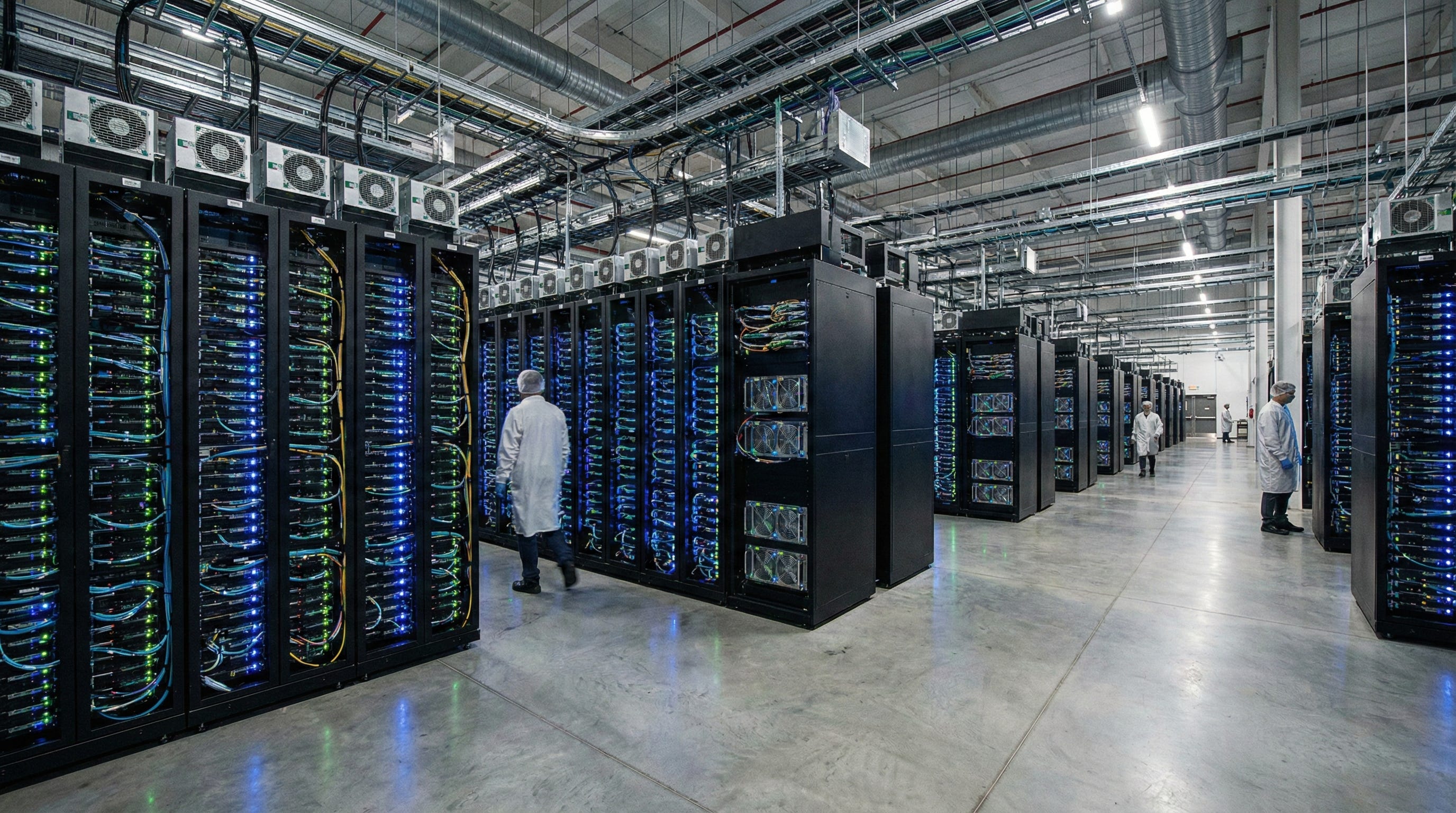
This distinction is important because training and inference require different infrastructure profiles. Training demands high-bandwidth memory and ultra-fast networking; inference traditionally prioritizes memory throughput and availability over cluster-wide synchronization. If hyperscalers are constructing “training-class” facilities—which are significantly more expensive because of specialized networking equipment—for workloads that will predominantly be inference, they may be systematically misallocating capital.
Reasoning-oriented models complicate this picture further. Starting with OpenAI’s o1 and o3 series, AI systems introduced what researchers call “test-time compute.” Unlike standard language models that generate tokens in a single forward pass, reasoning models can spend significantly more compute at inference time: generating intermediate work, exploring alternatives, and refining outputs before responding. The practical consequence is that “inference” for some applications can look much more like high-intensity compute and not a lightweight afterthought.
A complex reasoning query might consume a hundred times the compute of a standard prompt. This appears to validate the need for high-performance clusters even for inference. And if the future of AI is indeed “agentic,” where autonomous systems perform multi-step workflows requiring continuous reasoning, demand for inference compute could theoretically consume every watt of power currently under construction.
Why Inference Keeps Drifting Toward the Edge
The scenario I’ve just described, where reasoning and agentic workloads absorb every available data center watt, represents one future. It is the one hyperscalers bet on. But current market trends also suggest another possible future. Projections indicate that by 2026, a substantial majority of inference could happen locally on devices—smartphones, laptops, and enterprise edge servers—rather than in the cloud.
The driving force behind this development is basic economics. Cloud inference is an operating expense that scales linearly with usage; every API call costs money. Local inference uses hardware that the consumer has already purchased. Once a user owns a device with a neural processing unit, AI inference runs at a much lower marginal cost.
Rapid advancements in model compression, including distillation and quantization, have enabled this shift. As a result, the performance gap between massive models and small, efficient ones is increasingly narrowing. Models from Microsoft, Google, and Meta can now run on consumer hardware with sufficient efficacy for routine tasks. And the economics favor local processing for anything that’s high-frequency, latency-sensitive, or privacy-critical.
What’s emerging is a tiered architecture of intelligence. On-device processing handles the vast majority of daily tasks: summarization, basic coding assistance, email drafting, or interface navigation. These require instant response times and often involve sensitive data, making the round-trip to a distant data center impractical and even problematic. The cloud reserves capacity for genuinely heavy lifting: complex reasoning, scientific simulations, and the long-horizon planning that reasoning models enable.
This bifurcation creates a challenge for the current build-out. If the high-volume, routine traffic that hyperscalers are banking on migrates to users’ devices, utilization rates for new facilities could fall well below projections. It would mean that the massive infrastructure is being built for the fraction of hard problems that genuinely require centralized compute, while most daily tasks migrate into the user’s pocket.

So Is Hyperscaling Wrong, or Just Mistimed?
Looking at these developments, I think there is a substantial disconnect between present construction activities and potential future demands. Several structural vulnerabilities stand out to me.
Utilization risk: If a large share of high-volume inference moves to edge devices, centralized facilities may face an “air pocket” where projected demand never materializes.
Revenue gap: Infrastructure spending has raced ahead of demonstrated enterprise value. According to industry surveys, the large majority of generative AI pilots in enterprises struggle to show tangible value or reach production deployment. The “pilot purgatory” phenomenon, where organizations experiment endlessly without scaling, suggests that the expected flood of enterprise revenue may arrive more slowly than balance sheets can tolerate.
Stranded power: In key data center hubs, lead times for new high-voltage transmission lines have extended to 2029-2030. Developers are constructing facilities in locations where power availability is promised but not guaranteed. The nuclear renaissance that Big Tech is pursuing—restarting plants, or investing in small modular reactors—also faces a timeline mismatch. Commercial deployment of next-generation nuclear at scale isn’t realistic before the mid-2030s. The data centers are being built now, but the clean power to run them won’t be ready for years.
Depreciation mismatch: Hyperscalers are capitalizing GPUs as long-term assets, typically depreciating them over five to six years. But the innovation cycle for AI hardware has compressed to 12 to 18 months. If the economic life of a GPU is actually three years while companies book it as six, earnings are being artificially inflated, creating a risk for a “write-down supercycle” when reality catches up with accounting.
But I think there’s also reason to believe the opposite could occur: as the efficiency of producing intelligence improves, demand may increase so dramatically that total resource consumption rises rather than falls. This is the digital version of the Jevons Paradox—the nineteenth-century observation that efficiency gains in coal use increased rather than decreased total coal consumption.
If reasoning models and agentic systems become widespread, inference demand could balloon to levels that absorb every watt currently under construction. And beyond commercial dynamics, AI infrastructure has been securitized as a strategic national asset. Governments view compute capacity as a non-negotiable component of economic and military power. Even if commercial returns disappoint, sovereign AI initiatives and defense applications could place a floor under demand.
What This Means for Educators
For those of us in education, following infrastructure trends might seem like an odd priority. But where computation happens shapes what tools our students can access, what data leaves their devices, and what institutional choices we face.
Procurement and budgeting: Cloud AI represents a recurring operational expense that scales with usage. Edge AI converts that expense into device capital expenditure. Schools may find themselves pressured to “buy capability upfront” through newer devices rather than paying per-token later, and this would shift budget conversations from software subscriptions toward hardware refresh cycles.
Equity as a hardware problem: If capable AI becomes a device feature rather than a cloud service, access gaps become hardware gaps. A student with a recent laptop containing a neural processing unit has a fundamentally different experience than one using older equipment. This isn’t merely a connectivity issue; it’s a question of whether the intelligence is physically present on the machine.
Privacy and governance: Edge inference can reduce the need to send student data to third-party clouds. But operating system-level AI features still raise questions about logging, telemetry, and vendor terms of service. The data may not leave the device, but the device itself becomes a more complex policy object.
Assessment design: If AI works offline, enforcement systems premised on blocking websites or monitoring network traffic lose much of their power because a student’s laptop can autonomously solve assignments with no detectable network activity. As I have argued many times on The Augmented Educator, the durable response lies in assessment approaches that value process, revision history, oral defense, and situated performance.
What strikes me is how this infrastructure question connects to the broader project of AI literacy. Students should understand not just what AI can do but where the computation happens, what data leaves their device, and the energy tradeoffs involved when a model “thinks harder.” The tiered intelligence model—edge for routine tasks, cloud for complex reasoning—offers a conceptual framework that students can use to make informed choices about their own tool use.

Planning for Hybrid Reality
To return to the question I posed at the outset: is today’s data center hyperscaling a problematic bet? The honest answer is that it could be, and the evidence points to several reasons. But it may not collapse in the way bubbles typically do. Reasoning models and agentic systems could generate demand that absorbs the capacity. And governments may treat compute as strategic infrastructure worth subsidizing, regardless of commercial return. The outcome may be less a dramatic crash than a slow revaluation, where facilities built for one purpose get repurposed for another.
For educators, the practical imperative is to plan for a hybrid reality: some intelligence as a device feature, some as a paid service, and both reshaping how we teach students to think and demonstrate their thinking. The infrastructure paradox may resolve in ways none of us can predict. What we can do is stay attentive to where the workloads actually go, and adjust our policies, budgets, and pedagogies accordingly.
Artificial intelligence is coming closer to students, and our task is to ensure that proximity serves learning rather than undermining it.
The images in this article were generated with Nano Banana Pro.
P.S. I believe transparency builds the trust that AI detection systems fail to enforce. That’s why I’ve published an ethics and AI disclosure statement, which outlines how I integrate AI tools into my intellectual work.