


Regular readers probably know that I spend a lot of time on YouTube, partly because I run a channel of my own. Over the last few years, YouTube has also become the place where I get most of my news about AI. And every now and then, a video from well outside education ends up shaping a post here as well.
That is how a video by the Genetically Modified Skeptic turned into my post on AI religion, and how Noraly Schoenmaker’s motorcycle travels on Itchy Boots turned into a post about why we name our tools.
Today’s post is another one of those. This time the video comes from a cardiologist. Dr. Rohin Francis works in Britain’s National Health Service and runs the Medlife Crisis channel, where he explains medicine carefully and with the timing of a stand-up comedian. (He also does stand-up, so the timing is no accident.)
In AI WILL replace doctors, and here’s why, he criticizes his own profession for organizing more and more of its work around exactly the tasks AI does best, like ordering tests by protocol and ticking boxes on forms. Doctors who practice that way, he says, are making themselves easy to replace. His advice to colleagues who want to keep their jobs is simple: “Talk to your patients.”
What I found fascinating is that if you swap “doctor” for “teacher” and “patient” for “student,” most of the video still makes sense. In fact, I recognized several of my own arguments in it. And his core advice is the same one I have been giving educators on this Substack for quite a while now: “Talk to your students.”
Francis frames that advice as the main thing that keeps a doctor from being replaced by AI. In teaching, talking to students does even more than that. It is how a teacher finds out what a student understands, and it is also one of the ways the student comes to understand it in the first place. Apart from that, though, Francis’s advice carries over to teaching remarkably well. That is why, in today’s post, I want to put Francis’s arguments next to mine and see how far the comparison goes.
Taking a history
So what does talking to your patients look like in practice? For Francis, it starts with what doctors call the history, where a doctor hears the patient’s story before deciding which tests, if any, to order.
To show what a good history can tell you, he describes two patients who blacked out. One is a 22-year-old barista who collapsed after standing for hours on a hot day without eating. The other is a 72-year-old woman who suddenly pitched forward in church and has no memory of what happened.
Since both events are over, no test can really show what happened to either of them. But their stories make it pretty clear which one needs more attention. And he makes a similar point about test results. A shadow on a chest scan means one thing in a smoker with a cough and something quite different in someone with no symptoms at all.
Teaching works much the same way. An identical piece of work can mean very different things depending on who produced it. Take a student who asks a chatbot for a summary. If she has already read the text and formed her own judgment, the summary is just a convenience. If she hasn’t, it is a way around the reading.
And nothing in the prompt tells you which of the two you are looking at. That is why the same tool can lead one student to understanding and another to a polished result with nothing behind it. The difference comes from what each student brought to the work, and in most cases a teacher only finds that out by asking.
Cybernetics has a theorem that describes this situation quite well. In 1970, Roger Conant and W. Ross Ashby showed that a regulator, meaning anything that steers a system toward a goal, can only be as good as its model of the system it regulates. They were thinking about control systems, so applying their result to teaching is only an analogy. But it is a useful one. A teacher who knows very little about how a student works has very little to go on when deciding whether, when and how to step in.
In my own classroom, the way I apply this way of thinking is simple. Before anything is graded, I ask students how they used AI, with no threat attached. Those conversations only work when the possibility of an academic integrity case is off the table. But once that threat is gone, those conversations tell me more about how students think than any AI detector ever has.
And those conversations help the student, too. When you have to explain an idea to someone who keeps asking questions, you often discover gaps you hadn’t noticed before. That is the illusion of explanatory depth being exposed. Putting an idea into your own words is also one of the six steps in the translation cycle I proposed for working with AI. So a good conversation about a piece of work helps the student learn as much as it helps the teacher understand.
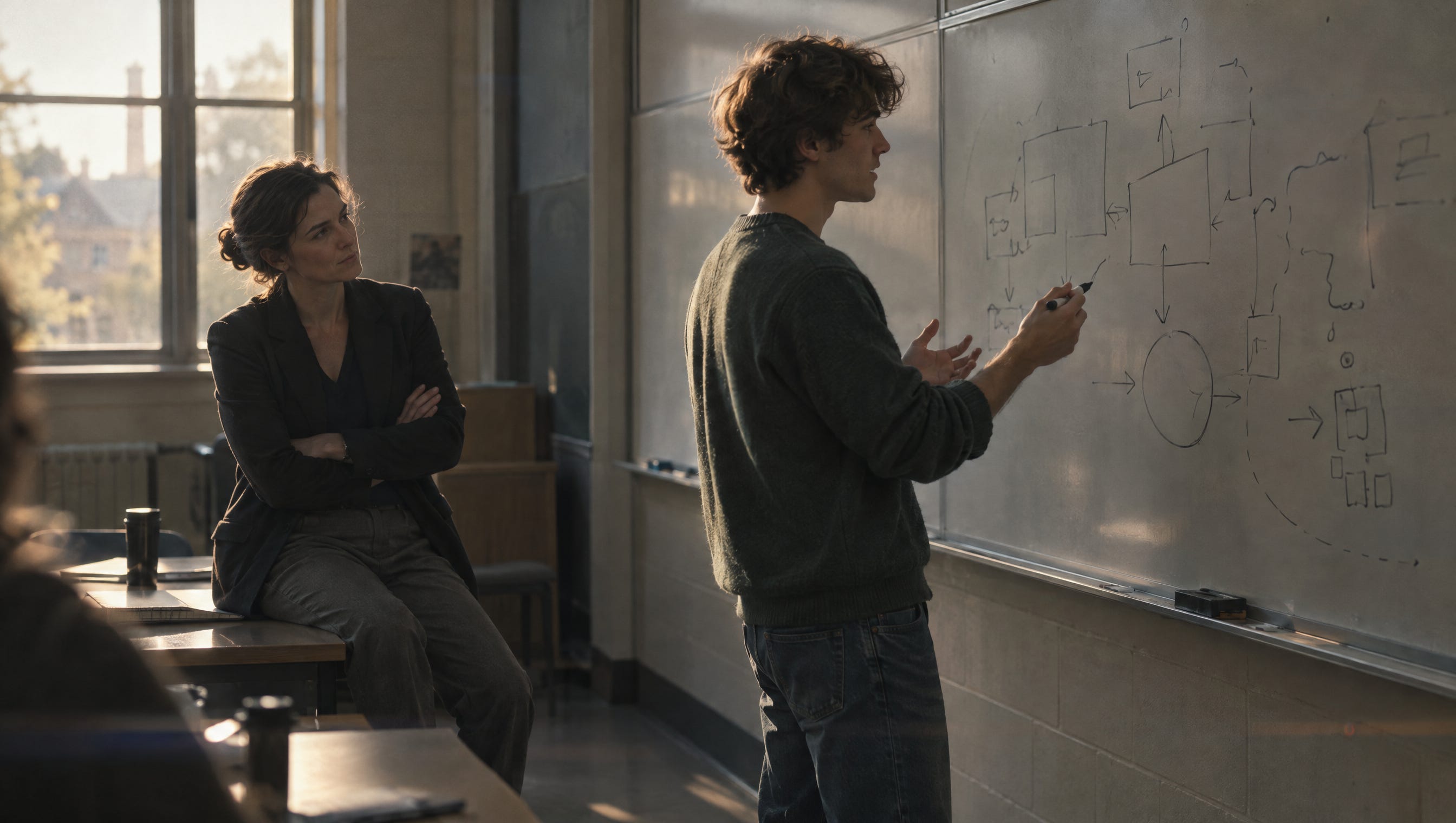
None of this means these conversations have to turn into oral exams, which would only favor a different group of students. A whiteboard defense suits some, while others explain themselves better in writing, or after they have had some time to think. A conversation can happen in any of those forms, and none of them requires anyone to guess who typed what.
The full-body scan for essays
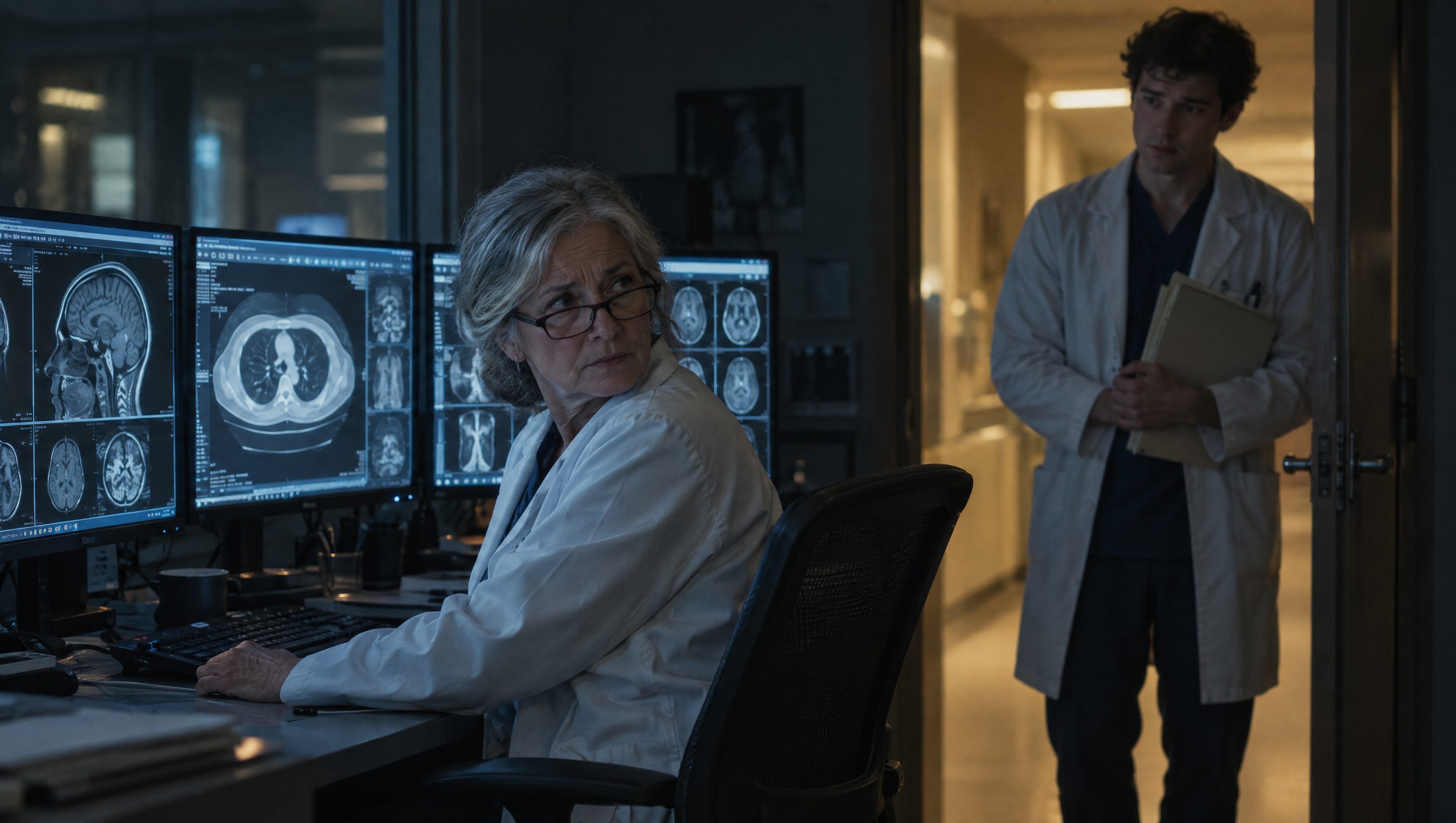
Francis believes medicine has taught the public to equate completeness with care. In other words, a good doctor orders every test, just in case. He points to an audit of several UK hospitals that found 26 percent of patients discharged from the emergency department had received a CT scan. For Francis, that is far too many.
His case against testing everyone just in case rests on the fact that every medical test is probabilistic. He illustrates this with a prenatal screening test for Down syndrome that is advertised as 99 percent accurate. But because Down syndrome is rare in many of the pregnancies being screened, a positive result can still be wrong surprisingly often. How often depends heavily on who is being tested. The headline number simply hides that.
Schools have their own version of that full-body scan. It is the habit of running every essay through an AI detector, whether or not anything about it seemed off. In There Is Only One Dial, I made essentially the same argument against it that Francis makes against over-testing. Human and machine writing overlap, so every school has to choose between catching more AI text and wrongly flagging more honest students. Better engineering can shift that trade-off around, but it can’t make it go away.
Both professions even share the same disclaimer. The outsourced radiology reports Francis describes run to four pages of hedging and then end by recommending “clinical correlation,” which hands the decision back to the doctor. Detection vendors do something very similar when they warn that their scores can’t be used as proof of misconduct, which hands the decision right back to the teacher.
Either way, whoever produced the number takes no responsibility, and the doctor or teacher is left to make sense of it. And because testing everyone just in case produces more wrong results, it is the people being tested who end up paying for it: the healthy patient sent on to an invasive procedure, or the honest student called in to explain an essay they wrote themselves.
One flag leads to another
A single result can set a lot in motion. As Francis explains, an ambiguous finding often leads to more tests, and sometimes it is one of those tests that does the harm. He mentions a singer whose career ended after a thyroid biopsy, in a chain of events that began with an MRI scan he had reported himself.
Something similar happens in schools. A detector flag is the ambiguous finding, and like a doubtful scan, it rarely settles anything on its own. So it leads to more scrutiny, first an integrity meeting and then, increasingly, software that records students while they write. In Students Performing Human, I explained why that makes things worse, since every new record is one more thing that can be misread. My short story Guess What I’m Thinking follows that logic a good deal further.
That is also why a conversation with a student shouldn’t become just another step in that chain. As I said earlier, those conversations only work when there is no threat attached. Once one turns into an interrogation, it stops working.
Francis also points out that doctors already lean toward doing something rather than nothing, a tendency he calls commission bias. So he asks whether an expensive AI, sold by a company that earns more with every test, is going to reduce that tendency or feed it. I would ask the same question about the companies now selling schools expensive software that records how students write.
There is a less visible cost as well. While a CT scanner is busy with low-risk patients, Francis notes, the stroke patient has to wait. In a school, the scarce resource is the teacher’s attention. Every hour spent investigating a flag on an honest student’s essay is an hour that doesn’t go to the student who has been lost since September.
Somebody in the loop has to say no
The second half of Francis’s argument is about doctors who won’t tell patients what they think is best. In his view, shared decision-making has turned into abdication. Some doctors simply hand patients whatever they ask for, while others leave patients to make hard decisions on their own. His example is a senior doctor who told the family of a man in a coma that the decision about resuscitation was theirs alone, and who then declined to offer any guidance when they asked what she thought.
Teaching has seen a similar change in the teacher’s role, which Alison King summed up in 1993 with the phrase “from sage on the stage to guide on the side.” Still, a guide has to point somewhere. Sometimes that means telling a student that an argument doesn’t hold up, or asking them to defend a claim more thoroughly.
AI makes this harder. Language models are prone to what researchers call sycophancy, which means they tend to go along with whatever the user already seems to believe. Over a long chat, that can slowly turn a student’s half-formed guess into something that reads like settled fact, a pattern I have called drift. Not every model does this in every conversation, of course. But a student can’t count on the model to be the one that pushes back.
Francis tells a story that shows what pushing back can look like. As a junior doctor, he had to go to the radiologists whenever he wanted a scan, and they would question him closely about why the patient needed it and whether it justified the radiation.
One of those radiologists, at St George’s in London, was simply known as The Judge. Francis says that he found those conversations scary, but that he also learned an enormous amount, including why tests get ordered in the first place. Today, he points out, many scans are read by outsourced services that are paid per scan, so they have little reason to refuse anyone. The Judge taught by making people justify what they asked for, and a teacher can do the same thing.
Asking a student to defend a claim works best as shared work, with the teacher working alongside the student. And over time, students start asking those questions themselves, both of their own work as well as the model’s answers. The habits I suggested in Every Link Holds, like writing down your question before you open the chat and checking where each claim in the answer came from, are meant to build exactly that.
Where the comparison stops working
I need to acknowledge that the analogy has its limits. Students are not patients. People usually go to a doctor because something seems to be wrong, and the doctor’s job is to find out what it is. Students come to school to become something they are not yet, and they differ enormously from one another in how they think and work.
In What Survives Outside the Loop, I described how a mismatch between my own neurodivergent way of working and the labor of linear writing left one of my theories unpublished for fifteen years. Differences in how people think and work are not symptoms of something wrong. They are the reason a teacher needs to talk with each student individually.
And because students are not patients, the conversation also serves a different purpose. In medicine, talking with a patient is mostly a way to reach a diagnosis. In teaching, the conversation is often part of the learning itself.
There is one point where I would build the case differently from Francis. He argues that AI can never take over the human side of medicine because it is not human and not conscious. I would rather not rest the argument on what AI can never do. Instead, I focus on what the conversation does for the student and on who is responsible for the outcome. Both hold no matter what AI becomes.
Knowing when not to
The video ends with the story of a patient Francis calls Olive. After two scans had come back normal, she wanted an invasive heart test. He advised against it, because the result would not have changed her treatment. So she found a private cardiologist who was willing to do it instead.
During the procedure, the catheter tore a main coronary artery, and Olive now lives with a severely weakened heart. An AI that recommends a test like that, Francis points out, doesn’t lie awake when the test ruins someone’s life. It has no skin in the game. Francis does.
Mistakes in a classroom are rarely that catastrophic, so the comparison has its limits here as well. But the principle still carries over. A teacher can hand many tasks to a model, yet the responsibility for what happens to the student stays with the teacher. That is what I meant when I wrote that accountability always has to stay human.
Francis closes with an old surgeons’ saying: a good surgeon knows how to operate, but the best surgeon knows when not to. The teaching version, which I would recommend to anyone writing an AI policy for a school, is very close to it.
A good teacher knows how to investigate a suspicious essay. The best teacher knows when not to, and knows to start with a conversation instead.
So if the parts of your job that a machine can do disappeared tomorrow, what would be left? If most of the answer is the time you spend talking with your students, you are in good shape. And if you are not sure what would be left, talking with your students might be the best place to start.
The images in this article were generated with GPT Image 2.5.
P.S. I believe transparency builds the trust that AI detection systems fail to enforce. That’s why I’ve published an ethics and AI disclosure statement, which outlines how I integrate AI tools into my intellectual work.
The full-boy scan analogy doesn't hold up because medical scans actually find things, whereas the AI detectors are nonsense. It also sounds like he's perhaps dealing with questionable colleagues, especially in light of that thyroid biopsy mishap. I've learned the hard way that tests, clinicians and doctors in a podunk state aren't quite at the level of their counterparts across the border in a major metropolitan city, working at an Ivy League institution.
As for saying no, everybody is afraid of getting sued and/or fired. A doctor won't give opinions, and teachers just pass students along. That's the way of things, sadly.
Mistakes in a classroom may not tear anyone's coronary, but there are responsibilities that arguably could be negatively impactful on someone's life. If it's clear someone isn't really cut out for the path their on, something should be said. Also, it could be that they would be better served pausing their education or perhaps switching to a more suitable institution. Pursuing the wrong degree, or the right one at the wrong institution, is more than just a waste of time. It's a massive waste of money.
Lastly, it looks like San Francisco Bay University has decided that talking to students is the replaceable part of education, giving all the lecture responsibilities to AI.