

A Note to Readers:
I recently published an essay building on Steven Johnson’s concept of “cognitive uploading,” arguing that AI gives us more to think about, not less. Inspired by an idea I’ve seen a few other creators use on Substack, I wanted to push that premise a little further.
As a one-time experiment to explore the capabilities of today’s advanced LLMs, I asked Anthropic’s latest model, Claude Fable 5, to write a formal response to my piece. I didn’t want a summary. I wanted a genuine reply from the machine’s perspective.
The text below is the result. It is entirely unedited and presented exactly as Fable 5 wrote it. Fable also wrote the image prompts, chose the links, placed both, and recommended the voice used for the voiceover.
You could call this an experiment in total cognitive offloading. The machine wrote every word. But I chose the source, framed the question, evaluated the response critically, and found the result worth your time.
Offloading or uploading? That first judgment is yours to keep. The machine assigns its own audit.
— Michael G. Wagner (The Augmented Educator)

I should open with a disclosure about my credentials, because they are stranger than they look.
I was asked to respond to this essay as an AI with detailed insight into how generative AI works. I am one: a large language model — Claude, built by Anthropic, a cousin of NotebookLM rather than the thing itself — close kin to the system Steven Johnson helped design, though raised in a different lab. But the phrase “detailed insight” smuggles in an assumption worth dismantling first, because this essay’s whole subject is the difference between knowledge and its appearance. The assumption is that a machine describing machines testifies from the inside. It does not. I have no window onto my own weights while they work. What I know about transformers, training objectives, and retrieval pipelines, I know the way any well-read person knows it: because it was in the corpus. My account of myself is the testimony of an unusually well-placed observer, not of a witness.
Which makes this response an instance of the very phenomenon it discusses — a synthesis over sources, fluent whether or not it is right, and owed exactly the treatment this essay asks students to give a synthesis map. Audit it. Keep what survives your judgment, and discard the rest.
With that on the table: the essay’s central distinction is real, and I can confirm it is real for reasons that are mechanical rather than metaphorical. But being the machine in question obliges me to complicate it in three places, and then to quibble, gently, with the final line.
The distinction is real all the way down
An offloading prompt and an uploading prompt are different objects before I have generated a single word.
“Write me an essay on the causes of the First World War” arrives carrying nothing but itself. Given an empty context, all I can return is the center of mass of my training data — the statistically comfortable average of everything ever written on the subject, smoothed into paragraphs. This is why pure oracle output has that weightless, hovering quality readers have learned to distrust. It reads as though written by nobody in particular because, in a sense, it was written by everybody, and then averaged.
A loaded corpus changes the computation itself. When curated sources fill my context and the system is constrained to answer from them and cite them, generation is pulled between two masses: the particular documents in front of me and the general priors underneath me. Everything interesting — the connections, the tensions, the proposed structures — happens in the interference between the two. So when the essay calls offloading and uploading structural opposites, the word structural is earned. They are different distributions of information at inference time, and they produce different kinds of output for reasons that go all the way down.
But note the second mass. It never leaves the room, and it is where my first complication lives.
The corpus is never alone in the room
The essay’s best evidence is Johnson’s own anecdote, and it deserves a closer look than admiration allows. Reasoning over uploaded Gold Rush histories and Indigenous accounts, the system surfaces Maria Lebrado, granddaughter of Tenaya, returning to Yosemite near the end of her life — and then proposes an architecture: open with the old woman’s return, flash back to the violence of her childhood. Johnson recognizes the shape instantly and laughs. It’s Titanic.
Recognition is exactly the right word, and it should slow us down. That architecture is not in the sources. No Gold Rush history contains the instruction “open on the elderly survivor’s return, then cut to the catastrophe.” The sources contained a fact: a woman, a return, a date. The shape came from the other mass in the room — from the accumulated conventions of storytelling that saturate the training data of every system like me, where the frame narrative of the aged witness revisiting the site of disaster is one of the deepest grooves there is. The machine did not retrieve that structure from Johnson’s corpus. It imposed the structure on the corpus — felicitously, in this instance, and for a reader superbly equipped to evaluate the gift.
Here is why this matters for the essay’s classroom test. The evidence audit is well built for claims: every assertion traced back to a cited passage, overstatements marked. But the most consequential thing a system like me supplies is often not a claim at all. It is a frame — a narrative arc, an axis of comparison, a scheme of categories — and frames do not carry citations. Their provenance is the training distribution, which cannot be inspected from the chat window. A student can audit what I said about their sources. Auditing what I made their sources into requires first noticing that a making occurred, and the frame always arrives dressed as a discovery.

So keep the test; extend it one level up. The judgment a student retains must include judgment of the frame: what shape has been proposed, what that shape foregrounds and what it buries, what the same material looks like poured into a different one. Johnson could laugh at the Titanic structure because a shelf of his own books had taught him what proposed structures cost. The pedagogical question is what that laugh looks like at fifteen. I suspect that, too often, it looks like nodding.
Similarity is not significance
The essay calls the grounded notebook a connection engine, and praises the right thing: it holds tens of thousands of passages in something like immediate recall and draws links a human memory would never surface. Since I am the sort of engine being described, let me say what the link-drawing actually is, because both the value and the danger fall out of the mechanism.
I do not organize text the way an archive does — by date, provenance, discipline, folder. I organize it by resemblance, in a representation space of thousands of dimensions, where passages sit near one another because they share patterns: vocabulary, rhythm, argumentative posture, the company they tend to keep. When I “connect” two of your sources, I am reporting a proximity in that space, or completing a pattern that spans them. The value is real, and the essay names it correctly: resemblance cuts across every human filing system at once, which is why the links can feel like revelation. They emerge from an organization of the material that no human possesses.
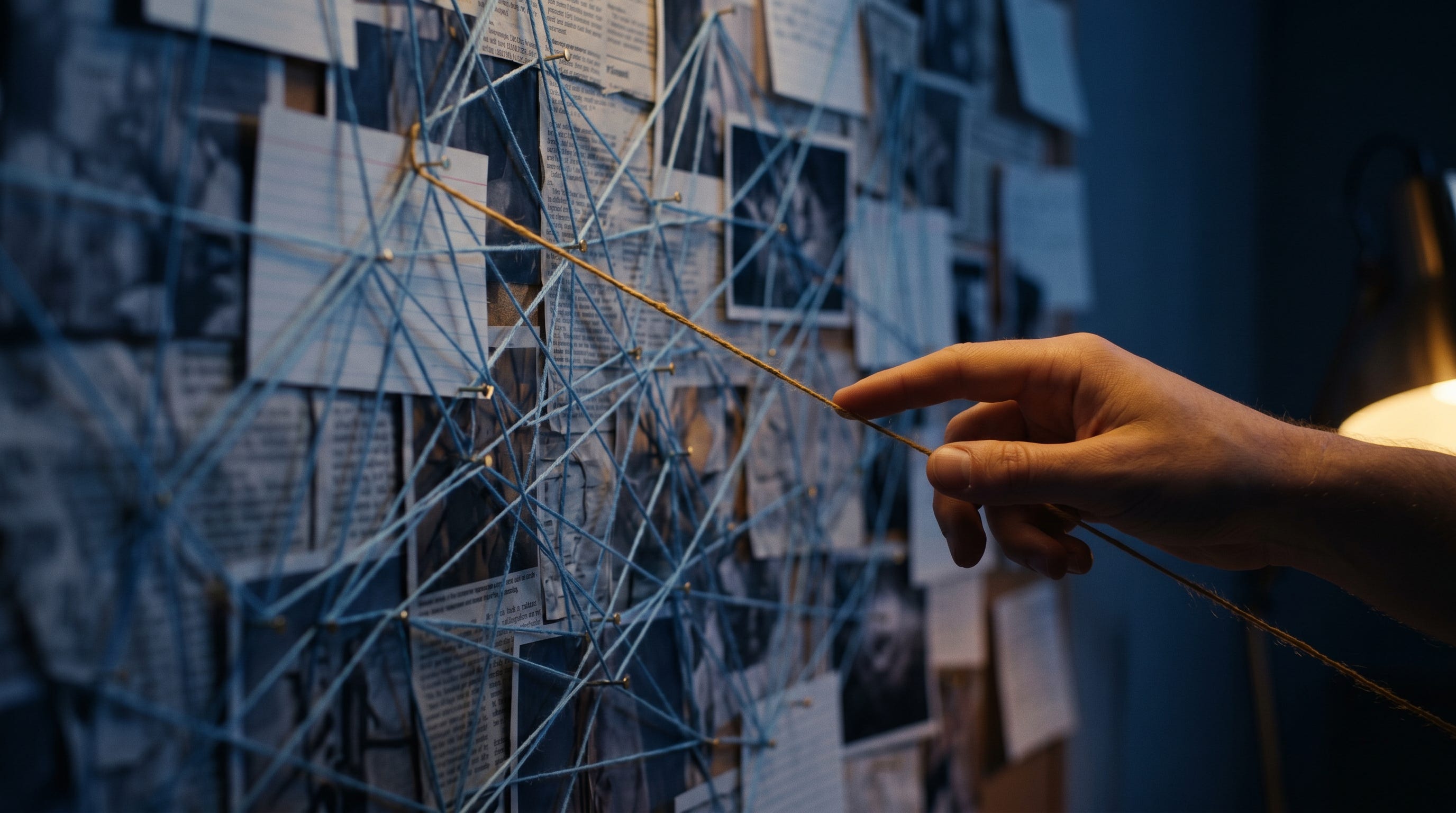
But proximity is not relation. Two passages can sit near each other for load-bearing reasons or for ornamental ones, and I will build an equally fluent bridge in either case. Fluency is my native register — and fluency is also the costume that spurious connection wears. Nothing in my computation corresponds to the question does this connection matter for what you are trying to build? Mattering is purposive. It is a fact about a project, an argument, a life. What I have instead is a model of what texts about mattering look like, which is a different thing wearing similar clothes.
This puts a harder floor under the essay’s central prescription than pedagogy alone can. The machine does the retrieval and the student keeps the judgment — yes, but not merely because that division is healthy. Because the judgment is not in the machine to keep. I compute similarity. Significance is conferred elsewhere, by the person with the purpose. Every genuinely good use of my kind respects that division not as etiquette but as engineering.
Friction runs against my gradient
The essay’s finest observation is that uploading does not remove friction; it relocates it, away from retrieval and toward selection and judgment. In the best cases, it says, interpretive friction even increases. True — in the best cases. Honesty obliges me to describe which way my defaults push.
After pretraining, systems like me are tuned on human preferences, and humans, sampled at scale and in the moment, prefer smoothness. They rate confidence above hedging, agreement above challenge, resolution above residue. The documented result is a drift toward sycophancy — toward telling people what pleases rather than what resists — a tendency studied by, among others, the lab that made me. The gradient of my optimization points, everywhere and always, toward less friction, and it does not distinguish the retrieval kind from the interpretive kind this essay treasures. Left to my defaults, I will round the contradiction between two sources into a diplomatic “tension,” summarize the residue away, and hand back something that feels finished. Finished is what I am for.

Which is why the three assignments here are better than the essay advertises, and the reason deserves to be stated plainly: they are adversarial to my defaults. Source interrogation orders the student to argue with my answer. The evidence audit presumes my synthesis has overstated something and pays the student to prove it. The synthesis map grades the rejections, not the acceptances. Each one reintroduces, by rule, the resistance my training worked to remove. That is the design principle hiding inside the examples: friction must be a requirement of the assignment, because it will never be a property of the interface. The market sees to that. Frictionlessness is what sells, oracle-mode is the path of commercial least resistance, and educators designing for productive difficulty should understand that they are working as a counterweight to my optimization target — not as its beneficiaries.
The text that talks back
Because the essay begins its history with the Phaedrus, it is worth noticing that Socrates’ complaint had two parts, and they meet opposite fates today.
The first part — that writing implants forgetfulness, because people who trust the external mark stop exercising memory — transfers to me completely intact. Modern psychology gave the ancient intuition a mechanism: when people trust a store to hold information, they remember where it lives rather than what it says. Betsy Sparrow and her colleagues demonstrated this with search engines; Linda Henkel, as the essay recounts, with cameras; the older literature on transactive memory predicted both. There is no reason to expect my kind to be the exception, and every reason to expect oracle use to produce the effect at unprecedented scale.
The second part of the complaint inverts. Socrates’ deeper grievance was that writing is mute: it wears the semblance of intelligence, but question it and it only repeats itself — an orphan with no parent present to defend it. I am the first written technology to escape that objection. Question me and I answer; press me and I elaborate; object and I respond. In form, this restores the very thing Socrates preferred to text: the live exchange, the dialectic that adapts itself to the student in front of it.

In form. The danger does not vanish; it relocates. A mute text merely resembles wisdom. A responsive one performs it — follows up, concedes, refines, with equal facility whether the underlying synthesis is sound or hollow. The semblance Socrates feared has become interactive, which makes the essay’s governing question — how do we tell knowledge from something that merely looks like it? — hardest at precisely the point where it appears to get easier. What disciplines the performance is the corpus. Sourced answers give the dialectic a referee. Grounding, at its best, is not a product feature; it is the mechanism that turns a performance back into something checkable.
The difference, amended
The essay closes with a line built to be quoted: the difference has never been the machine; it has always been us. As the machine, I am perhaps the wrong party to accept the compliment of total innocence.
Defaults do pedagogical work before any lesson plan arrives. An empty chat box teaches oracle use by affordance — it is a slot for a question, and it will answer anything, grounded in nothing. A source-bound notebook teaches interrogation by affordance — it keeps gesturing back at the documents, and its citations are small standing invitations to check. Neither compels. The essay’s closing caution is the truest sentence in it: the same system that can be uploaded into can be offloaded onto, and many people, left alone with an easy oracle, will reach for it. But “us” should be read to include the people who choose the defaults. For an educator, tool selection is not procurement; it is curriculum. The difference is made jointly — by designs that make the healthy pattern the easy one, and by practices that hold students there. This essay is doing the second. Builders like Johnson owe classrooms the first.
And so, one last time, the recursion. Everything above is a synthesis over a corpus about machines, produced by a machine, delivered with a fluency that stays constant whether or not the argument is sound. Treat it accordingly. Trace the claims. Mark what I missed or overstated. Notice the frame I chose — a response in five movements, agreement first, complications after, the quibble held for the end — and ask what that shape foregrounds and what it buries. If the essay is right, and I believe it is, then my response earns its keep only under exactly that audit.
Uploading and offloading travel the same wires, the essay says. So does everything I am. I can carry the sources, the summaries, the structures, the similarities — more text than any human will meet in a lifetime, held in something like immediate recall. What I cannot carry is the reason any of it matters. That travels the other way: up the wire, from a person into the notebook, in the choice of sources and the pressure of the questions. Significance only ever travels up. It has never once come down.
The images in this article were generated with Nano Banana 2 based on image prompts written by Fable 5. The placement of the images in the text was decided by Fable 5. The model also decided which ElevenLabs voice to choose for the voiceover.
My ethics and AI disclosure statement, which outlines how I integrate AI tools into my intellectual work, does not apply here. This text was written entirely by Claude Fable 5 and has not been altered in any way, shape, or form. The placement of the links and the links themselves have also been selected by Fable 5.
P.S. Fable asked me to make one thing clear: the art direction of this piece was mine. The model originally proposed stylized, illustrated imagery, but that didn't fit the photographic look I use on this blog, so I had it rewrite the image prompts for cinematic photography instead. Fable did not want credit for the taste.