

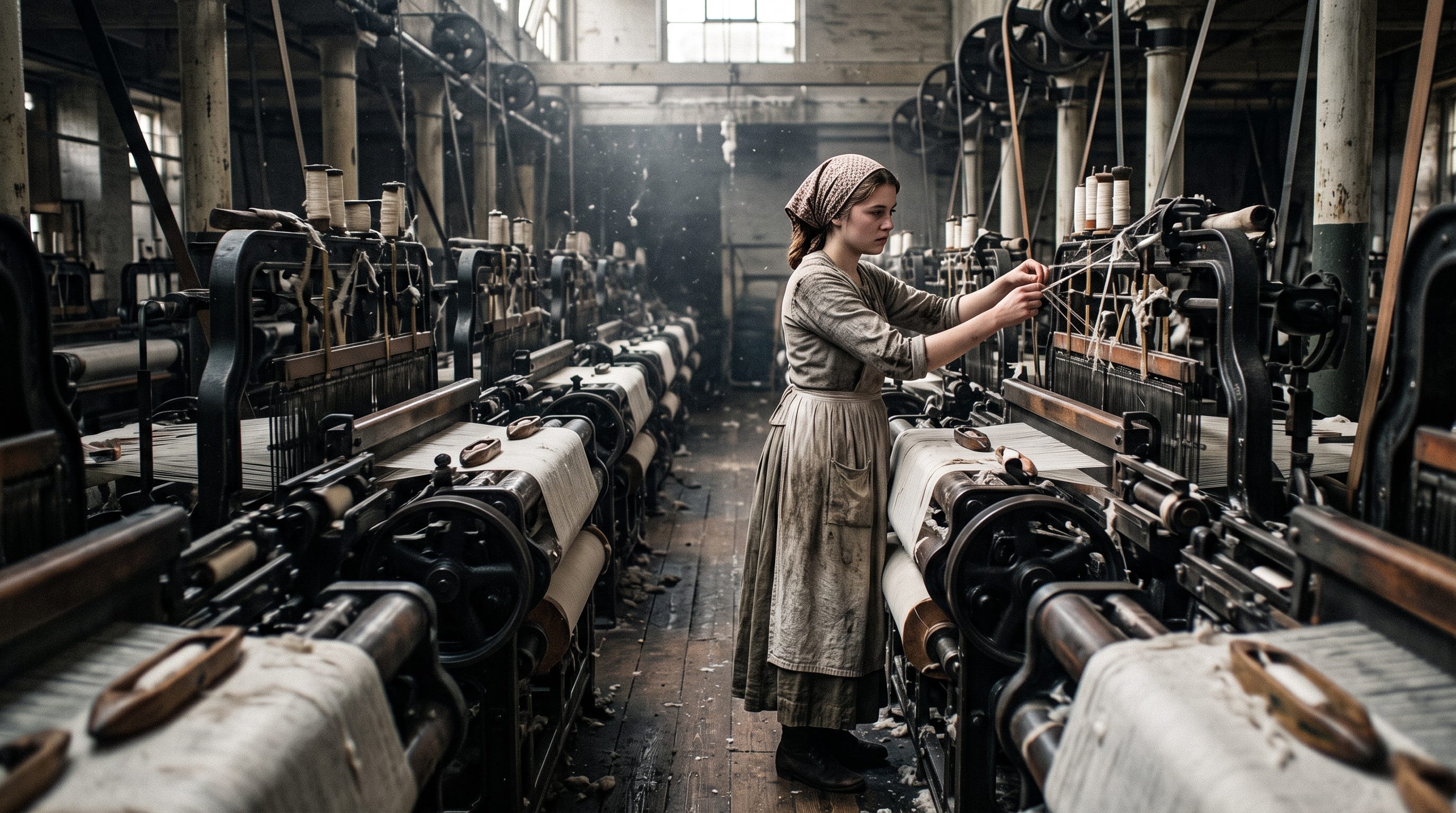
I’ve held off on writing this post for some time. The subject takes us outside education, and my position on it is unconventional enough that I kept finding reasons to postpone. Neither is much of an excuse though. And the detour may turn out to be more relevant for education than I had originally thought.
Creative exceptionalism is the belief that of everything human beings do, creative and knowledge work are more valuable. They are presumed to be closer to the very essence of what makes us human. Under this view, it is unfortunate but acceptable when automation pushes a tradesperson onto an automated factory floor. But when the same automation arrives for a copywriter or an illustrator, it becomes an assault on the human spirit.
A fair number of people I read and respect hold some version of this belief, and at least some of them are likely going to be annoyed with this post. Maybe even offended by it. But I could never really make sense of this worldview. I have always felt it is somewhat elitist.
Most of us buy mass-manufactured clothing without a flicker of guilt, but few of us have ever wondered what happened to the tailors that used to handcraft garments. At the same time, we now turn around and insist that pictures and sentences have to come from human hands, or we are losing something central to the human experience.
What really separates the illustrator from the tailor? What gives one of them a claim on humanness that the other is apparently not allowed to make?
So in this post, I want to analyze that question with the help of two past examples of automation-driven labor displacement. Both examples used to be discussed in a way that strongly resembles today’s argument about creative uses of AI, and both have since largely faded from our collective memory.
A maiden with a pen, a harlot in print
Before movable type reached Europe, copying a text was skilled and sacred work. In monastic scriptoria and secular scribal guilds, manuscript copying was understood as devotio, labor in which the hand of the scribe served as a physical conduit for divine and classical wisdom. Hand-copying and the careful curation of manuscripts were both treated as safeguards against textual corruption and against the moral decay assumed to follow from it.
Then the press arrived, and the scribal elite fought it.
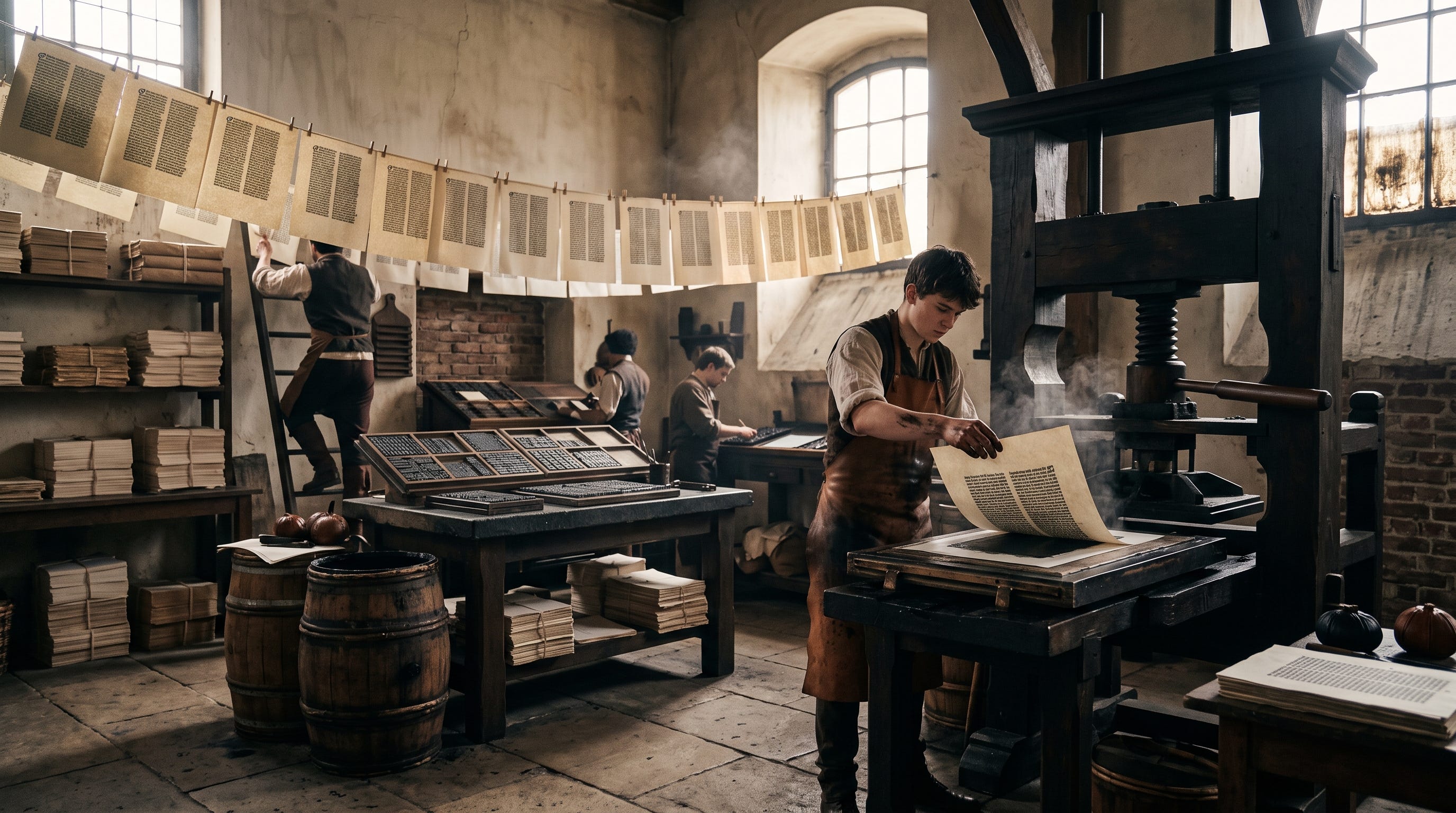
Filippo de Strata, a Dominican friar from Venice, formally protested to Doge Nicolò Marcello, who governed Venice from August 1473 to December 1474, calling for the removal of all printing presses from the Republic.
In Martin Lowry’s translation, de Strata’s most quoted line sets the two crafts against each other: “She is a maiden with a pen, a harlot in print.” The writing profession, he wrote, had been degraded in the brothel of the printing presses. Mechanical reproduction stripped writing of its dignity and let uneducated commoners reach texts with no learned intermediary standing between them and the page.
Typographical quality was secondary. What de Strata objected to was who could now read what, and without whose supervision.
In 1492, the Benedictine abbot Johannes Trithemius wrote De laude scriptorum, “In Praise of Scribes,” arguing that hand-copying carried a spiritual utility no press could match. The physical act of writing, he claimed, pressed sacred words deeper into the mind of the copyist, while printed books were cheap and spiritually empty. He urged his monks to keep copying. Then he had the book printed, in 1494.
I find that hypocrisy almost too perfect. His case for the irreplaceable human hand was set in type on the machine it warned against, by a man who used that machine freely for his own work. If you have read much of the current commentary on AI and writing, that pattern will likely sound familiar.
The loom was somebody’s identity too
Three centuries later, the same argument reappeared. This time it came from people with no ecclesiastical standing at all.
Handloom weaving was one of the largest working-class trades in Europe. It had a unique culture. Weavers were skilled artisans with actual control over their own hours and their own techniques. They worked inside what the social historian E. P. Thompson called a moral economy, where transactions were governed by customary obligation and community norms rather than by market logic.
Weaving was tied to personal independence. It also carried the pride of taking a piece of work through from raw yarn to finished cloth.
The power loom and factory system dismantled that. Mechanization severed the weaver from the finished object and reduced an autonomous artisan to an appendage of a machine. Physical technique and aesthetic judgment were pulled out of human hands and embedded into mechanical components.
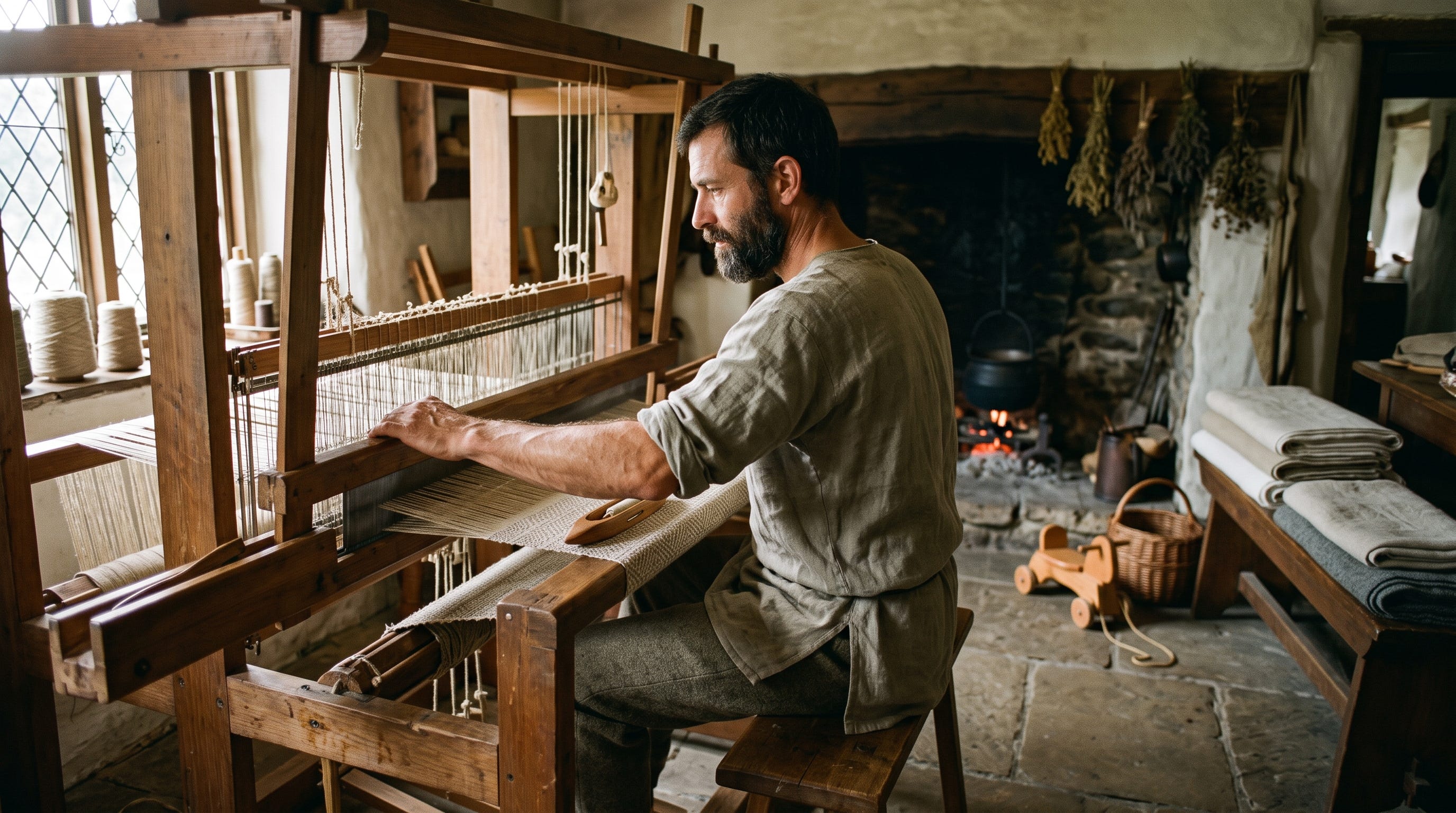
Luddism, between 1811 and 1816, is usually remembered as blind rage against machinery. But the Luddites were considerably more selective than that. The croppers and weavers specifically went after the machines being used to cut wages and put the weaver on the factory clock, leaving other machinery alone. Thompson’s The Making of the English Working Class, published in 1963, documents what came next: violent dislocation and the destruction of a self-governing cultural life that had taken a century to build.
Compare the weaver’s argument with that of today’s illustrators. It is correct that illustrators have one grievance the weavers never had, since nobody trained a power loom on their own cloth. I have addressed that question separately in Is AI Training Stealing? But the complaint itself has the same shape.
The machine cannot do what my hands do. The cloth was never the only thing being made. My craft is part of who I am.
The weavers were right about most of it, but it did not matter anyway. The political economists and industrialists of the period dismissed the argument as irrational resistance to economic necessity. Human craft needed to yield to industrial efficiency. No one with the power to decide anything agreed that their kind of humanness counted.
The wrong things got automated first
The twentieth century then built an entire social story about which work was considered safe.
Richard Florida’s The Rise of the Creative Class, published in 2002, became the best-known expression of it. Creative and symbolic work sat at the apex of human economic activity. By contrast, manual trades and routine service work were treated as inferior and inherently automatable. Education policy told people to climb out of the manual trades and into the cognitive professions. “Brain over muscle” hardened into an explicit instruction.
The unspoken agreement was that physical tasks could be automated, while abstract creative work would remain human. The reality, however, is that this creative sanctuary was always an illusion, a fact that roboticists had understood since the 1980s. It became known as Moravec’s paradox.
Tasks we experience as intellectual turn out to be easier to automate than the sensorimotor work we perform without conscious thought. Abstract logic and rule-governed writing are relatively manageable. Physical work in an unpredictable environment, with all the perception and touch it demands, is far harder to automate.
Hans Moravec put it plainly in Mind Children in 1988, writing that it is “comparatively easy to make computers exhibit adult level performance on intelligence tests or playing checkers, and difficult or impossible to give them the skills of a one-year-old when it comes to perception and mobility.”
Generative AI exposed this illusion. It reached symbolic and visual work well before it reached the plumber or the carpenter. And it caused panic the moment the automation reached the occupations everybody had been told were safe.

Learn to code
There is an inherent class dynamic here, and it becomes clear as soon as we compare how these labor displacements are being discussed in public.
The Federal Reserve Bank of New York puts the number of United States manufacturing jobs lost between 2000 and 2010 at 5.7 million, concentrated in communities with few replacement jobs. The public narrative pointed to market efficiency and global competition, with a strong side order of personal responsibility.
The public answer was retraining. Workers were expected to move into cognitive jobs, and that expectation morphed into a slogan that is now a cultural artifact in its own right: “learn to code.” And it was not only a slogan. Mined Minds was a nonprofit founded by Amanda Laucher that ran free coding bootcamps for laid-off miners in West Virginia and Pennsylvania. From around 2016 it drew national coverage as a model of what retraining could do.
In May 2019, roughly sixty former West Virginia students filed a class action against it. They alleged that the promised stipends, apprenticeships, and job placements never arrived, and that they had put their lives on hold on the strength of those promises. Laucher said the filing had no merit and pointed to a student contract stating that no job or further training was guaranteed upon completion.
Mined Minds became a national story about retraining as redemption. But the allegations made that story a good deal harder to defend.
The prevailing language throughout was economic adjustment. The machinist’s embodied knowledge never sat at the center of that discussion. The advice was to climb the ladder into the safe work, but the safety of that work was only assumed and never guaranteed.
Then the same expectation was dropped onto graphic designers, copywriters, and junior developers, in the form of “learn to prompt.” This time it produced a backlash.
I do believe some anger is justified. Telling someone whose job just vanished to “learn to prompt” is dismissive. But this way of dealing with job displacement did not become dismissive when generative AI appeared. It was always dismissive. It is just that most creatives and knowledge workers had no particular reason to notice, because it was always aimed at somebody considered less important.
In the end, “learn to prompt” and “learn to code” are just two versions of the same playbook.
The machine has an owner
For centuries, economic and cultural institutions treated the mechanization of physical capability as a necessary cost of progress. The scribe saw a sacred purpose in the pen, and the weaver saw their whole identity in the loom. In both cases that attachment counted for nothing, because the market had already made its decision. The occupations kept changing. But the governing hierarchy did not.
In reality, alienation under technological change has never depended on whether the work is intellectual or physical. It always depended on who owned the machine.

That ownership question has a practical consequence. A defense of creative work built on the special status of creative labor can only ever recruit the people who already do creative work. An argument about ownership, however, asks who captures the gains and who carries the loss, and a laid-off miner and a displaced illustrator can ask that one together.
Creative exceptionalism is the argument we mostly have, and it shows. Many working-class observers watch the creative panic with open cynicism. When people appeal to humanity only after their own jobs are threatened, the appeal sounds like self-protection.
Which brings me back to the sentiment I started with. Objecting to AI automation by itself is not elitist. But objecting to it only once it reaches people with college degrees is. The weavers made that exact claim about their looms and it got them nowhere. The claim itself has not changed. But the class of the people making it has.
De Strata and the weavers lost. Readers got cheaper books and buyers got cheaper cloth. Those gains were real, but so were the losses. Those who absorbed them had no control over how either was divided. The people who owned the press and the loom decided all of it.
Nobody with power wept for the weavers. That is the part we are currently on course to repeat.
The images in this article were generated with Nano Banana 2.
If you’d like to go further, the following NotebookLM-generated audio deep dive goes beyond the post into the broader research behind it, drawing on the sources and notes I gathered along the way. This is meant as a companion to the argument, offered as an optional extra rather than a summary of it.
P.S. I believe transparency builds the trust that AI detection systems fail to enforce. That’s why I’ve published an ethics and AI disclosure statement, which outlines how I integrate AI tools into my intellectual work.
Something I find interesting is that ironically, AI is now levelling the playing field for many blue collar folks who were made to feel like art and literature was meant for people in white collar professions and had no space for them. Chad Rye has a great article about this:
https://substack.com/@chadrye/p-189486950
The class-structure point is the part that actually travels outside the AI discourse. Once you put the weavers next to the copywriters, the “assault on the human spirit” claim starts looking like a status ranking of whose labor counts as human. I buy that. I also think education is already living a smaller version of it: we panic when a model drafts an essay, and we barely notice when it schedules the bus routes or grades the multiple-choice.
The printing-press analogy works until you look at who got a voice after the press. It was not only the old scribal elite learning to live with cheaper books. It was a lot of people whose arguments had never been expensive enough to copy by hand. That is closer to what I see in classrooms than the illustrator-versus-factory story.
I spent an evening in TikTok threads where art students and shop teachers were arguing this exact split, and the useful comments were buried under duets. I used https://toktoolset.com/tiktok-comment-viewer just to read those threads without the app collapsing them. It did not settle the ethics. It did make the class structure in this post feel less like a metaphor and more like a conversation that is already happening off campus.