

This post is going out early as a thank-you to paid subscribers. The full piece opens up to free subscribers next Tuesday. I’m grateful you’re here, and grateful for your commitment to rethinking what education can be. Your support is what keeps this work going.
Every now and then, I write a post on this Substack that is more personal than usual and that often questions something most educators take for granted. I am getting close to retirement age, and after a long and successful career, I feel it is time to pass on some of what I have learned, even when it runs against conventional wisdom.
Some of these posts, like the one about how I use AI in my own writing, touch on subjects a younger educator might not dare to write about for fear of hurting their career. I no longer have that fear. My CV speaks for itself, and I really have nothing left to prove. That gives me the luxury of writing more openly, as I do in today’s post.
Forty years of useless notes
If you are ever in a meeting with me, you will find me sitting at the table, listening carefully. But you will not find me taking notes. It has never worked for me, in any meeting or any classroom, not even as a student.
My phone usually lies face down on the table in front of me so that it can’t distract me. Sometimes I have a computer open as well, but quite honestly, that is only for show. Over the years I learned that some people consider it rude when you don’t take notes in a meeting.
In the vast majority of these situations, I am a complete outlier. Everybody around me is writing things down constantly, either on paper or on one of those new e-ink tablets that are supposed to feel like paper. I don’t. In fact, I don’t even own a pen.
For a long time, I wondered why that is. Why do all these people need to write everything down? Can’t they remember what is being said? Earlier in my career, I felt that I had to fit in, which today we would call masking. So I forced myself to take notes. But no matter how often I tried, it always ended up being pointless.
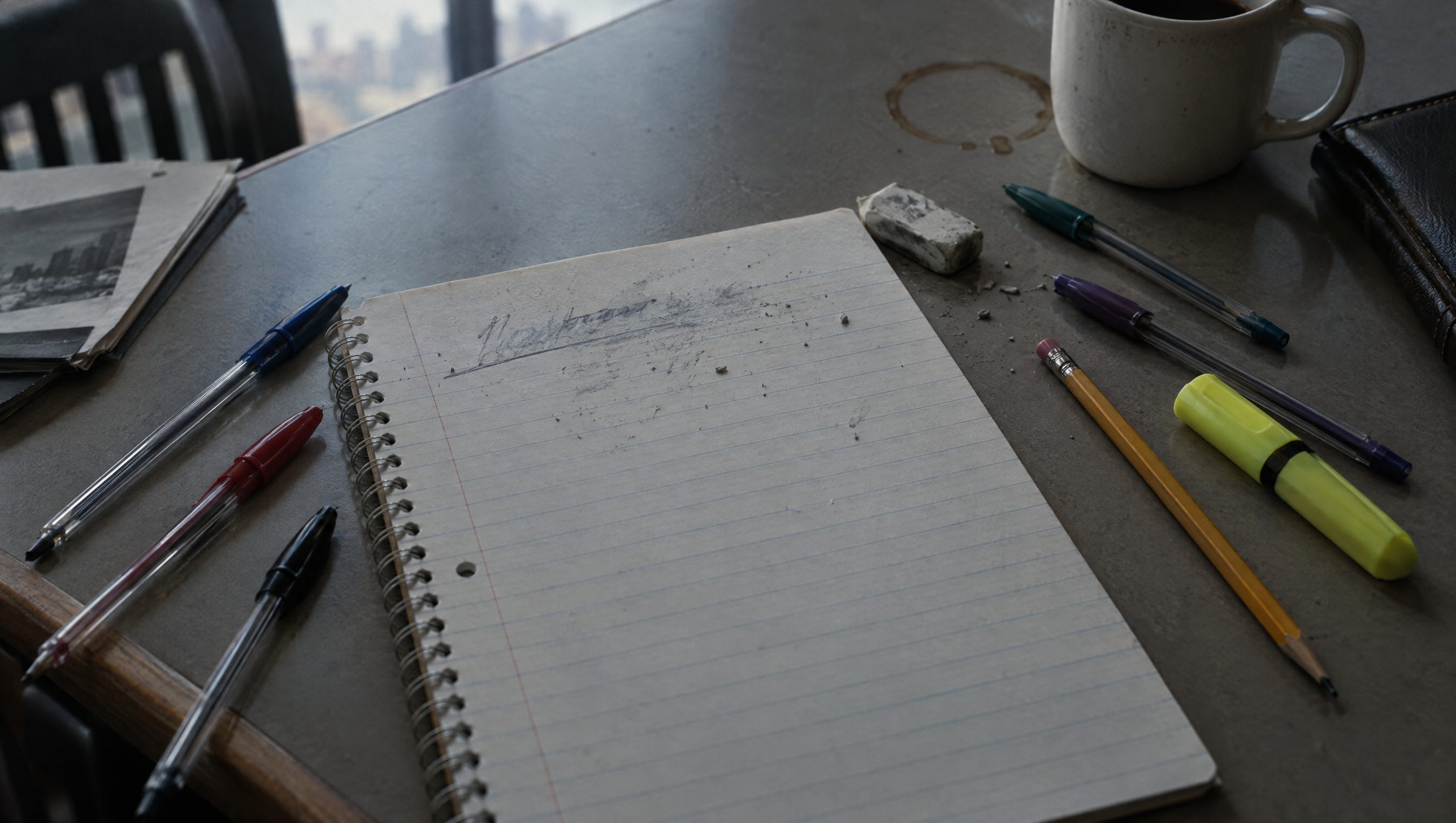
I would look at the empty page and start to wonder. How should I write this? What is the title? Do I need to add the date? Crap, the title isn’t straight. I need to erase it and start over. Should I use small caps? Should I underline it? What color should I use? Do I even need a color? Nobody else is using color. Should this be a bulleted list, or are numbers more appropriate? What do I do if the list doesn’t fit on the page? Do I even have enough pages left in this notebook? Is this a new topic? Should I say something?
By then, the conversation had already moved on to something completely different, and I had not the slightest clue what everybody was talking about. Every meeting and every lecture ended the same way. Whenever I forced myself to take notes, I walked out with no idea of what had happened in the room. And I forced myself more often than I can count, literally hundreds of times over the last forty years. Every single time, I left remembering nothing.
Yes, I had notes. But they were almost always useless.
There is one notable exception. I am still proud of the notes I took in 1989 in a class on algebraic line geometry, a fairly obscure corner of higher mathematics. Those notes were spotless. They also had very little in common with what most people picture when they think of notes. They were pages and pages of pure mathematical notation, with more Greek letters than Latin ones.
And I only took them because the topic was so obscure that no textbook on it existed at all. During that class I more or less wrote the textbook on algebraic line geometry myself. I still have it somewhere.
But in general, note-taking has always been extremely distracting to me. The moment I start writing, I stop thinking about whatever the conversation or the class is about. And I keep wondering: why do other people find it so useful that they do it all the time?

A couple of years ago, shortly after the pandemic, I realized that I am not the only one whose brain works this way. Honestly, that came as a relief. I now know that I am neurodivergent, and that the way I experience the world differs from how “normal” people experience it.
These days I no longer feel the need to pretend. You will find me in meetings and lectures listening carefully, even if I don’t make eye contact, without a notepad or any other note-taking device.
I still don’t own a pen, and now I am almost proud of it. I’m with Socrates on that one.
I am bringing all of this up because, ever since AI arrived as a tool for writing assistance, I keep hearing that writing is essential for thinking. If you outsource your writing to a machine, the argument goes, you lose the ability to think critically.
I feel that I am living proof that this is not true, at least not for everybody. I can look back at a long and quite diverse career as a critical thinker (you are welcome to check my resume if you don’t believe me). I built it by listening and watching, and by carefully working through what I experienced against everything I already knew. A pen was never part of that equation.
So in today’s post, after a much longer introduction than usual, I want to dig into what the research says about whether writing is essential for developing a critical mind. As a hint, the reality is a lot more diverse than most people would like it to be.
