

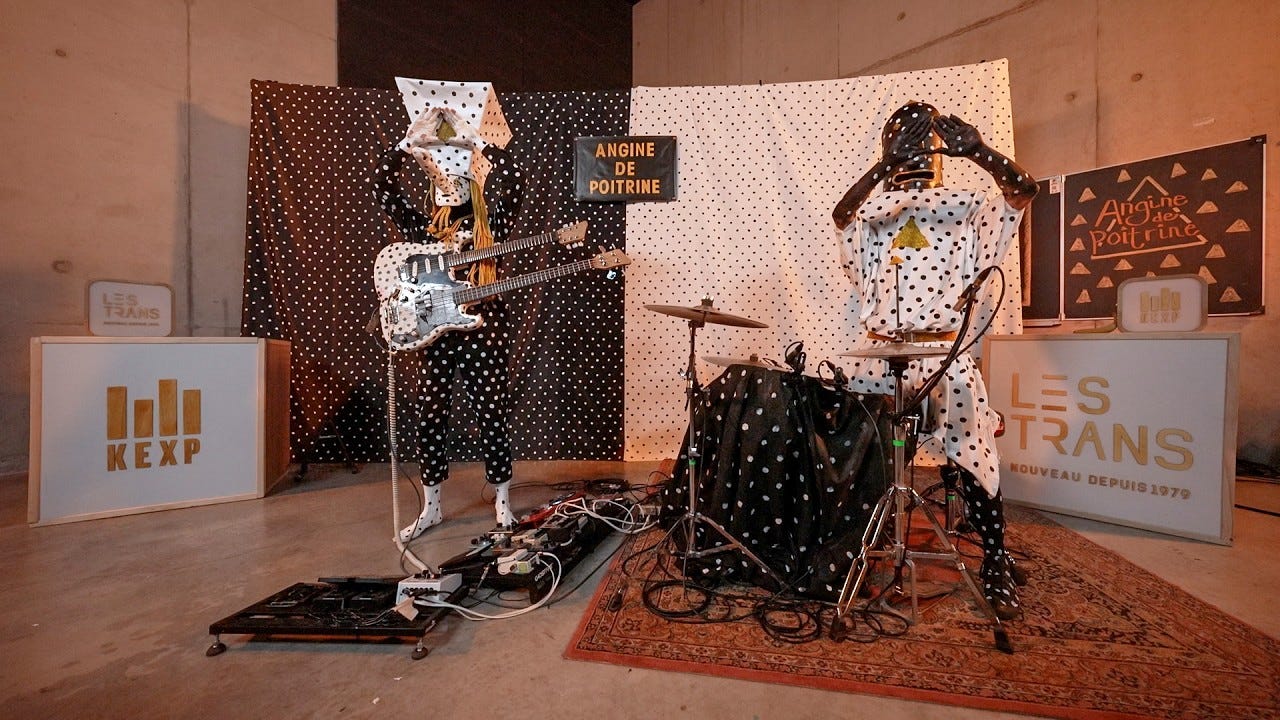
My YouTube algorithm has recently taken me down yet another unexpected rabbit hole. I had been working on a video for my YouTube channel responding to Rick Beato’s argument that the current AI data center buildout mirrors the recording studio buildout of the late 1990s. In researching for that video I came across Beato’s analysis of the experimental duo Angine de Poitrine, which he posted to his over five million subscribers. I couldn’t believe what I saw. It prompted me to set aside the video project temporarily and write this essay instead, because what Angine de Poitrine represents — and what people’s reaction to them shows — strikes at the heart of a question this newsletter has been circling for months: what does it mean to create, and to be human, when machines can approximate so much of what we do?
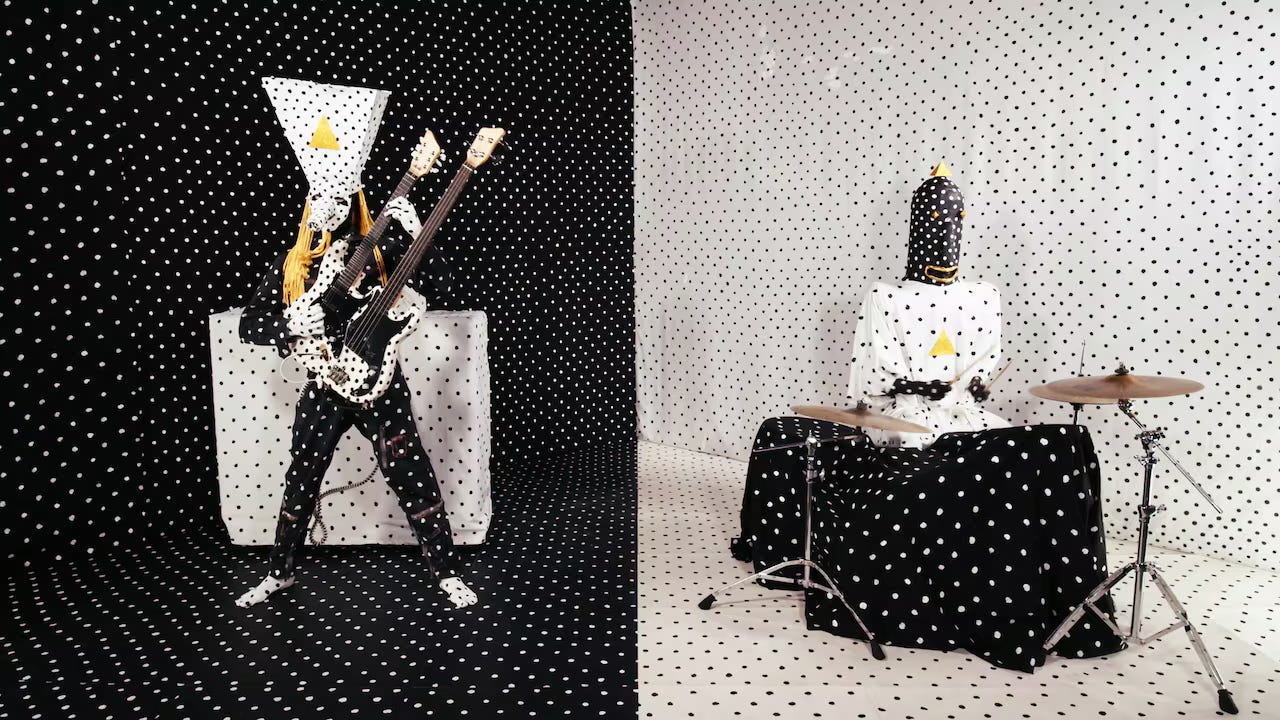
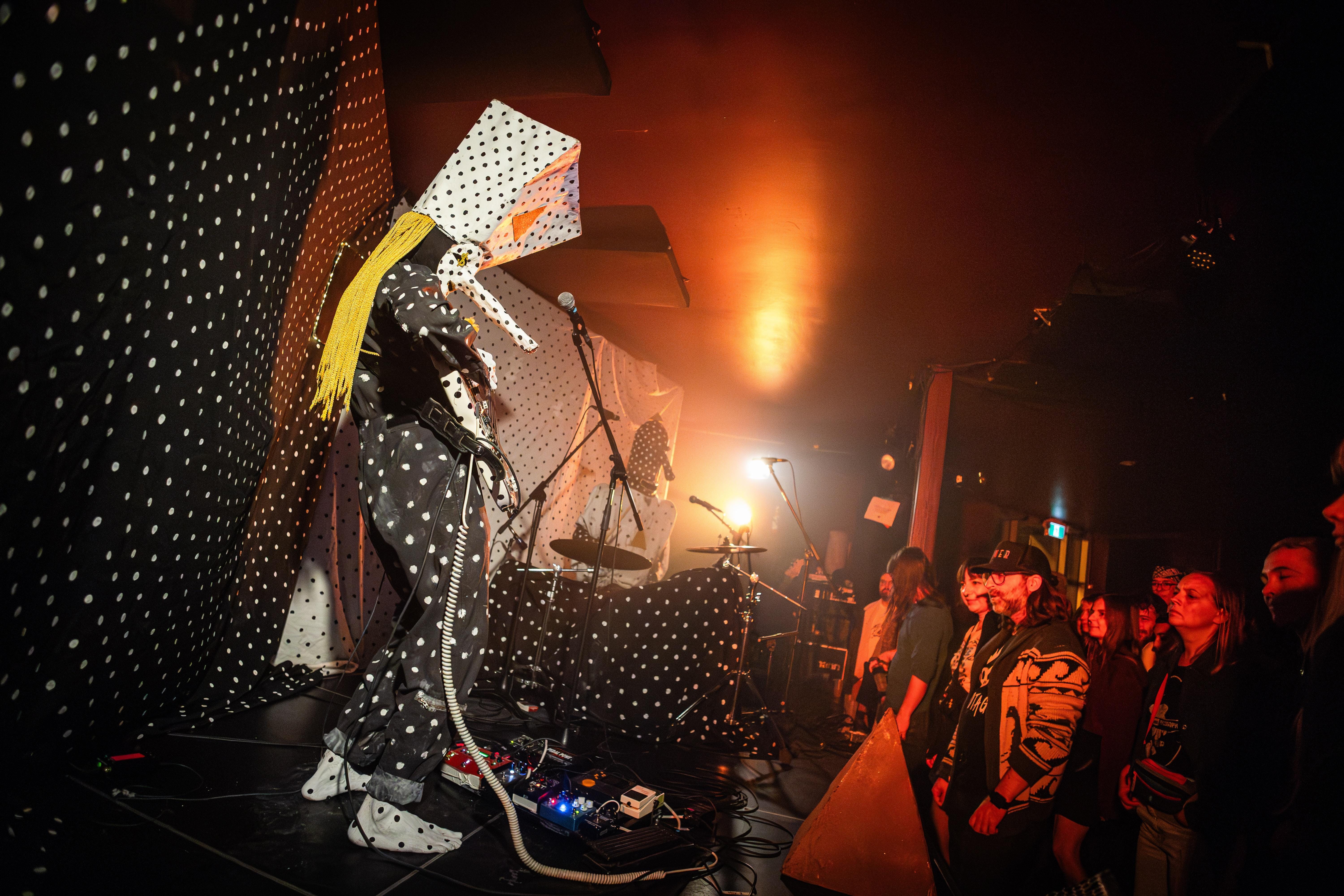
If you haven’t yet encountered Angine de Poitrine, here is what you need to know. They are a duo from Saguenay, Quebec — a guitarist known as Khn and a drummer known as Klek — who perform in oversized papier-mâché masks and black-and-white polka-dot costumes that cover every inch of exposed skin. They communicate on stage only in a made-up language. Khn plays a custom double-necked guitar-bass fitted with twice the standard number of frets, allowing him to perform in quarter-tone tuning, twenty-four notes per octave instead of the twelve we are accustomed to in Western music. He layers this with a complex array of loop pedals while Klek drives the rhythmic foundation beneath him. Their self-described genre, if you can call it that, is “mantra-rock dada pythago-cubiste.”
In February 2026, a recording of their performance at the Trans Musicales festival in Rennes, France, was posted to KEXP’s YouTube channel. It has since accumulated more than three million views, spawning hundreds of reaction videos and filling Reddit threads with listeners trying to make sense of what they had just witnessed. Some of the most upvoted comments on the original video distill the range of public response: “Absolutely insane usage of free will,” and — more telling for our purposes — “This is the only way we can win the battle against AI” as well as “Eat this, AI!” These comments capture something extremely profound, and it is worth unpacking.
The flood no one can hear coming
To understand why a masked duo playing microtonal math rock has become a focal point for anxieties about artificial intelligence, we need to reckon with the scale of what is happening in generative audio. The numbers are sobering.
In November 2025, Deezer published data showing that approximately 50,000 fully AI-generated tracks were being uploaded to its platform every day. This represented a 400% increase from January of that year, when the company first began tracking synthetic content using its proprietary detection tools. Those 50,000 daily tracks accounted for roughly 34% of all new music delivered to the service. To put that in perspective: more than one in three new songs arriving on a major streaming platform were created entirely by machines.
The financial infrastructure behind this surge is substantial. According to reports from Market.us and Goldman Sachs, the AI music sector reached a valuation of approximately $6.65 billion in 2025, with projections for tenfold growth over the following decade. Generative AI music users made up about 10% of all music creators by that year, with the number of paying users doubling in a single year. Meanwhile, the acquisition of traditional, skill-based music software experienced consecutive annual declines in 2024 and 2025.
Perhaps most critically, the fidelity of generative models has crossed the threshold of casual human discernment. The landmark study commissioned by Deezer and conducted by Ipsos encompassed 9,000 participants across eight countries, including the United States, Canada, the UK, France, Germany, and Japan. When asked to listen to tracks and determine which were fully AI-generated, 97% of respondents failed to identify the synthetic music. Fifty-two percent reported feeling uncomfortable when they learned they could not tell the difference.
These figures describe a landscape in which the sheer volume of machine-produced music is overwhelming distribution networks, and the perceptual gap between human and synthetic creation is effectively closing for most listeners. The implications for working musicians are obvious and grim. The implications for what we value in art are more subtle and perhaps more important.
What the machines cannot do
This is where Angine de Poitrine enters the conversation, and where the YouTube comments “This is the only way we can win the battle against AI” and “Eat this, AI!” become genuinely illuminating rather than merely reactive.
Consider what Khn and Klek have accomplished over the past two decades. They have been playing together since they were thirteen years old. Their current project emerged in 2019, when a friend managing a local venue had a slot to fill. Having already performed at the same venue that week under a different project, they invented the costumes on the spot so no one would recognize them. What began as a joke became an identity, one that allowed them to separate their creative personas from their private lives while committing fully to a distinctive artistic vision.
The musicianship itself is formidable. As Klek told Noize Magazine, what Khn accomplishes on stage is technically extraordinary: managing two different necks, each with twice the standard number of notes, while simultaneously operating a loop pedal to build layered compositions in real time, all while performing barefoot with painted skin, seeing only through narrow slits in a papier-mâché mask. Their influences range from Turkish psychedelic music of the 1970s to Indian classical traditions to progressive rock architects like King Crimson. The resulting sound occupies a space that no genre label adequately describes, which is precisely the point.
Here is what strikes me most. Every element of Angine de Poitrine’s work represents a deliberate choice to move toward difficulty, toward strangeness, and toward the kind of creative risk that generative AI is structurally incapable of taking.
Generative models work by identifying and reproducing statistical patterns in their training data. They excel at producing output that sounds like a plausible average of what already exists. They can generate a convincing indie folk track or a serviceable lo-fi beat because those forms have been thoroughly mapped in the training corpus. What they cannot do is decide, on a whim, to build a double-necked microtonal guitar, spend years learning to play it, wrap themselves in polka dots, and perform in an invented language. They cannot decide to pursue the notes between the notes — the quarter-tones that exist outside the Western twelve-tone system most training data is built on — because those intervals are statistically aberrant. They are noise, not signal, from the model’s perspective.
This distinction is critical because it clarifies what AI actually homogenizes. The threat is not that machines will produce music indistinguishable from human creation. Deezer’s study already shows they can, at least to untrained ears. The deeper threat is that the flood of statistically plausible, emotionally adequate synthetic content will gradually reshape our expectations of what music should sound like. When 50,000 AI tracks per day are optimized for engagement metrics and trained on existing patterns, the cultural center of gravity shifts toward the familiar. The weird, the difficult, the genuinely novel — these become harder to discover and easier to dismiss.
The accidental manifesto
What makes Angine de Poitrine’s viral moment so resonant is that the duo was not trying to make a statement about artificial intelligence. They were simply being themselves — which is to say, they were being irreducibly, stubbornly, absurdly human. The masks, the invented language, the microtonal explorations, the two decades of shared musical development: none of this was designed as a counterargument to generative AI. It predates the current moment entirely. Their debut album, Vol. 1, was released in 2024. They have been performing at Quebec festivals since 2020.
And yet the internet received their KEXP performance as precisely that: a counterargument. The comment sections and reaction videos are saturated with references to AI, to authenticity, to the irreplaceable value of human creative risk. Viewers are not merely enjoying the music. They are clinging to it as evidence of something they fear is disappearing.
I think this response is worth taking seriously rather than dismissing as nostalgia or technophobia. What audiences are recognizing in Angine de Poitrine is not just technical skill, though the skill is undeniable. They are recognizing intentionality. This is the visible evidence that two human beings made a series of difficult, idiosyncratic, sometimes absurd choices over a long period of time, and that those choices produced something no optimization algorithm would ever converge upon. The masks are not efficient. The microtonal guitar is difficult. And the invented language is not accessible. Every aspect of their performance is a monument to human willfulness, to the creative agency that exists precisely because it serves no purpose other than the creator’s vision.
Redefining what it means to be human
Here is where I want to push the conversation beyond simple resistance — beyond “Eat this, AI” — toward something more constructive.
The presence of generative AI in creative fields does not merely threaten human artists. It also forces a clarification. For decades, we have operated with a loose, often unexamined understanding of what makes human creativity valuable. We have assumed that the value lies in the product: the song, the painting, or the text. AI disrupts that assumption, because when a machine can produce a product that 97% of people cannot distinguish from the human version, the product alone can no longer be where the value lives.
This is uncomfortable, but it is also an opportunity. AI compels us to locate the value of human creativity where it actually lives: in the process, the intention, the accumulated experience, the willingness to fail, the relationships forged through collaboration, and the embodied, physical reality of performance. Khn navigates a double-necked fretboard with twice the standard number of notes. Klek cannot see his kit clearly through a mask slit. They play anyway, and the tension between difficulty and mastery is part of what audiences perceive as authenticity. No model replicates that tension, because no model experiences difficulty.
As I have explored in previous essays for this newsletter, the distinction between process and product has profound implications for education as well. If we teach students that the value of writing lies in the finished essay, then AI renders the exercise pointless. If we teach them that the value lies in the thinking that writing demands, it lies in the struggle to articulate half-formed ideas, to organize arguments, and to find one’s own voice through revision. AI becomes a tool that can augment that process rather than replace it. Angine de Poitrine models this principle in the domain of music. The value of what they do is inseparable from how they do it and who they are while doing it.
What we carry forward
The viral success of Angine de Poitrine is neither an anomaly nor a solution. It is a signal. It tells us that audiences, even casual YouTube viewers, can sense the difference between human creative risk and optimized content. The key to success of not the level of the audio signal, but the level of meaning. They respond to the visible evidence of human commitment, eccentricity, and accumulated craft. They respond, in other words, to everything that generative AI structurally cannot provide.
The challenge for educators, artists, and anyone invested in human creative development is to build on that signal rather than merely celebrate it. The flood of synthetic content is not receding. 50,000 daily AI tracks on Deezer will become 100,000, then more. The perceptual gap will continue to narrow as models improve. In this environment, the response cannot simply be to reject AI or to romanticize a pre-digital past. The response must be to invest — deliberately, seriously, and with institutional support — in the kinds of creative practice that machines cannot reproduce: embodied performance, deep craft built over years, cultural specificity, collaborative risk-taking, and the cultivation of genuine artistic vision.
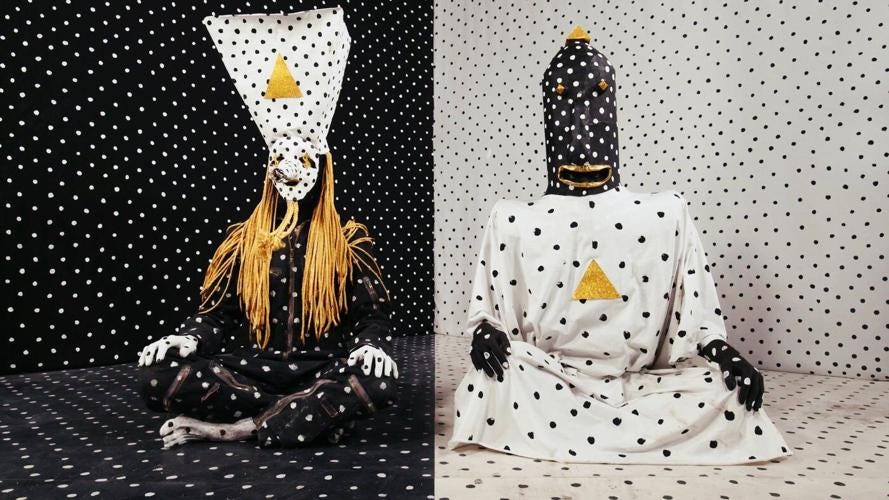
Angine de Poitrine did not set out to answer the question of what it means to be human in the age of AI. They set out to make the strangest, most committed music they could, wearing masks and speaking in tongues, because that is what their creative vision demanded. That the internet has received them as an answer to that question anyway tells us something important: we already know, intuitively, what the machines cannot give us.
The task now is to protect and cultivate it.
The images in this article are real.
P.S. I believe transparency builds the trust that AI detection systems fail to enforce. That’s why I’ve published an ethics and AI disclosure statement, which outlines how I integrate AI tools into my intellectual work.
People have done weird stuff in the name of art forever, and there's no shortage of examples over the last few centuries. Sometimes it shifts the popular mood in new directions. Sometimes it's just a urinal. But the important thing is that the vast majority of us just keep on listening to tin pan alley and watching the Brady Bunch. Because while humans are capable of messing with the parameters, a far, far more "human" tendency is to find a rut – preferably one carved out by lots of other sheep – and stick to it until you die. Loving AI slop is an incredibly (if irritatingly) "human" thing to do. It's why Stock, Aitken & Waterman were so successful. A few delightfully creative weirdos on the margin doesn't change anything. (Although if it did, I would point to someone like Plini rather than Angine de Poitrine – someone who can mess with the parameters and yet remain astonishingly accessible to people who don't have a PhD in music theory or get excited by different for the sake of different.)