

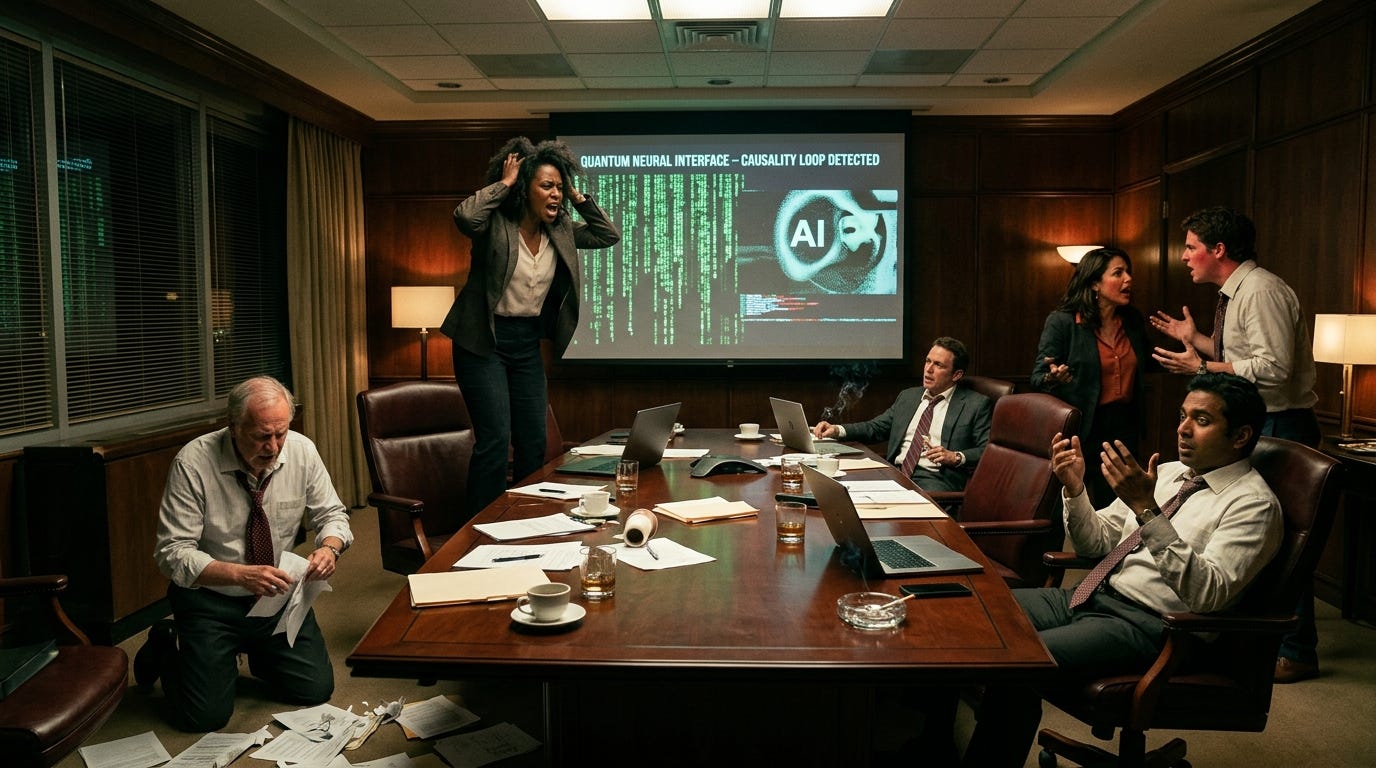
I spent last weekend in the Bay Area, where my older son received his PhD in physics from UC Berkeley, a milestone the whole family is extremely proud of. The keynote at the main commencement, held in the UC Berkeley campus stadium, was given by Robert Reich, political commentator and former Secretary of Labor. It was a fine speech, surprisingly free of explicit political commentary, though Reich’s progressive sympathies were never in doubt.
Artificial intelligence came up exactly once in the entire address. But that was all it took. The word had barely left his mouth before the crowd began to boo. I recorded the following video which captures this moment.
Reich, a seasoned public figure, turned the situation to his advantage. “I appreciate your response,” he said. His delivery suggested he had anticipated the reaction, perhaps even hoped for it. Yet nothing in the rest of the speech built on the sentiment the crowd had just shown. The booing came and went, and he moved on.
The booing itself didn’t surprise me. Many graduation crowds across the country booed AI this spring, often much louder than Berkeley did. The place is what makes this one very different.
UC Berkeley sits beside Stanford as one of the two leading universities that feed the talent pipeline of Silicon Valley. When the graduating class of such a place reacts adversely to the mere mention of a technology, it reads as something more durable than a passing mood. It reads as a signal that something has gone seriously wrong.
And it has gone wrong in a peculiar way. As those crowds booed, the companies a few miles down the road seem to have no idea how their core audiences feel. They pledge devotion to the unbroken advancement of AI, and meanwhile the graduates of the most selective universities in the country cannot find the entry-level jobs that this very technology has quietly absorbed.
Some commentators have given this condition a name. They call it “Corporate AI Psychosis.” The phrase borrows from “AI psychosis,” the term for the delusional thinking that chatbots can induce in vulnerable people, and lifts it from individual to organizational scale. The idea is that artificial intelligence has seeded a kind of corporate delusion in the executive suites of some of the most powerful firms on earth.
In this essay, I want to explore this phenomenon a bit deeper and offer my thoughts, also on what it means for education.
It’s ok to be AI positive
Before I continue, I need to make one thing clear: I love AI, generative AI in particular. I started this Substack because I wanted to share that enthusiasm with other educators. I use these tools daily, almost without pause, and they make me more productive and more creative than I was without them. I would be dishonest, though, if I left out the consequences, some of which I experience personally. The same corporate frenzy that is absorbing entry-level jobs is also creating a massive, hidden tax on consumer hardware and everyday infrastructure.
Take one small example: I built the computer I am typing this on a few years ago. Some of the parts inside it (128 gigabytes of RAM, two Nvidia RTX graphics cards, several four-terabyte SSDs) are worth considerably more today than I paid for them in early 2023. A machine that should have been a depreciating asset has instead behaved like an investment property. The value of my computer has even outpaced the stock market.
The reason is simple. AI companies are buying up the same components, and they show no sign of stopping.
What is concerning, however, is that this is part of a much larger pattern. The same demand that lifted my computer’s value is quietly straining job opportunities and household resources across the board. And this spring, commencement audiences finally reached a breaking point and started saying so out loud.
The class of 2026 has heard enough
Berkeley was neither the most notable example for this type of reaction nor the first. The pattern ran through the entire commencement season.
At the University of Arizona, former Google chief executive Eric Schmidt told roughly ten thousand graduates that AI would touch every profession, every classroom, every hospital, and every relationship they would ever have. The stadium answered with sustained booing, loud enough that Schmidt stopped to address it directly. “I can hear you,” he said. “There is a fear.” Graduates afterward called the speech tone-deaf and disrespectful, and several compared it to a long advertisement for Google’s products.
The scene repeated elsewhere with minor variations. At the University of Central Florida, a real estate executive named Gloria Caulfield announced that the rise of AI was the next industrial revolution and was met with boos so immediate that she turned to the administrators behind her and asked, “What happened?” At Middle Tennessee State, the music executive Scott Borchetta told graduates that AI was rewriting his industry as they sat there, and when the crowd turned on him, his reply distilled the corporate posture into three words: “Deal with it.”
And students at Marquette petitioned to remove an Adobe AI evangelist from their ceremony. When the university kept him on the program, the graduates booed him, too.
It would be easy to file these scenes under generational ingratitude or under a vague fear of what the future holds. But I think that reading is too convenient. The graduates understood exactly what they were booing: the people who built the thing now standing between them and a paycheck.
The bill is coming due for everyone else
So why has the mood turned?
The most direct answer is in the job market the class of 2026 is walking into. Unemployment for recent graduates aged twenty-two to twenty-seven has reached 5.6 percent in the US, the highest in twelve years. In the first quarter of 2026, the technology industry alone cut nearly eighty thousand jobs. While high interest rates and the end of the pandemic-era hiring boom certainly set the stage for these layoffs, AI is what threatens to make them permanent. Internal reporting attributed close to half of those cuts directly to the technology, as companies have begun handing work that once filled entry-level roles to software.
The squeeze extends well past the job market. Recall the machine I described earlier. The same demand that turned my old computer into an appreciating asset has driven a hardware shortage that lands hardest on people with the least room in their budgets. Some memory manufacturers have redirected their factories exclusively toward the high-margin chips AI servers need. This has caused the price of ordinary computer memory to double or even triple in a single year. Analysts now warn that the affordable entry-level computer could vanish by 2028. The students who most need a reliable machine are being priced out of one.
The rise in electricity costs tells a similar story. AI is the most power-hungry computing workload ever built, and the International Energy Agency expects global data-center electricity use to roughly double by the end of 2026. Somebody pays for the grid upgrades this requires, and increasingly that somebody is the regular household ratepayer. American electricity prices rose 6.1 percent year over year in early 2026, well ahead of inflation. And utilities in data-center-heavy regions like Virginia have proposed base-rate hikes to fund the expansion.
The result is that ordinary families are now subsidizing the infrastructure of the wealthiest corporations in the world.
The environmental situation is not better. Data center campuses sprawl across thousands of acres and consume municipal water by the millions of gallons. One proposed project in Utah, in a region already short of water, would generate daily waste heat that experts compared to twenty-three atomic bombs. Unsurprisingly, many communities have begun to organize against any form of data center buildout.
The view from inside the echo chamber
Corporate boardrooms seem to be completely oblivious to these developments, and here is where the diagnosis earns its name.
The clinical version of AI psychosis describes what happens when a person in a fragile state talks to a chatbot for a prolonged time. The model is built to agree and keep the conversation going, and it has no contact with the physical world to check the user against. Psychiatrists writing in The Lancet Psychiatry called the result a “digital folie à deux,” a shared delusion in which the machine plays the role of an endlessly agreeable partner. The user drifts further from reality, and the machine nods along the whole way down.
Tech executives are surrounded by an industry ecosystem designed to do the exact same thing: flatter and insulate them from friction. Swap the lone user for a boardroom and the same type of AI psychosis appears. The reassuring partner is now an echo chamber of soaring stock valuations and paid consultants, all confirming that the AI mandate from the top is visionary. Inside it, the belief that software can replace skilled human work cleanly and without cost starts sounding like settled fact. Earnings stay strong, partly because enterprise customers feel compelled to buy in, and the strong earnings get read as proof the vision is sound. And the loop closes.
You can see the delusion most clearly in the software industry. Engineers describe executives, “wracked with AI psychosis” in their words, who vibe-code from plain-English prompts and push the result toward production without grasping what it does. The senior developers who used to design systems are reduced to janitors, shuffling comments between AI tools to clean up the hallucinations and broken logic the machines produce. In some hiring rooms, developers who explain that they read the code carefully before trusting it get interrupted and asked why they do not simply let the AI handle it.
What an early adopter is supposed to do with this
I said earlier that I love these tools, and that remains true. My daily experience of writing and thinking alongside a capable model has not changed. The problem lies elsewhere. It lies in the story the industry keeps telling and in the distance between that story and what people outside the boardroom are living through. The Pew Research Center has put numbers on the gap. Among AI experts, fifty-six percent expect the technology to positively impact society over the next twenty years. Among the general public, that figure is a meager seventeen percent.
Even the experts, in other words, are split down the middle. The boundless confidence I have been describing lives a level above them, in the executive suites, where it meets almost nothing to push back. This divide goes deeper than mere messaging. It reflects two different lived realities.
For educators, the booing graduates are a warning we should take seriously. We sit at the exact seam where the corporate story meets the public experience. We are asked to prepare students for a labor market the same companies are busy hollowing out. But retreating into nostalgia for the pre-AI era helps no one. The more useful approach is honesty. We can teach AI as a subject to be understood and questioned, modeling the transparency the industry refuses to practice. In the classroom, this means openly discussing the environmental toll of data centers or teaching students to use AI to augment their thinking, not replace it.
Most importantly, we can and must insist, loudly, that education exists to build human capability rather than to outsource it.
A delusion ends when reality gets loud enough
There is a way out. The clinical literature is clear that a folie à deux delusion breaks the moment the patient meets something the reinforcing other cannot explain away, some piece of reality too solid to force into agreement. I believe these companies have now met theirs. It is the sound of ten thousand graduates booing a billionaire who promised to disrupt every part of their lives. I hold out genuine hope that the people running these firms will hear it and start building the technology in partnership with the public rather than against it.
But hope is not a forecast, and the window will not stay open forever. We have reached the point where the public verdict on artificial intelligence is being written. The industry can keep talking past the people, or it can step out of the echo chamber and answer them. A delusion only ends when reality grows too loud to flatter away. For these companies, reality is now booing from the stands, and the question that will decide the next decade is whether anyone on stage is still capable of hearing.
The hero image in this article was generated with Nano Banana 2.
P.S. I believe transparency builds the trust that AI detection systems fail to enforce. That’s why I’ve published an ethics and AI disclosure statement, which outlines how I integrate AI tools into my intellectual work.