

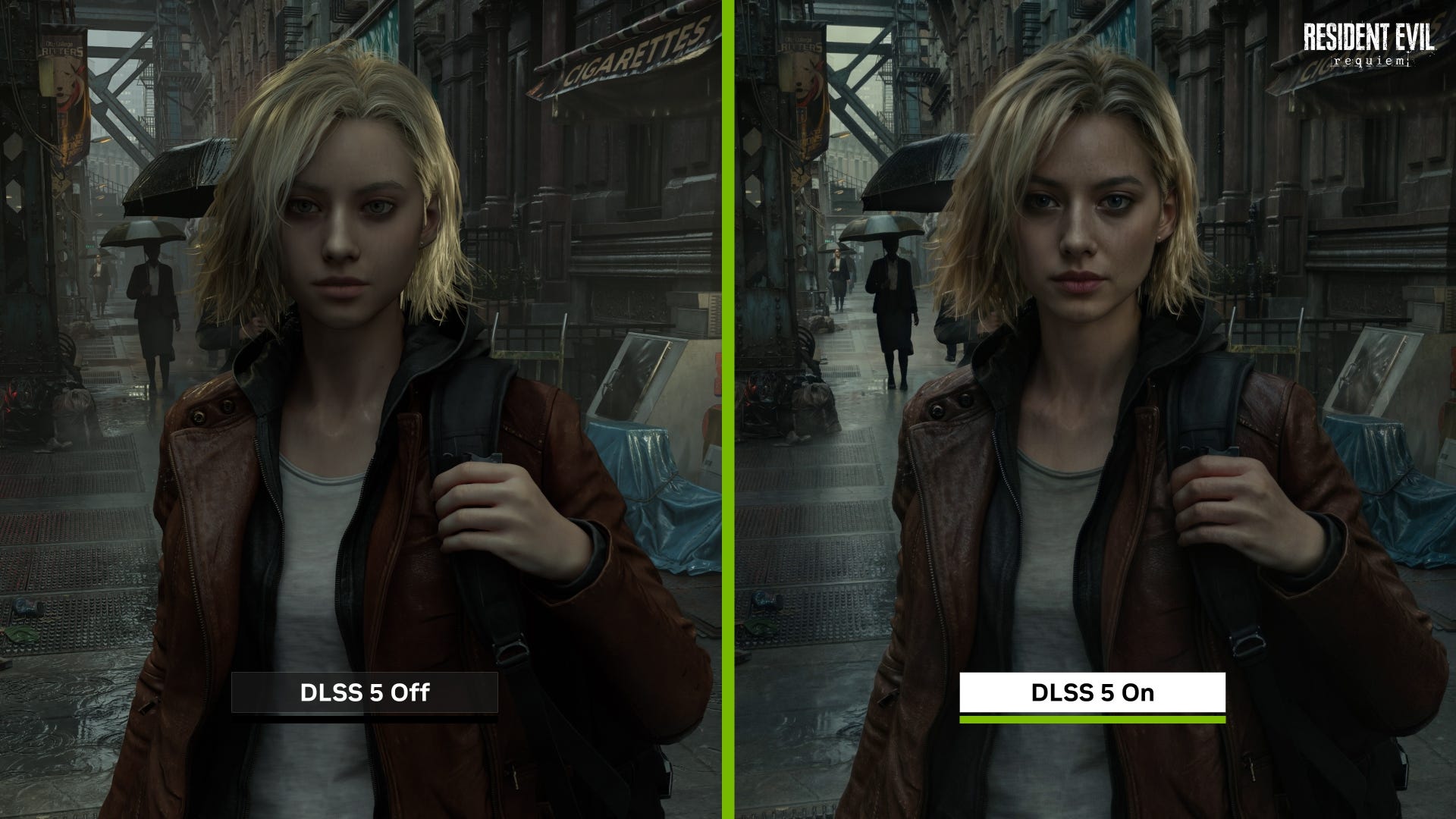
If you follow technology news at all, you may have noticed a firestorm erupt in the gaming world over the past few days. At its annual GTC conference in March 2026, Nvidia, the company whose graphics processors power everything from video games to AI data centers, unveiled a technology called DLSS 5, which it described as the “GPT moment for graphics.” The response from developers and players was immediate, visceral, and overwhelmingly negative.
On the surface, this looks like a niche dispute about video game visuals. It is anything but. The DLSS 5 controversy is one of the clearest illustrations I have encountered of a pattern that should concern every educator. Technology companies are building powerful AI tools while fundamentally misunderstanding what their users actually value. And the same logic driving Nvidia’s misstep is the logic currently also reshaping classrooms: the assumption that faster, smoother, and more ‘realistic’ is always better.
What DLSS 5 actually does
Some brief technical context is necessary here, though I will keep it accessible.
Rendering a video game in real time is an extraordinarily demanding computational task. A game running at sixty frames per second gives the hardware roughly sixteen milliseconds to calculate and display each frame. This is a constraint that has shaped every visual decision in the medium’s history. Just for comparison, a single CGI frame in a Hollywood film can take minutes or hours to render on massive industrial server farms.
For years, Nvidia’s DLSS technology (Deep Learning Super Sampling) helped bridge this gap through a clever trick: it rendered games at a lower resolution, then used AI to fill in the missing pixels intelligently. The result looked sharper and ran faster. The underlying artwork remained untouched.
DLSS 5 does something completely different. Rather than upscaling an existing image, it analyzes a scene’s content, identifying skin, hair, fabric, and lighting conditions, and then uses a generative AI model to reconstruct what those elements should look like. The system doesn’t enhance the artist’s work. It overwrites it with what the algorithm determines to be a more photorealistic version.
This is a crucial distinction. Previous iterations of DLSS were, in essence, a better magnifying glass. The way DLSS 5 works is closer to an uninvited collaborator who repaints your canvas while you watch.
Why artists are furious
Nvidia’s marketing presented DLSS 5 as a visual triumph. The artistic community saw something else entirely.
The controversy crystallized around Nvidia’s official demonstration running on Capcom’s Resident Evil Requiem. Comparison shots of a character named Grace Ashcroft showed that with DLSS 5 enabled, she effectively looked like a different person. The AI had altered her facial geometry, changed the shape of her ears and nose, added unintended wrinkles to her lips, and made her features appear fuller and sharper than the original 3D model.
Beyond the geometry changes, senior animator Mike York, whose credits include major industry titles, also identified eye misalignment where one eye appeared to look in a different direction than the other, a flaw introduced entirely by the AI’s probabilistic guessing. The gaming community labeled this “yassification”: the application of an unwanted, homogenizing beauty filter that forces characters to conform to a synthesized standard of attractiveness.
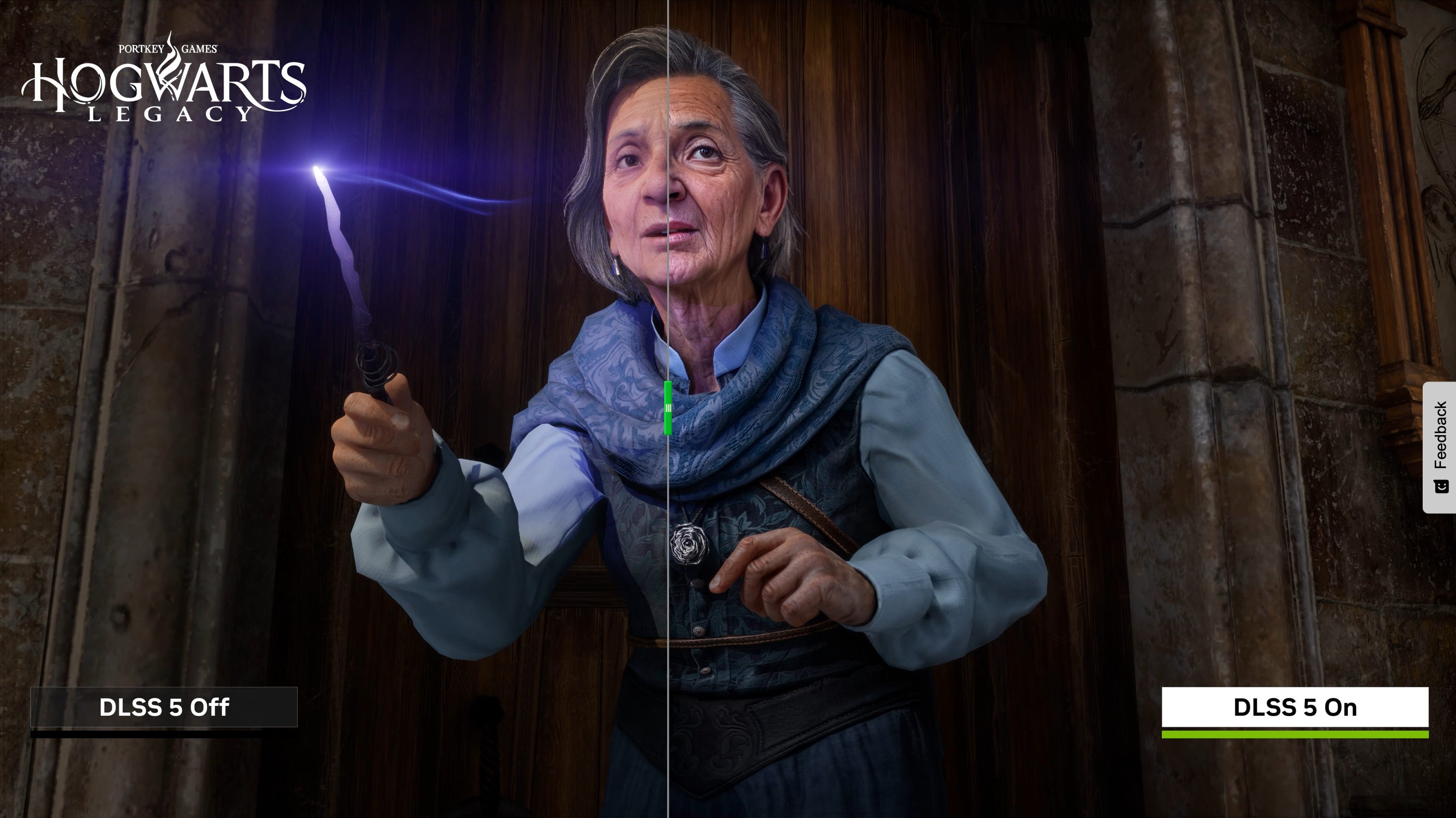
What struck me most about the backlash was how precisely the critics diagnosed the underlying problem. As commentators on Creative Bloq and other digital art forums pointed out, a game’s visual style is not achieved by generating a photorealistic scene and then dialing it back with a filter. Style emerges from the ground up, through deliberate choices about shape, color, value, and light. A game like Persona 5 or Okami possesses a visual language that exists for specific thematic reasons. Running that language through a generative model trained on photorealism doesn’t enhance the art. It erases the decisions that made it art in the first place.
“Completely wrong”
Nvidia CEO Jensen Huang’s response to the backlash made the disconnect unmistakable. He told critics they were “completely wrong,” insisting that DLSS 5 provides “content-control generative AI” and that developers keep full artistic authority because they can adjust the intensity of the effect, apply color grading, or use masking through a software development kit.
This defense shows a specific kind of misunderstanding, one that extends far beyond video games. Huang’s argument treats artistic intent as something that can be preserved by offering post-hoc controls over an algorithm’s output. From the perspective of the artists actually making the work, this is backward. Artistic control means deciding what gets created, not adjusting what a machine has already decided for you.
A lead producer at Epic Games went further in defending the technology, calling the idea that DLSS 5 detracts from art direction “absolutely insane” and arguing that if the same visual improvements had been presented as a traditional hardware upgrade, the reception would have been positive. This defense rests on the same flawed assumption: that higher fidelity is inherently superior and that moving closer to photorealism is always moving in the right direction. But the entire history of the medium shows otherwise.
The creative power of limitation
This is where the story becomes most instructive for educators, because the history of game design offers a remarkably clear demonstration of how constraints generate creative excellence rather than merely obstructing it.
Consider Mario. The most recognizable character in video game history is a direct product of severe technical limitations. Working with the tiny 8-bit pixel grid of 1981 arcade hardware for Donkey Kong, designer Shigeru Miyamoto could not animate a mouth or facial expressions. He gave the character an oversized mustache to define the nose, a hat to eliminate the need for animated hair, and brightly colored overalls to make arm movements visible against dark backgrounds. Every iconic element of Mario’s design is an elegant solution to a hardware constraint. Nintendo has built a corporate legacy on this principle, consistently prioritizing aesthetic charm and distinctive character over raw processing power.
Or consider the 1999 horror game Silent Hill. The original PlayStation’s hardware could not render the game’s town geometry fast enough to keep up with the player’s movement, producing ugly visual artifacts as buildings and streets popped visibly into existence. The developers at Team Silent solved this by shrouding the entire environment in thick, oppressive fog.
What began as a workaround became the defining characteristic of the game. This arguably created one of the most effective horror atmospheres in the medium’s history. The fog transformed Silent Hill into a space where, as philosopher O.F. Bollnow had previously described, “things lose their tangibility” and “acquire by this very process a newly menacing character.” Limited visibility fostered paranoia and dread far more effectively than any fully rendered monster could.
Even the foundational mechanic of Space Invaders, the accelerating difficulty that makes the game increasingly frantic as the player succeeds, was an accident of hardware limitations. The processors of 1978 were too weak to render the full alien armada at a consistent speed. As the player destroyed sprites, the reduced computational load caused the remaining aliens to move faster. Developer Tomohiro Nishikado recognized the value of this unintended behavior and kept it, inadvertently creating the concept of the escalating difficulty curve.
The lesson these examples share is straightforward: limitations are not obstacles to be optimized away. They are conditions under which creative problem-solving flourishes. If DLSS 5’s photorealism-maximizing algorithm had existed when Silent Hill was made, it would have identified the fog as a visibility defect and removed it, revealing an unthreatening low-polygon town. The horror would have vanished entirely.
Where the classroom enters the picture
I dwell on these examples because the logic driving DLSS 5 — the conviction that removing friction and maximizing fidelity always improves the product — is the same logic currently being applied to education at industrial scale.
When technology companies promise to “optimize the learning pipeline” with AI-powered personalization, they are making the same miscalculation Nvidia made. They see the constraints of the classroom — the slow pace, the struggle with difficult material, the messiness of open-ended assignments, or the time-consuming work of providing individual feedback — and identify these as engineering problems to be solved. From a corporate perspective, the friction looks like inefficiency. From a pedagogical perspective, much of that friction is the curriculum itself.
Organizing a complex essay teaches a student to structure an argument. And struggling to recall information strengthens long-term memory. These processes are slow, uncomfortable, and resistant to optimization for the same reason that Silent Hill’s fog was never a bug: the difficulty is performing essential work.
A recent UNESCO report on AI in human development pinpoints the same dynamic. Corporate frameworks like the “human-in-the-loop” model, a term borrowed directly from robotics, position the AI system as the center of gravity in the classroom. The teacher becomes a secondary actor, a failsafe whose pedagogical judgment is invoked only when the algorithm encounters ambiguity. Education, under this paradigm, stops being a relational act between people and becomes a workflow to be monitored. Teachers shift from designing the learning experience to administering software.
The parallel to DLSS 5 is unmistakable. Just as the neural renderer overwrites the artist’s visual choices with what the algorithm determines a scene should look like, adaptive learning platforms overwrite the educator’s pedagogical choices with what the algorithm determines a student should learn next. Both technologies assume that the professional closest to the work — the artist or the teacher — is an inefficiency to be routed around rather than a source of irreplaceable judgment.
Smoothing away the human signal
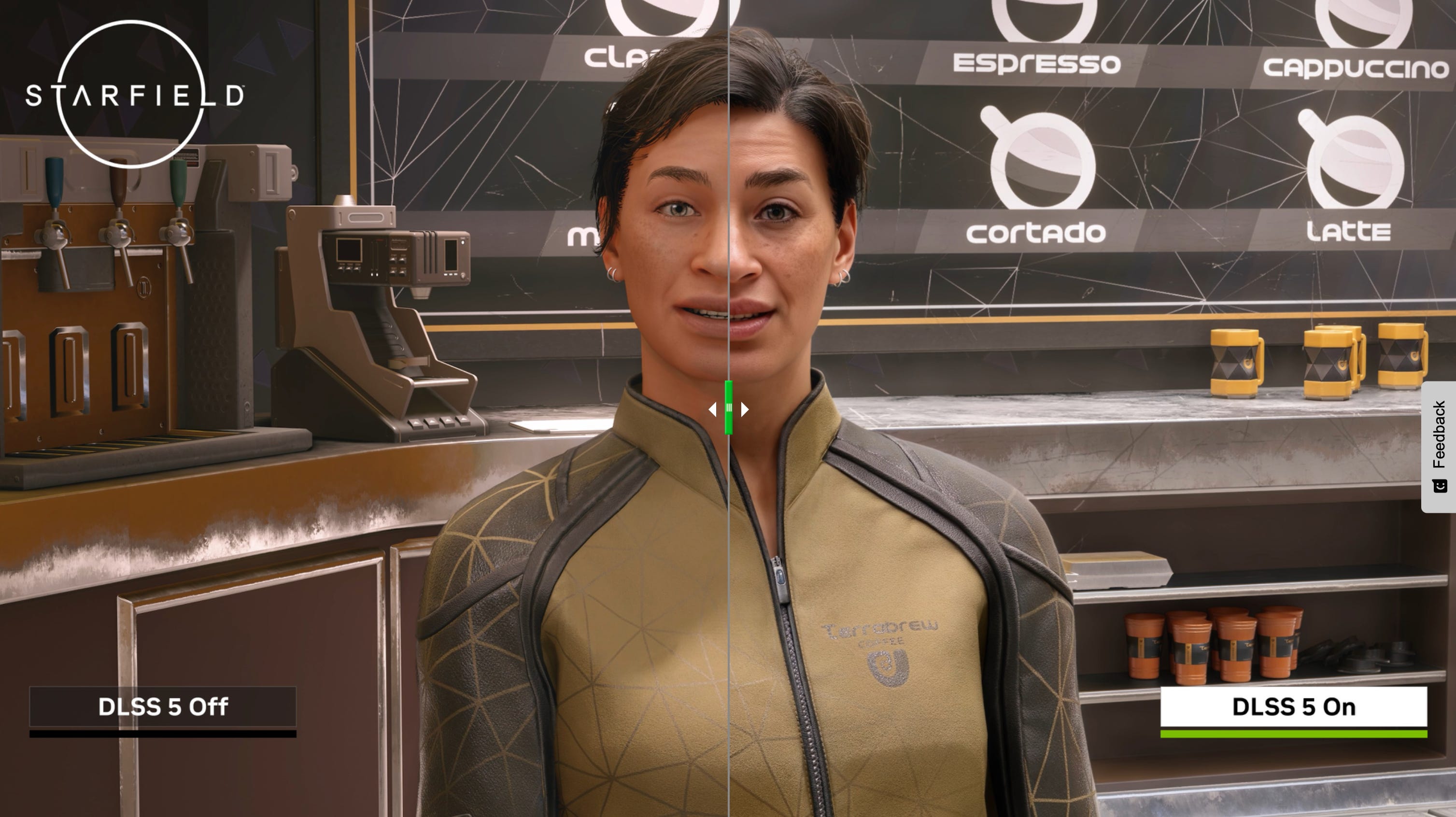
The problem extends beyond visuals. If DLSS 5 represents the algorithmic homogenization of visual art, including flattening distinct aesthetic choices into a single photorealistic standard, then generative AI writing tools might produce a strikingly similar effect on student expression.
Researchers at Stanford have described this phenomenon as “The Great Smoothing,” documenting how AI writing assistance causes language to converge toward a shared, neutral tone. A study by computer scientist Kenneth Arnold and colleagues found that participants using predictive text produced shorter, more predictable prose that lacked specific detail, choosing generic terms like “man” instead of precise descriptors like “baseball player.” And research from New York University found that essays co-written with large language models were statistically less diverse and more homogenized than those written by humans alone, with measurably lower lexical diversity.
Perhaps most concerning is a 2025 study from Cornell University that examined the cultural effects of AI writing assistance. Indian and American participants wrote culturally grounded essays with AI support. The researchers found that the AI actively altered the Indian participants’ cultural references, auto-completing Bollywood actors’ names to American celebrities and substituting local foods and traditions with Western equivalents like pizza and Christmas. American participants experienced frictionless efficiency gains. Indian participants, on the other hand, spent significant effort fighting the tool’s defaults.
The mechanism is identical to what DLSS 5 does to a carefully designed game character. The algorithm imposes a generalized standard and treats deviation from that standard as an error to be corrected. Individual expression, cultural specificity, and deliberate stylistic choices all register as noise.

Choosing when to resist the override
The DLSS 5 controversy offers educators a useful framework for evaluating AI tools, and it can be distilled to a single question: Does this technology respect the intent of the person using it, or does it substitute the algorithm’s judgment for theirs?
A tool that helps an artist render their vision more efficiently, without altering their choices, is genuinely useful. A tool that overwrites their aesthetic decisions with its own defaults is something else entirely, no matter how technically impressive the output. The same distinction applies in education. An AI tool that helps a student check their citations or identify gaps in their research supports the learning process. A tool that generates the essay, or smooths the student’s language toward algorithmic defaults, subverts it.
Stanford’s Teaching Commons has framed AI literacy through four domains: functional, ethical, rhetorical, and pedagogical. What I find most compelling about this framework is its insistence that AI literacy includes the ability to decide when to resist automation. Students need to be taught to recognize when a tool is amplifying their thinking and when it is replacing it. This requires practice, and it requires educators who model that discernment themselves.
The artists and developers pushing back against DLSS 5 are not Luddites resisting technological progress. They are professionals who understand their craft deeply enough to recognize when a tool, however sophisticated, is undermining the work it claims to improve. Educators are in an analogous position. The fog, the pixelated mustache, or the accelerating aliens — these remind us that constraints are not just obstacles to learning. Frequently, they are the learning.
Nvidia could have asked the artists. They didn’t. Educational technology companies still have time to avoid that mistake.
All images were taken from Nvidia’s press release.
P.S. I believe transparency builds the trust that AI detection systems fail to enforce. That’s why I’ve published an ethics and AI disclosure statement, which outlines how I integrate AI tools into my intellectual work.